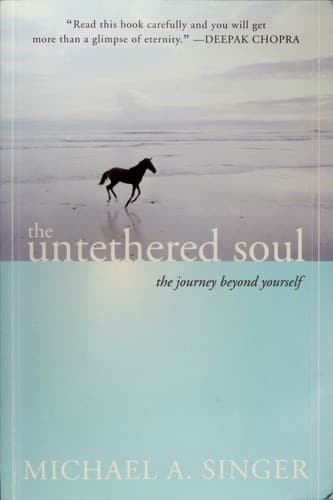
Core Idea
- The book’s central claim is that you are not the voice in your head, your emotions, your body, or your life story, but the awareness that notices them.
- Spiritual freedom comes from untethering consciousness from the psyche’s constant commentary, defenses, and identifications so you can remain aware of being aware.
- The practical test is direct experience: observe inner life honestly, without relying on theory, credentials, or ideology.
The Self, the Mind, and Witnessing
- Singer repeatedly uses the subject-object distinction: anything you can observe—thoughts, feelings, sensations, roles, memories—is an object, not your real Self.
- The “inner roommate” or mental voice judges everything, predicts badly, narrates the past and future, and creates unnecessary melodrama.
- Instead of asking what to do next, the deeper question is “Who is being disturbed?” and then “Who notices the disturbance?”
- Consciousness can either get absorbed into objects or turn back on itself; true meditation is becoming aware that you are aware.
- The “lost soul” is consciousness identified with synchronized thoughts, emotions, and sensations, while the centered person keeps awareness anchored in itself.
- The book ties this witnessing Self to traditions that speak of Soul, Atman, or pure consciousness.
Energy, Pain, and the Heart
- Inner life is framed as a flow of energy; when the heart or mind closes, energy gets blocked and life becomes heavy, fearful, and self-protective.
- The heart is treated as an energy center: when open, there is love, enthusiasm, and vitality; when closed, there is tightness, lethargy, and darkness.
- Samskaras are stored unfinished impressions from past experience that remain active and keep reappearing when triggered.
- The mind’s chatter is often an attempt to process or avoid these blockages, so the goal is not to think better but to let the energy pass through.
- The key instruction is repeated in many forms: when pain, fear, jealousy, loneliness, or irritation arise, do not close; relax, witness, and let it move through now.
- Pain is presented as the price of freedom because the psyche has built itself around avoiding pain, and that avoidance keeps the pain in place.
- When pain is met with resistance, the mind builds protective structures around it; when it is faced openly, “a piece of the pain leaves forever.”
- Fear is treated as a root problem because it drives the impulse to control life, protect the self-image, and keep old blockages intact.
Practice, Nonresistance, and Going Beyond
- The book’s spiritual discipline is not self-improvement in the ordinary sense but nonresistance: stop fighting the past, the future, and what is happening now.
- Small daily irritations—traffic, social slights, minor discomforts—are training grounds for noticing when you are about to get pulled into the psyche.
- Singer urges frequent reminders, like pausing before opening a door or entering a car, to remember not to enter the mind game.
- A recurring injunction is to “fall behind” the disturbed energy rather than follow it, because following it feeds and amplifies it.
- The walls of the self are made of thoughts, emotions, beliefs, hopes, and memories; enlightenment means taking down those walls rather than defending them.
- The psyche is compared to a house in a field: it feels safe, but it also blocks the natural light beyond it and traps you inside a self-made world.
- Spiritual growth requires going beyond every boundary the mind sets, even comfort zones that feel like protection.
- The middle way is the state of balance where you stop oscillating between extremes and use your energy from a centered point rather than from reaction.
- Willpower is not rejected; it is used to stop participating in resistance, clinging, and defensive behavior.
Unconditional Happiness, Death, and God
- Chapter 15 reframes the path as a simple decision: do you want to be happy unconditionally, or only when life cooperates?
- Unconditional happiness means refusing to make inner peace dependent on outcomes, approval, success, or safety.
- The book repeatedly says that life will test this commitment through loss, embarrassment, disappointment, and change.
- Death is used as a teacher because it reveals the temporary nature of body, roles, and possessions, and clarifies what is actually worth carrying.
- Thinking about death is meant to make life more vivid and present, not morbid; if you would live differently in your last week, why not now?
- God is described in experiential terms as Eternal, Conscious Bliss; as inner obstruction falls away, what remains is love, beauty, appreciation, and ecstasy.
- Divine vision is portrayed as nonjudgmental: like looking at nature, God sees creation with admiration rather than criticism.
- The culmination of the path is not a new identity but the dropping away of the false one, leaving consciousness free, open, and at peace.
What To Take Away
- The book’s most distinctive move is to shift the problem of suffering from the world to the way consciousness attaches to inner disturbances.
- Its recurring method is simple but demanding: notice, do not close, do not cling, do not identify.
- Singer’s spiritual psychology treats everyday triggers as opportunities to release stored energy rather than as problems to manage externally.
- The endpoint is not escape from life but a way of living in which awareness stays centered while life, pain, love, and change continue to unfold.
Generated with GPT-5.4 Mini · prompt 2026-05-11-v6