Core Idea
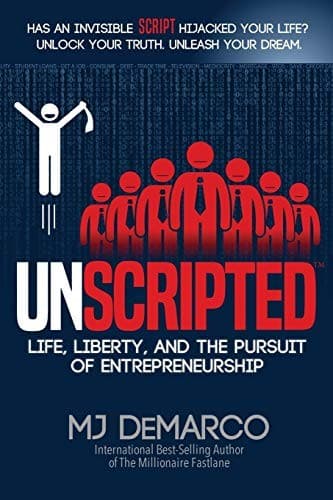
- DeMarco argues that most people are living by the SCRIPT: a conventional system that trades away freedom, time, and agency for debt, routine, consumption, and delayed hope.
- His core claim is that real freedom comes from unscripted entrepreneurship—building a business and life that are controlled by you, create value for others, and are not dependent on a job, Wall Street fantasy, or social approval.
- The book is both a critique of modern “scripted” life and a framework for escaping it through entrepreneurship, self-awareness, and disciplined execution.
The SCRIPT, Hyperreality, and the Two Bad Life Paths
- SCRIPT is DeMarco’s term for conventional wisdom sold by compromised parties and profiteers: go to school, get a job, consume, save, invest, and wait for retirement.
- He says schools, media, government, corporations, and finance culture reinforce obedience, consumption, and dependence while making this path feel natural.
- He calls many ordinary beliefs hyperrealities—constructed illusions that seem real because society repeats them, such as named weekdays, consumer status symbols, money, freedom, and corporate power.
- The two scripted paths are the Sidewalk and the Slowlane.
- The Sidewalk borrows from tomorrow through debt, status spending, and financed consumption.
- The Slowlane delays life by austerity and hope, relying on decades of saving and market returns to someday buy freedom.
- DeMarco says both end in the same place: one is enslaved by debt and the other by deprivation, with neither producing real independence.
- His opposite ideal is “fuck you” freedom: the ability to say no to bosses, mortgage bondage, weak raises, and manipulative norms because you are not economically trapped.
- He emphasizes time as the scarce asset; “temporal prostitution” is his term for trading youth and life hours for money that can be replaced.
The Wake-Up Call, the Brain’s Traps, and the Entrepreneurial Framework
- The exit from the SCRIPT begins with a Fuck This Event (FTE), a moment when pain and shame finally outweigh the comfort of staying put.
- DeMarco’s own FTE came while he was a 26-year-old limo driver stranded in a Chicago blizzard, feeling like his life was a train wreck and his degrees meant nothing.
- A real FTE turns interest into commitment; a fake one disappears when fear, comfort, pride, or responsibility reassert themselves.
- He says entrepreneurship requires walking through discomfort first, not waiting to feel ready.
- TUNEF—the Unscripted Entrepreneurial Framework—is his operating model for escaping mediocrity.
- TUNEF starts with micro-processes (beliefs, biases, self-talk) and macro-processes (repeated actions), because one-off effort does not create a life change.
- The internal enemy is the 3(B)s: beliefs, biases, and bullshit.
- He treats biased thinking as a real prison: the brain protects comfort, confirmation, and sunk costs even when those things keep you miserable.
- Among the key brain battles are change adversity, righteousness, antithetical apathy, Semmelwashing, podium popping, survivor spotlighting, and momentum paralysis.
- These names cover familiar errors: resisting change, needing to be right, holding incompatible beliefs, mocking unconventional ideas, copying celebrity advice, mistaking survivors for proof, and staying stuck because of sunk costs.
- His general cure is to step back, watch your thoughts, and replace reflexive reaction with deliberate observation.
Belief Scams, Purpose, and How Businesses Actually Win
- DeMarco’s “belief scams” attack shortcut thinking: there is no magic event, no innate-talent myth, no consumer fantasy, no money chase, and no luck gospel that can replace process and value.
- The process principle says extraordinary results come from repeated effort, not silver bullets; his own examples range from gym routines to business-building.
- The consumer scam is the idea that buying signals success; his antidote is producerism, which means creating value and being paid by the market.
- The money scam is treating money as the goal instead of as a value-voucher that represents stored perceived value.
- The poverty scam and villain narrative frame wealth as theft; DeMarco counters with the Fiduciary Principle: serve others well and wealth follows from the value created.
- The luck scam becomes a probability problem: repeated action changes your odds, and “luck” is just the visible shadow of cause and effect.
- Frugality alone is not enough; a low-income, deprivation-based life cannot produce freedom without offensive income.
- Compound interest is not his solution for ordinary people because time, reality, and inflation overpower the neat charts sold by finance media.
- His preferred answer is to build Controllable Unlimited Leverage (CUL): a business with a high income ceiling that can scale beyond your labor.
CENTS and the Business Model of Freedom
- The book’s entrepreneurial core is CENTS: Control, Entry, Need, Time, Scale.
- Control means not building on someone else’s whims, platforms, or permission.
- Entry means the best opportunities are usually harder to enter, because easy businesses become crowded and commoditized.
- Need means the business must solve a real problem or satisfy a real want with relative value, not just personal enthusiasm.
- Time means the business must eventually detach income from your labor through legacy value systems like software, digital products, rentals, money systems, or product systems.
- Scale means a business can replicate its value at profitable magnitude, not just serve one customer at a time.
- He says the first customer matters, but the real goal is a productocracy—a product so valuable that customers pull others in through testimonials, repeat use, and word of mouth.
- Execution follows the 3 As: act, assess, adjust.
- His 7 Ps of Process move an idea from plan to path to soft proof to prototype to hard proof to productocracy to propagate.
- He repeatedly warns against action-faking: looking busy with logos, cards, or prep while avoiding real market feedback.
- Strong businesses are built by iterating with the market, not by waiting for perfect certainty.
What To Take Away
- DeMarco’s book is a polemic against conventional life and conventional advice, especially when that advice sells safety while producing dependence.
- His central standard for judging any path is whether it buys freedom, autonomy, and time, not whether it looks respectable.
- Entrepreneurship, in his view, is not a hobby or a passion project but a disciplined system for building value, control, and leverage.
- The final message is blunt: if you want an unscripted life, stop waiting, reject the default script, and start building something the market actually needs.
Generated with GPT-5.4 Mini · prompt 2026-05-11-v6