Core Idea
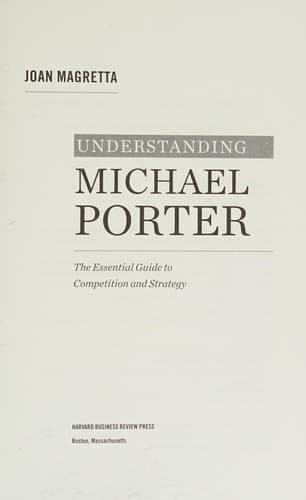
- Porter's central question is why some companies are more profitable than others, and his answer is that profit comes from competition, industry structure, and strategic position rather than from vague notions of excellence.
- Magretta frames the book as a guide to how to think about strategy, not a recipe book; Porter's value is in helping managers recognize what a real strategy is and avoid seductive but destructive shortcuts.
- The core strategic insight is that companies must choose what not to do, because trying to be the same as rivals usually drives convergence, price pressure, and weak performance.
Competition, Industry Structure, and Advantage
- Porter rejects the idea that business competition is like sports or war with one winner; many firms can thrive if they create different kinds of value for different customers.
- The strategy-to-be-the-best mindset is often self-defeating because it pushes rivals onto the same path, as in hotel “bed wars” and airline feature matching, where imitation raises costs without creating lasting advantage.
- His alternative is competition to be unique: serve a chosen set of customers in a distinctive way, so price is only one dimension of rivalry.
- The five forces—buyers, suppliers, substitutes, entrants, and rivalry—explain the structure of industry profitability, and structure matters more than labels like high-tech, regulated, or service.
- Each force has a predictable effect: more buyer power lowers prices, more supplier power raises costs, substitutes cap price, entrants add capacity and pressure, and intense rivalry compresses returns.
- Industry structure is sticky but dynamic: it changes over time, as when Walmart gradually became a powerful buyer or the PC industry shifted value toward Microsoft and Intel while PCs commoditized.
- Five-forces analysis is not just a label of “attractive” or “unattractive”; it explains current profitability, how it may change, and where a firm can position itself where the forces are weakest.
- Competitive advantage is relative and must show up in the P&L as higher relative price and/or lower relative cost than rivals.
- Porter prefers ROIC as the best measure of performance because returns on sales, growth, market share, and stock price can all mislead about whether resources are being used well.
Value Proposition, Value Chain, and Trade-offs
- Advantage comes from a distinctive value proposition matched to a tailored value chain; the two are inseparable because a promise to customers only matters if it requires different activities than rivals.
- The value chain is the sequence of activities that create, sell, deliver, and support the product, while the value system extends beyond the firm to suppliers, channels, and customers.
- Relative price comes from the buyer value a firm creates, which is why Apple, the Madrid–Barcelona AVE, and Paccar can charge premiums for different forms of convenience, service, or fit.
- Relative cost comes from doing activities differently or more efficiently, often across many functions at once, as in Dell’s low working-capital model, Vanguard, IKEA, Walmart, and Nucor.
- Value chain analysis works by mapping the dominant industry chain and comparing firms’ activities to find the sources of cost and price differences.
- Porter repeatedly shows that cost and differentiation are not slogans but the outcome of activity systems, as with Schwab’s stripped-down discount brokerage, Nomacorc’s system-level approach to cork taint, and Whirlwind’s wheelchair design and repair model.
- Trade-offs are the linchpin of strategy: choosing one position means giving up other needs, features, or services, and that sacrifice is what protects advantage from easy imitation.
- Feature creep and mission creep are dangerous because they weaken the trade-offs that keep a company focused, even when the added features look cheap or customers ask for them.
- In-N-Out, Edward Jones, and Southwest defend their positions by saying no to profitable but incompatible offerings, preserving fresh food, face-to-face advice, and low-fare simplicity.
- Trade-offs can come from incompatible product features, mismatched activities, or image conflicts; copying a rival’s position often imposes an economic penalty, which is why straddling usually fails.
- Failed straddles include McDonald’s “Made for You,” Blockbuster’s attempt to combine stores and Netflix-like delivery, and British Airways’ Go Fly, while Lowe’s succeeded by choosing a different home-improvement segment rather than imitating Home Depot.
Continuity, Fit, and How Strategy Evolves
- Porter’s fifth test of strategy is continuity: a strategy must keep its core value proposition stable long enough for fit, brand, relationships, and capabilities to accumulate.
- Continuity is not stagnation; it is a stable core with continuous improvement in operational effectiveness, which is necessary but not sufficient because best practices are quickly copied.
- The book’s cooking metaphor is that strategy is a stew, not a stir fry: its flavor develops over time as activities, people, partners, and reputation align around a clear position.
- Long-term continuity helps firms shape suppliers, channels, labor, and culture, as in Dell’s Austin ecosystem, Nestlé’s work with milk farmers, Enterprise’s neighborhood offices, and Toyota/Lexus relationships.
- Great strategies often emerge through learning and trial rather than full predesign; Southwest, IKEA, and Aravind all evolved through discovery while keeping a stable core.
- Some technologies or market changes force strategy change, but only when customer needs become obsolete, key trade-offs are invalidated, or a new breakthrough truly disrupts the old value proposition.
- Many apparent “disruptions” are just new channels or tools that existing businesses can absorb, which is why flexibility alone is not strategy.
- Firms should keep improving operational effectiveness while protecting strategic fit; BMW’s mid-1990s development changes show how to modernize processes without sacrificing the qualities that define the brand.
- Strategy-specific innovation can extend an existing position, as with Netflix’s move from DVDs to streaming and Aravind’s expansion of affordable eye care.
What To Take Away
- The deepest strategic choice is not how to do everything well, but what position to occupy and what to leave out.
- Industry structure sets the baseline for profitability, but firms still differ sharply based on the activities they choose and how well those activities fit together.
- Durable advantage comes from a coherent system of trade-offs, not from copying best practices or chasing every feature competitors offer.
- The book’s recurring lesson is that good strategy combines choice, fit, and continuity so a company can create more value than rivals in a way rivals cannot easily copy.
Generated with GPT-5.4 Mini · prompt 2026-05-11-v6