Core Idea
- Kaufman argues that Maslow’s famous pyramid badly distorts Maslow’s actual theory: needs are integrated, people can work on multiple needs at once, and lower needs can re-emerge without the theory collapsing.
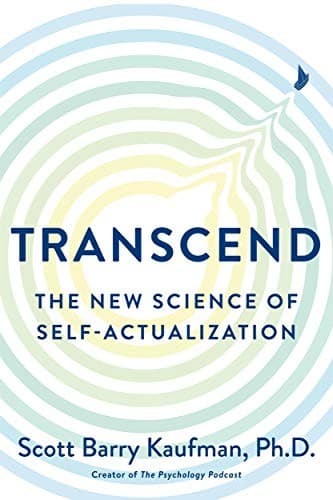
- The book’s central claim is that self-actualization is not the endpoint; it is a bridge toward transcendence, where the self becomes more open, integrated, and oriented toward values larger than itself.
- Kaufman reframes the good life as the healthy integration of security, growth, and transcendence, not as money, status, dominance, or even constant happiness.
Maslow Reinterpreted
- Kaufman restores Maslow’s late-career emphasis on Being: B-needs, B-cognition, B-love, and B-values concern ends, wholeness, and “pure Being,” not means or deficit satisfaction.
- He rejects the rigid ladder model and instead uses a sailboat metaphor: the hull is security, the sail is growth, and people cannot fully open to growth without enough safety.
- The growth side of the hierarchy is organized around exploration, love, and purpose, with transcendence as the highest reach when security and growth are sufficiently in place.
- Maslow’s own intellectual path matters here: Blackfoot observations, Adler’s social interest, Goldstein’s organismic actualization, and wartime reflections all pushed him toward a more humane, anti-reductionist psychology.
- Kaufman treats Maslow’s work as a theory of human existence, not just motivation, because people must face death, freedom, isolation, and meaninglessness.
Security, Connection, and Healthy Self-Esteem
- Safety means predictability, coherence, control, and trust; without it, uncertainty creates psychological entropy, anxiety, vigilance, and narrowed possibility.
- Hunger, attachment insecurity, trauma, and chronic poverty are used as examples of deficiency needs that can warp perception and push people toward impulsive or defensive behavior.
- Attachment theory is central: secure attachment supports coping, altruism, self-esteem, and tolerance, while insecure attachment tracks depression, loneliness, substance abuse, and health problems.
- Kaufman emphasizes that attachment patterns are dimensional and changeable, not fixed destinies; warm relationships and security priming can shift them.
- Connection splits into belonging and intimacy: belonging is acceptance and social protection, while intimacy is mutual care, emotional sharing, and deep relatedness.
- Social exclusion is treated as a real pain signal; loneliness is one of the book’s strongest warnings because it predicts poor health, mortality, and desperate attempts to secure status or fame.
- Money can buy some safety, but beyond a point it does not substitute for connection; the quality of spending matters more than income level, and therapy is highlighted as a particularly valuable growth purchase.
- Self-esteem is separated into self-worth and mastery: the first tracks relational value and social acceptance, the second tracks agency and competence.
- Kaufman uses this distinction to explain narcissism: vulnerable narcissism is unstable self-worth shaped by shame and rejection fear, while grandiose narcissism is a defended, entitled, admiration-hungry self-image that can become addictive.
- Healthy pride is different from narcissism: it rests on genuine accomplishment and supports both respect and likability.
Growth, Purpose, and the Best Self
- Exploration is treated as a basic growth motive, not reducible to status, mating, or affiliation; curiosity and openness are foundational to development.
- Purpose is a “mattering instinct” that organizes life around leaving a mark, but it must integrate agency and communion rather than become a vehicle for ego, violence, or extremism.
- Maslow’s account of work and calling is central: in the right environment, people can experience work as self-expressive, socially useful, and even morally unifying.
- Kaufman stresses that self-actualization is hard work, not effortless spontaneity; it involves commitment to real tasks, real constraints, and responsibility.
- He uses research on self-concordant goals, personal strivings, and signature strengths to show that well-being rises when goals fit deep values and internal motivation.
- The “Jonah Complex” names fear of one’s own greatness: people may hide ambition behind false humility to avoid envy, punishment, or the demands of their own potential.
- The book’s view of authenticity is nuanced: the “true self” may partly be a useful fiction or “most valued self,” but feeling in touch with it still predicts well-being.
- Acceptance is crucial: one must acknowledge disliked or contradictory parts of the self, because self-acceptance can make change possible rather than impossible.
Transcendence and Peak Experience
- Maslow’s late work gives peak experience a special role: it is an episode of intense integration, creativity, humor, spontaneity, and ego-transcendence.
- He also later described plateau experience or serene B-cognition: a quieter, more enduring, age-linked form of awakened perceiving.
- Kaufman links transcendence to awe, meditation, mystical experience, inspiration, gratitude, and the overview effect of seeing Earth from space.
- These states can expand morality and prosocial feeling, but Maslow insists they are not automatically true; revelations still need validation by science, logic, and reason.
- The book repeatedly warns against shortcuts: psychedelics may catalyze experiences, but they are not substitutes for development, and “to have a peak experience, you have to sweat.”
- Higher development ends in B-humility and B-playfulness: accurate self-acceptance, reduced egotism, gratitude, humor, and a childlike-yet-mature freedom from dominance and hostility.
What To Take Away
- Maslow’s real theory is not a staircase but an integrated, dynamic system in which security, love, growth, and transcendence interact.
- The book’s deepest contrast is between deficiency mode and Being mode: one is driven by fear and lack, the other by openness, meaning, and wholeness.
- The healthiest lives are not those that maximize comfort or status, but those that build enough security to risk growth and enough growth to move beyond the self.
- Transcendence, in Kaufman’s telling, is the farthest reach of human nature: a mature form of living that is still embodied, still tested by reality, and still oriented toward the good.
Generated with GPT-5.4 Mini · prompt 2026-05-11-v6