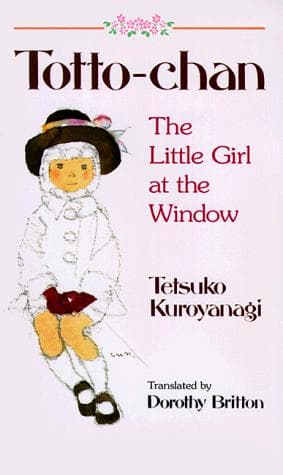
Core Idea
- Totto-Chan is a memoir of a child who was labeled disruptive in ordinary school but flourished at Tomoe Gakuen, where Sosaku Kobayashi treated children as whole people and let their curiosity lead.
- The book’s emotional core is that education can either crush or uncover a child’s nature: Kobayashi’s patience, trust, and freedom build confidence, while war eventually destroys the school and tests those values.
- Tomoe’s unusual practices are not presented as novelty for its own sake; they are Kobayashi’s way of protecting individuality, bodily confidence, attention, and joy in learning.
Tomoe Gakuen: How the School Worked
- Tomoe’s setting itself signals difference: railroad cars as classrooms, a tree-trunk gate, and a headmaster who listens to Totto-chan talk for hours before admitting her.
- Kobayashi’s first principle is radical listening; he lets children speak, chooses responses that preserve dignity, and often learns their character by observation rather than correction.
- The school day is built around child choice and movement: children can decide what to study first, read in the library car, climb trees, garden, experiment, or simply play after class.
- Learning is constantly tied to lived experience: walks become lessons in science, biology, and history, and the “farming teacher” teaches weeds, insects, and soil by taking children into the field.
- Kobayashi values the body as much as the mind: eurythmics, swimming, nude bathing, dancing, sports, and field kitchens all aim to reduce shame and connect rhythm, concentration, and physical confidence.
- He is especially attentive to children with disabilities or differences, using Tomoe to prevent inferiority complexes rather than hide them; Yasuaki’s polio and Takahashi’s short stature are met with inclusion, not pity.
- Tomoe also normalizes speaking: after lunch, children stand up and say whatever they like so they can practice clarity, courage, and self-expression.
- Totto-chan repeatedly hears Kobayashi say, “You’re really a good girl, you know,” and that judgment gives her a stable sense of self even when she causes trouble.
Totto-chan’s Growth, Friendship, and Loss
- Totto-chan begins as an impulsive child who talks to swallows, opens desk lids, loses things, tears clothes, and makes scenes; Tomoe converts that energy into curiosity rather than punishment.
- Her friendships show the school’s ethic in miniature: she bonds with Yasuaki-chan, helps him climb a tree, shares lunches and walks with him, and later mourns him deeply after his death.
- The book often uses small incidents to show how trust works: when Totto-chan drops her purse into a cesspool, Kobayashi’s calm question—whether she will put everything back—turns embarrassment into responsibility.
- Totto-chan’s love for Rocky the dog, her devotion to Tai-chan, and her care in sharpening pencils or protecting friends show attachment as a form of character.
- She learns loss early and repeatedly: baby chicks die, Yasuaki dies, Rocky disappears, and the war closes in; these events make the memoir increasingly grave beneath its playfulness.
- Totto-chan also learns social awareness: she encounters prejudice against Koreans, sees deaf children communicating with their hands, and notices how adults label difference.
War, Ending, and Kobayashi’s Educational Ideal
- The book’s warmth is shadowed by wartime scarcity and militarization: food becomes scarce, boys and men are sent off, wounded soldiers are visited, and American bombs eventually destroy Tomoe.
- Some scenes are devastatingly ironic, such as the cheerful lunch song sung to wounded soldiers, or the school’s “tea parties” for Ryo-chan, which become a childlike substitute for farewell as the war tightens.
- Kobayashi refuses to let war fully define the school’s values: he keeps insisting on beauty, freedom, natural observation, and a humane rhythm of life.
- His philosophy, as explained in the postscript, is that children are born with an innate good nature that adults can damage; education should uncover that good nature and let individuality develop naturally.
- He criticizes schools that overemphasize writing and neglect sensory perception, intuition, beauty, and inspiration.
- The postscript also emphasizes Kobayashi’s broader background: rural poverty, music study, Seikei’s freer curriculum, European study with Emile Jaques-Dalcroze, and later work founding Seijo Kindergarten, Tomoe, and the Japan Eurythmics Association.
- When Tomoe burns, Kobayashi’s response—asking his son, “What kind of school shall we build next?”—captures the book’s faith that the educational vision survives the building.
What To Take Away
- Good teaching in this book is not control but attentive respect: it notices a child’s character and protects it.
- Freedom is structured, not chaotic: Tomoe’s apparent play is organized around listening, movement, direct experience, and social confidence.
- Difference is treated as ordinary human variety, and the school’s practices are designed to prevent shame from hardening into a lifelong complex.
- The memoir ultimately argues that a humane childhood education matters most when history becomes inhumane, because that is when the school’s values are most fragile and most necessary.
Generated with GPT-5.4 Mini · prompt 2026-05-11-v6