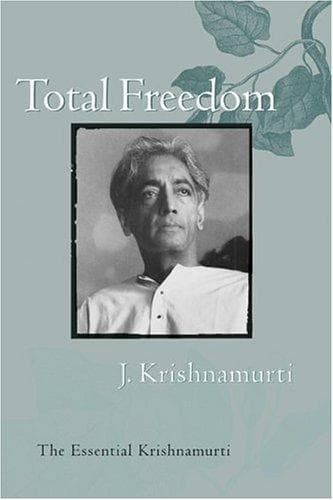
Core Idea
- Krishnamurti’s central claim is that truth is a pathless land: it cannot be reached through religion, authority, ritual, organization, or a borrowed system of thought.
- Freedom comes not from adopting a better belief, but from directly seeing what is in oneself and in relationship, until the division between observer and observed drops away.
- He insists that human conflict is sustained by conditioning, psychological time, images, and identification, and that only choiceless awareness can end it.
How Krishnamurti Diagnoses Human Unfreedom
- The self is not an inner essence but a bundle of memory, fear, hope, pleasure, prejudice, and social conditioning that mistakes itself for a stable “I.”
- Thought is time in his sense: it is the movement of memory into the present and future, so psychological progress, becoming, and “more” are forms of escape rather than transformation.
- The mind seeks security through family, class, nation, religion, ideals, and even immortality, but these become the very structures that generate conflict, dependence, and fear.
- He repeatedly rejects substitution: replacing one teacher, creed, ideal, or system with another only swaps one falsehood for another.
- Fear is tied to dependence and loneliness; what people call love often hides mutual use, possession, and escape from emptiness.
- Pleasure is pleasure only because thought continues sensation into memory and repetition; once sustained by thought, it turns into pain and craving.
- Sorrow deepens when it is escaped through explanation, comparison, belief, drink, or consolation; if fully met, it can end rather than be managed.
The Main Mechanisms: Awareness, Time, and the Observer
- Krishnamurti distinguishes chronological time from psychological time; the latter is the real problem because it is the self living through memory, hope, and accumulation.
- Transformation is not gradual in the psychological sense: trying to become nonviolent, free, or wise over time is often only postponement.
- The key discipline is not control but choiceless awareness—alert, passive attention to what is happening without motive, conclusion, or image.
- A recurring formula is that the observer is the observed: fear, jealousy, attachment, hurt, and confusion are not separate objects owned by a separate self.
- Because analyzer and analyzed are not truly distinct, analysis is limited in the psychological realm; total attention is what dissolves division.
- He treats consciousness as its content: beliefs, rituals, ambitions, nationalism, and sorrows are not added to consciousness; they are what consciousness is.
- Words, symbols, and images are powerful conditioners: “my religion,” “my country,” “Jesus,” “Buddha,” and similar abstractions shape the brain more than direct fact does.
- His idea of sanity is wholeness: fragmentation into roles, ideologies, or compartments is a form of disorder and even madness.
Society, Education, and Relationship
- The book extends inward psychology into society: war, violence, poverty, racism, nationalism, and exploitation are not separate public problems but expressions of shared human conditioning.
- There is no real separation between you and me and the world; the individual and society are mutually made, so a new society begins only in inward revolution.
- Krishnamurti rejects political and religious authority in psychological inquiry; to grant authority is already to stop questioning.
- He defines religion not as belief but as total inquiry into truth with all one’s energy, free from dogma, priesthood, and organization.
- Education should not produce conformists or specialists first; it should cultivate intelligence, freedom from comparison, and an integrated relation among thought, feeling, and action.
- The teacher’s role is not to be “the one who knows,” but to help students observe motives, fear, and conditioning for themselves.
- He values practical training—body, senses, craft, art, health, nature—but only as part of a whole life, not as preparation for a fragmented career.
- Relationship is central: when we relate through images, conclusions, and self-protection, we are relating to memories, not to actual human beings.
- If two people meet without images, the relationship may be genuine love; where there is possession, comparison, or hurt, there is separation.
What To Take Away
- Krishnamurti’s teaching is a sustained attack on psychological authority, inner division, and self-becoming.
- His positive alternative is not a doctrine but direct perception: seeing fear, desire, sorrow, and thought as they actually are.
- He treats freedom, love, compassion, and intelligence as inseparable from this seeing, not as ideals to be achieved later.
- The book’s lasting challenge is that nothing essential changes until the mind stops seeking escape and becomes capable of silent, total attention.
Generated with GPT-5.4 Mini · prompt 2026-05-11-v6