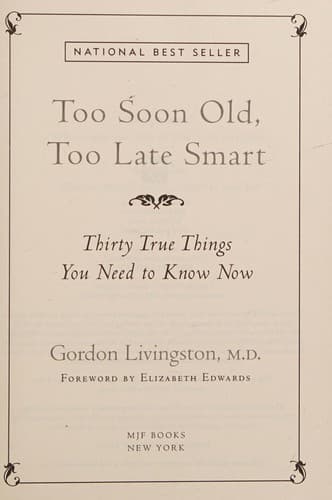
Gordon Livingston was a psychiatrist and Vietnam veteran who lost his eldest son to suicide, then his youngest son to leukemia thirteen months later. This book distills thirty hard-won truths from decades of listening to patients and living through devastating personal loss. The tone is grave, unsentimental, and compassionate -- the opposite of cheerful self-help.
Core Idea
- "If the map doesn't agree with the ground, the map is wrong" -- when your beliefs conflict with reality, update the beliefs, not your perception of what's happening
- We are what we do, not what we intend -- actions reveal priorities; feelings follow behavior, not vice versa
- Only bad things happen quickly -- meaningful change is slow; patience and sustained effort are required for real transformation
On Self-Knowledge
- The statute of limitations has expired on most of our childhood traumas -- stop blaming your past for present choices
- Examine the habitual patterns running below your awareness; they reveal who you actually are
- "It is hard to remove by logic an idea not placed there by logic" -- emotional convictions resist rational argument
On Behavior & Change
- Act first, motivation follows -- don't wait to feel like changing; behavior precedes and shapes feeling
- When a strategy reliably fails, abandon it; repetition of failed patterns is the definition of hopelessness
- Distinguish wishes from actual change; promises without corresponding action are noise
On Relationships
- Choose partners based on kindness and character, not chemistry or potential
- Any relationship is under the control of the person who cares the least -- recognize imbalance rather than deny it
- Love is demonstrated through behavior (time, sacrifice, consistency), never just words
- Chronic criticism destroys relationships; drastically reduce it and notice what fills the space
On Happiness & Meaning
- Three requirements for happiness: something to do, someone to love, something to look forward to
- Be bold and take risks; those who act attract opportunity and connection
- Accept "good enough" over perfection to escape paralysis and anxiety
- Humor and laughter are essential responses to the certainty of mortality
On Loss & Mortality
- Forgiveness and letting go are not the same thing -- you don't have to forgive the unforgivable, but you must release the anger so it doesn't consume you
- Love transcends death through memory and devotion; the dead live on in how you hold them
- Embrace mortality to find meaning now; denying death guarantees despair
- There is nothing inherently ennobling about suffering -- reject the cliche that pain automatically produces growth
On Freedom & Mental Health
- Mental health is fundamentally about freedom of choice -- self-imposed constraints and avoidance patterns are what keep people stuck
- People rarely change through criticism or external control; autonomy is essential
- Watch for the hidden comforts of illness (sympathy, avoidance, reduced expectations) that reward staying stuck
- Fear the real threats -- loneliness and meaninglessness -- not the imagined catastrophes anxiety manufactures
The Thirty Truths
The book is organized as thirty compact, aphoristic chapters, each built around a single truth. Among the most memorable: "If the map doesn't agree with the ground, the map is wrong." "We are what we do." "It is difficult to remove by logic an idea not placed there by logic in the first place." "Only bad things happen quickly." "The statute of limitations has expired on most of our childhood traumas." Life's two most important questions are "Why?" and "Why not?" -- the trick is knowing which one to ask.
Generated with Claude Sonnet 4.6 · prompt legacy-pre-v6 · model inferred from repository history