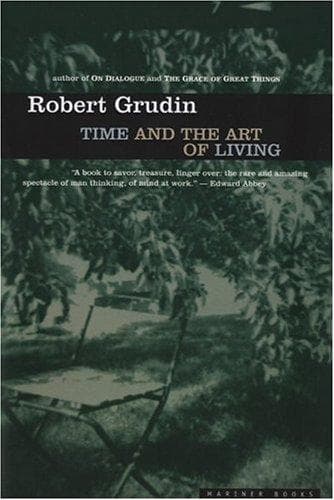
Core Idea
- Time is the book’s subject, but Grudin treats it as a lived psychological and moral reality rather than a measurable quantity.
- His central claim is that freedom, achievement, love, and even ethics depend on learning to inhabit time well: seeing repetition, continuity, timing, and duration instead of treating the present as isolated.
- The book’s unusual fragmentary form is intentional; it works through metaphor, juxtaposition, and reflection because time is better grasped as structure and movement than as a neat argument.
How Time Is Perceived
- Grudin argues that time becomes intelligible when we notice its shape: beginnings, middles, and ends feel different, and much of our “available” time is lost to interruption, distraction, or friction.
- He repeatedly contrasts outer motion and inner stillness, using images like the railway car at dusk to show how human life splits experience from awareness.
- Metaphor is his preferred tool because it reveals hidden relations and awakens both conscious and unconscious responses.
- Objects, rooms, and events have different temporal extensions; seeing these contrasts is his version of perceiving the fourth dimension.
- Memory and imagination are the means by which a person can live across time instead of being trapped in a thin present.
- Identity is therefore temporal: we become ourselves by holding past, present, and future together as a single architectural whole.
Freedom, Morality, and Social Life in Time
- A free person can see life as a recurring structure, not as a sequence of disconnected episodes, and can treat plans as enlargements of freedom rather than as shackles.
- Grudin rejects both crude mechanism and pure chaos in history and character; the future is patterned by recurrence within variation, like a Bach fugue.
- He attacks presentism: each age imagines itself uniquely special and forgets continuity with the past and future.
- Good prediction, he says, comes from integrity, continuity of mind, and consistency of will, not mystical foresight.
- Political liberty also depends on four-dimensional thinking, while tyranny is described as a flat, three-dimensional mentality that resists motion and continuity.
- Morality is temporal because action includes omission, delay, and refusal; what is not done can be as consequential as what is done.
- Evil is especially skilled in time: it postpones accountability, moves by increments, hides inside normality, and exploits the gap between intention and recognition.
- Lying and slander are temporal injuries because they reshape future trust; slander is especially dangerous because it passes under the cover of friendship and public hesitation.
- Love, too, must be expressed in time; it is not just feeling but daily, repeated sustenance.
Education, Work, Aging, and Art
- In children, especially very young children, time is different: they live in deep present concentration without the adult burden of past and future.
- Grudin values concentration as temporary forgetting of everything else, and criticizes education that fragments attention while producing bright but ineffective people.
- He insists that children should not be treated as fixed personalities; they are fluid, willful, and shaped by what adults repeatedly ask of them.
- Obedience is presented as the substructure of self-control, and positive commands are often better than prohibitions because they recruit will instead of merely resisting it.
- Teachers matter profoundly, but teaching should not be reduced to entertainment; better teaching creates disciplined discovery, making ideas open like flowers after difficulty and resistance.
- He thinks higher education suffers a crisis of method: every teacher teaches subject matter, investigation, and teaching itself, and method matters more than content.
- Maturity is often overpraised as caution; Grudin argues that boldness, rebellion, enthusiasm, and even chagrin are essential to growth.
- Youth needs something to rebel against, while middle age often monopolizes institutions and imitates youth without really investing in it.
- Aging is portrayed as a gradual tightening of constraint, not a single event; retirement can accelerate decline by removing work’s discipline and purpose.
- Yet some artists remain evergreen by always beginning again, converting change into renewed labor.
- Death should be understood stoically as our “forward profile in time,” not as proof that time itself is enemy; to think death well is to intensify life.
- Art is one of the book’s major models for living in time: great works require patience, repetition, follow-through, and the ability to hold structure in mind while working through detail.
- He favors artists who can sustain long stretches of time, and he contrasts superficial competence with true achievement, which lives in larger temporal arcs.
- Structure in art depends on opposition—light and dark, fast and slow, comic and serious—and repetition makes variation possible.
- Writing and journaling are exemplary because they preserve lived time in detail; a journal is like a letter to one’s future self.
What To Take Away
- Time is not just something to manage; it is the medium in which identity, morality, and freedom are formed.
- The book’s deepest opposition is between thin, presentist living and a richer life that recognizes recurrence, continuity, and long duration.
- Grudin’s practical wisdom is always tied to temporality: concentrate, plan, repeat, wait, and keep the self stretched across past and future.
- His recurring ideal is a person who can act boldly in the present while remaining structurally aware of the larger temporal whole.
Generated with GPT-5.4 Mini · prompt 2026-05-11-v6