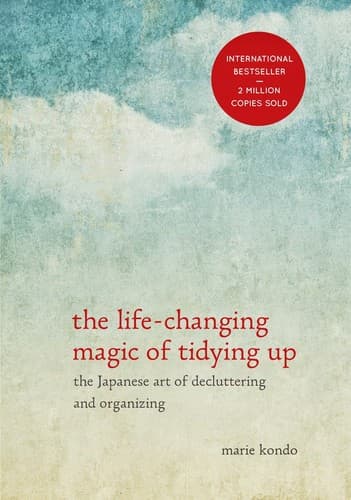
Core Idea
- Tidying is a life-changing, one-time transformation: Kondo argues you should discard first, then organize thoroughly “in one go,” because half-tidying, daily tidying, and storage tricks create rebound clutter.
- The real issue is mind-set, not technique; she says success is mostly about awareness, values, and deciding what kind of life you want.
- Her central test is “Does it spark joy?”: keep only what you truly want to live with, and treat discarding as making room for what matters.
The KonMari Method: What To Discard, and In What Order
- The method is explicitly category-based, not room-based: sort clothes, books, papers, komono (miscellany), then sentimental items.
- She insists you should handle each item in your hands and choose what to keep, rather than browsing shelves or relying on vague rules like “haven’t used it in two years.”
- Before sorting, she says to visualize your destination—a concrete picture of the ideal lifestyle you want—because clarity about the goal prevents rebound.
- A “why” exercise pushes you to ask why you want that life three to five times, until you reach the underlying desire for happiness.
- For clothes, gather everything from the whole house, start with off-season items, and do not reclassify castoffs as “loungewear.”
- Her preferred clothing storage is folding and vertical storage: fold items into simple rectangles and stand them upright so every garment is visible and has a “sweet spot.”
- She says socks and stockings should never be balled up; they should be folded into resting shapes rather than treated roughly.
- For books, take them off shelves and put them on the floor, since books left on shelves are effectively invisible; keep only those that still give a “thrill of pleasure.”
- She treats unread books as usually discardable, because “sometime” generally means “never.”
- For papers, the rule of thumb is to discard everything except papers in use, needed for a limited time, or kept indefinitely; her paper system uses only three containers, with the “needs attention” box ideally empty.
- For komono, keep only the miscellaneous items that spark joy and discard the many things people keep by habit: samples, boxes, cords, broken appliances, extra stockpiles, and similar clutter.
- For sentimental items, the task is hardest, but the point is to process the past instead of storing it; handle objects one by one, thank them, and keep only what truly moves you.
- Photos are left until last because they can appear anywhere during tidying, and stockpiles should be reduced all at once rather than kept “just in case.”
Storage, Space, and the Home
- Kondo’s rule for storage is that every item needs a designated place, otherwise one stray object can unravel the whole house.
- Storage should be designed after discarding, because once possessions are reduced, placement becomes obvious.
- She rejects “storage expert” complexity and says the goal is ultimate simplicity: know at a glance what you own and avoid forgotten things “rotting in the darkness.”
- Her basic storage rules are to keep like with like and avoid scattering storage spaces around the house.
- For families, she recommends assigning separate storage by person and concentrating each person’s belongings in one place; even a child can tidy if her items have one defined area.
- She strongly prefers vertical storage for clothes, papers, fridge contents, and small items because stacking hides volume and neglects what is buried beneath.
- She repeatedly favors ordinary containers—especially shoeboxes—over special gadgets, since they are free, durable, and flexible.
- Large cardboard boxes, irregular containers, and many commercial storage products are usually unnecessary, and buying special organizers too early only postpones the real work.
- Bags should be stored inside other bags, with straps visible and sets organized by material, size, and use; purses should be emptied daily so they can “rest.”
- In closets, off-season items can go high, everyday clothes in drawers or closet space, and bedding or bulky items should be placed where they do not crowd the floor.
- She extends the same logic to kitchens and baths: keep humid, greasy, or wet items from lingering in sinks or on counters, dry things after use, and store them away.
- She also recommends removing packaging, tags, labels, and printed seals because even hidden spaces should feel calm, and visual “noise” creates mental clutter.
- Charms and talismans are treated as entrusted items with an expiration, typically one year, after which they should be returned to a shrine or temple.
- Secret pleasures should be displayed privately rather than hidden, and tidying is framed as making the home a sacred, energizing space.
Why It Matters
- Kondo says tidying changes people because handling possessions trains decision-making confidence; repeated sorting teaches you to trust your own judgment.
- She argues people often cannot discard because of attachment to the past or anxiety about the future.
- The emotional work is to face what each object represents—failure, shame, dependency, hope, or fear—instead of storing it away.
- She believes people rarely miss what they discard after a full tidying, and that fewer possessions reduce searching, hesitation, and wasted time.
- Tidying can even change life direction: clients may quit jobs, start businesses, recommit to family, or rediscover long-standing interests from the books and objects they keep.
- She presents her own object-care rituals—greeting the house, thanking belongings, dressing formally for tidying—as ways of treating possessions and the home as responsive partners.
- Objects are not sacred, but they are to be parted with gratefully; even discarded things are said to leave behind the energy of having served.
- She also claims tidying can have bodily side effects—weight loss, clearer skin, digestive reactions—though she does not present this as scientifically proven.
- Her larger claim is that once you own only what you love and need, you can move into your real mission, and “real life begins after you have put your house in order.”
What To Take Away
- Do the work once, by category, and with full attention; half measures and endless re-tidying are what create rebound.
- Keep only what sparks joy; storage is secondary, and the decisive act is learning to choose.
- Design the home around visibility, simplicity, and designated places so possessions support daily life instead of hiding from it.
- Tidying is not just housekeeping in Kondo’s view; it is a practice for clarifying values, strengthening judgment, and changing how you live.
Generated with GPT-5.4 Mini · prompt 2026-05-11-v6