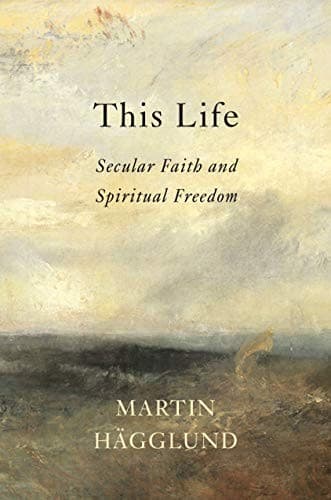
Core Idea
- Hägglund’s central claim is that finite life is not a deficiency but the condition for anything to matter: care, responsibility, love, grief, justice, and freedom all depend on the possibility of loss.
- He calls this orientation secular faith: commitment to persons, projects, and the world precisely because they are vulnerable, temporal, and not guaranteed.
- The book opposes this to religious ideals of eternity or invulnerability, which it argues would erase urgency, practical commitment, and the possibility of meaningful concern.
Secular Faith, Time, and Loss
- Drawing on Augustine, Hägglund argues that time is always a stretched, unstable experience of retention and anticipation, so human life is essentially exposed to uncertainty.
- Secular faith is defined by three features: existential commitment, necessary uncertainty, and the motivational force that comes from risking loss.
- To care about anything is to believe it can be lost; if loss were impossible, devotion, responsibility, and mourning would lose their point.
- Grief is therefore not evidence against secular life but one of its clearest expressions, because funerals, burial, and mourning honor the irreplaceable value of finite lives.
- Hägglund uses C. S. Lewis, Luther, Sandy Hook, and other examples to show that even when people use religious language, what actually matters in mourning is not eternity but the wish that shared life could continue.
- He rejects the idea, associated with Charles Taylor, that secular people secretly want timelessness; what people want is for this life to last, not to become eternal.
Why Religion Misdescribes Human Freedom
- Religious faith, as Hägglund defines it, aims at being absolved from loss; whether through God, nirvana, or eternal peace, it promises a condition where concern itself disappears.
- He reads Augustine, Tillich, the Stoics, and Buddhism as converging on this aspiration toward invulnerability, and argues that it would abolish action, desire, and human life as such.
- Augustine’s distinction between frui and uti is treated as especially revealing: finite things are to be “used” in relation to God rather than loved for themselves, which means actual worldly attachment is devalued.
- Against this, Hägglund argues that if your child, friend, or project could not be irretrievably lost, then your love would not be real in the first place.
- The point is not that religion is always hypocritical, but that religious doctrines of eternity cannot account for the meaning that believers actually invest in finite attachments.
Marx, Democracy, and the Revaluation of Value
- Hägglund presents Marx as the key thinker for a secular account of freedom, because Marx starts from the “existence of living human individuals” and asks how finite beings can expand the realm of free time.
- Marx’s basic contrast is between necessity and freedom: labor is required to sustain life, but technology and social organization can reduce necessary labor and increase disposable time.
- He treats free time as real wealth, because wealth is not the quantity of labor performed but the socially available time for education, deliberation, relationships, art, and self-development.
- Capitalism is criticized because it measures value by socially necessary labor time while also claiming to free labor through productivity, thereby turning time into a means for profit rather than an end in itself.
- Surplus value comes from living labor, so capitalism is exploitative even when individual capitalists act well; the system must convert workers’ life-time into profit or collapse.
- The proposed alternative is a revaluation of value: democratic socialism would measure wealth by free time and organize production so that the purpose of the economy is democratically decided.
- Hägglund insists that democracy is incomplete if it governs elections but leaves the economy’s purpose to capital accumulation; actual democracy must extend to production, property, and the use of social labor.
- He also argues that Marxism failed when it focused only on distribution or state ownership while leaving the capitalist measure of value intact.
King, Struggle, and the Political Horizon
- Martin Luther King Jr. is read as a practical theorist of this revaluation, especially in his later turn from civil rights reform to economic justice, anti-war politics, and the Poor People’s Campaign.
- King’s diagnosis of the U.S. as “two Americas” shows that formal rights are not enough without resources, housing, education, and health care that make freedom usable in practice.
- Hägglund highlights King’s claim that something is wrong with capitalism and his call for a radical revolution of values toward democratic socialism.
- The book treats King’s final Memphis speech and the sanitation workers’ struggle as a closing image of secular faith: people commit themselves to justice without any guarantee of success.
- The concluding political message is that emancipation requires both material struggle and normative reflection; nothing outside our finite lives will secure justice for us.
What To Take Away
- The book’s deepest claim is that vulnerability is not a flaw in life but the source of meaning, responsibility, and freedom.
- Secular faith is not unbelief but faithful commitment to finite life, where loss is possible and therefore care matters.
- Religion is criticized not for producing morality, but for promising a form of peace that would eliminate the very conditions of human attachment.
- Democratic socialism is the political form of the book’s ethics: a society where the point of production is to expand free time and make collective self-government real.
Generated with GPT-5.4 Mini · prompt 2026-05-11-v6