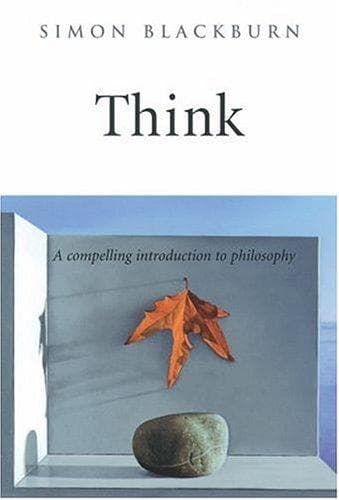
Core Idea
- Blackburn treats philosophy as conceptual engineering: the disciplined repair, testing, and clarifying of the concepts that organize thought about knowledge, mind, freedom, self, God, nature, and value.
- His basic wager is anti-skeptical but modest: we cannot escape all doubt with Cartesian certainty, yet we can still have reliable, self-correcting, practical understanding.
- Across the book, he repeatedly defends a Humean “mitigated scepticism”: reason matters, but its authority comes from fallible human practices rather than from absolute foundations.
Knowledge, Skepticism, and the Limits of Certainty
- Chapter 1 begins with skepticism about whether the world is a dream, a virtual reality, or a brain-in-a-vat, then uses Descartes to show how radical doubt pressures ordinary beliefs.
- Descartes’s method of doubt seeks indubitable foundations; the Cogito survives because doubting already presupposes a thinker.
- The wax argument shows that bodies are not known by the senses alone but by the understanding that identifies the same thing through changing appearances.
- Blackburn questions whether skeptical doubt is as strong as Descartes needs: sensory error is often corrected by further sensing, so “the senses sometimes deceive” does not imply “the senses are wholly unreliable.”
- He criticizes the trademark argument, the Cartesian circle, and universal doubt as relying on contested assumptions about causation, clear and distinct ideas, and divine guarantee.
- The alternatives are rational foundationalism, natural foundationalism, coherentism, and skepticism; Blackburn favors a Humean naturalism in which sense and reason are trustworthy because they work and correct themselves, not because they are demon-proof.
- Russell’s “world created moments ago” scenario and related entropy considerations show how even local skepticism can unsettle common-sense confidence.
Mind, Self, Free Will, and Responsibility
- Chapter 2 uses dualism to frame the mind-body problem: body is public and mechanical, mind is private, conscious, and apparently separate.
- Zombie and Mutant cases press the worry that consciousness may be either absent in physical duplicates or radically independent of physical structure.
- Blackburn traces later positions: behaviorism, functionalism, and identity theory, while noting the persistent problem of qualia and the first-person authority of mental life.
- Color science makes some “inverted spectrum” ideas less coherent than they first seem, because our perceptual systems already constrain what combinations make sense.
- Thought and intentionality remain puzzling because thoughts are about things; Blackburn resists reifying thoughts as inner objects and treats them as a person’s way of taking the world.
- Chapter 3 frames free will as the clash between lived agency and determinism; neither strict causation nor random quantum “fits and starts” seems to yield responsibility.
- He rejects fatalism and the “lazy sophism,” insisting that our actions are part of how the future happens.
- Blackburn’s preferred answer is compatibilism: freedom is action flowing through flexible decision-making systems, not a ghostly break from nature.
- Responsibility extends to negligence, recklessness, and cases where blame can reshape behavior, deter others, or express moral response; the key is flexibility, not metaphysical exemption from causation.
- Chapter 4 argues that the self is not a simple inner substance revealed by introspection: Hume finds only a stream of perceptions, while Locke ties personal identity to continuity of consciousness and memory.
- Reid’s “brave officer” objection shows the problems of strict memory-based identity, yet Blackburn stresses Locke’s forensic point: identity matters because responsibility tracks consciousness, not bare human sameness.
- Blackburn’s own diagnosis is structural: the “I” is the organizing point of view that integrates experience over time, not an extra object hidden inside us.
- First-person imaginings of surviving death or being another person can feel compelling without proving a continuing soul; they may simply exploit perspective-taking.
- Scrambling, duplication, and reassembly examples suggest that personal survival often becomes vague, so the future may not contain a single crisp fact about “which one is you.”
God, Nature, Logic, and the Methods of Thought
- Chapter 5 treats religious claims as truth-apt and tests the classic arguments: Anselm, cosmological, design, problem of evil, miracles, and Pascal’s wager.
- Blackburn rejects the ontological argument because existence is not a predicate and imagined greatness does not compete with real existence in the way Anselm needs.
- He is skeptical of the first-cause argument, noting Hume’s point that “necessary existence” is obscure and that stopping the regress at God is no less arbitrary than stopping it at the cosmos.
- The design argument is weakened by weak analogy: the world is not obviously like a machine, and the inference could as well point to an incompetent, limited, or indifferent designer.
- The problem of evil is central: the actual world looks mixed, painful, and often indifferent, which undercuts the claim that the creator is perfectly good and powerful.
- Hume’s test for miracles is that testimony is never enough unless its falsehood would be even more miraculous; competing miracle traditions and the ordinary causes of error make such reports suspect.
- Pascal’s wager is treated as pragmatic but underdetermined, since it assumes too much about which God exists and ignores the plurality of religions.
- Chapter 6 shifts to logic, induction, and probability: validity concerns whether true premises can yield a false conclusion, independent of topic or usefulness.
- Blackburn emphasizes truth-tables, quantifiers, definite descriptions, and the hidden structure of ordinary language, including presupposition and ambiguity.
- Hume’s problem of induction remains decisive: the future’s resemblance to the past cannot be justified by reason alone.
- Bayes’s theorem is presented as a tool for weighing priors and evidence, clarifying why rare hypotheses need strong support and why false positives matter.
- Science advances by building better explanations and models, not by a priori knowledge of causes; Kuhn’s paradigms matter, but Blackburn rejects crude relativism and keeps self-correction central.
The World, Value, and Final Outlook
- Chapter 7 contrasts the manifest image of colours, sounds, smells, and feels with the scientific image of particles, forces, and spatial structure.
- Locke’s distinction between primary qualities and secondary qualities makes the latter mind-dependent powers to produce sensations, while Berkeley and Hume press the worry that even primary qualities may not escape this problem.
- Blackburn notes that if matter is reduced to powers and forces, the underlying “stuff” becomes elusive, and Kant’s noumenal limit marks what experience cannot reveal.
- Kant’s Copernican revolution says objects of experience conform to our cognitive framework of space, time, objecthood, and causation rather than our simply copying a ready-made world.
- In practical philosophy, Blackburn resists psychological egoism and treats concerns, not just desires, as what move us.
- Reasons are both descriptive and normative: they explain what matters to us and also justify or criticize our aims, emotions, and actions.
- Ethics is not grounded in divine certification or Platonic Forms; it is a matter of shaping concerns into a coherent web of fairness, honesty, gratitude, sympathy, and reciprocity.
- He is wary of manipulation in rhetoric, advertising, and politics, but thinks practical reasoning can genuinely change what people care about by widening perspective and testing consistency.
- The book ends with a sober confidence: we do not need absolute foundations to live intelligently, criticize ideology, or build decent moral and intellectual lives.
What To Take Away
- Blackburn’s deepest pattern is that philosophy exposes where certainty fails, then shows how fallible human practices still yield knowledge, agency, and responsibility.
- The major metaphysical debates about mind, self, and God are treated as tests of whether our concepts really cohere or only feel compelling from the inside.
- Freedom, identity, and morality are not rescued by mystery; they are made intelligible by flexibility, continuity, and the social role of reasons.
- The book’s final stance is neither cynicism nor dogmatism, but a disciplined Humean modesty about what we can justify and how far reason can go.
Generated with GPT-5.4 Mini · prompt 2026-05-11-v6