Core Idea
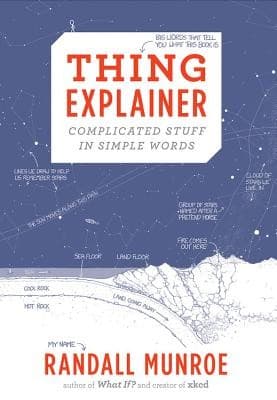
- Thing Explainer uses only the 1,000 most common English words to describe complicated things by what they do, not by their official names.
- The method is also the joke: plain language exposes hidden structure, while the book’s restraint shows that technical accuracy can still survive without specialized vocabulary.
- Munroe repeatedly shows that many familiar claims are only “sort of true” once you look closely, so the point is not oversimplification but clearer seeing.
How the Book Re-Names the World
- Everyday objects become readable systems: a writing stick is wood, plastic, ink, springs, metal ball tips, and caps; a hand computer is a pocket machine that absorbed phones, cameras, music, books, and radios.
- Human bodies are treated the same way, with parts renamed by function: blood pushers, blood cleaners, little food hallways, yellow water holders, and breathing machines reveal purpose before anatomy.
- Hospital rooms, sports, locks, and lifts all become diagrams of interlocking actions, rules, and fail-safes rather than mysterious black boxes.
- Munroe’s word choice makes hidden dependencies visible, such as a face checker, pocket mover, or hot spot talker on a phone, each named for the thing it does.
- Even simple objects are shown as layered histories of earlier matter, so cheap tools and devices are really accumulations of old materials and old designs.
Science, Scale, and Systems
- The book is strongest when it explains large systems by behavior: the shared space house works because Earth is falling around it, air and water must be carefully managed, and many countries and spacecraft keep it alive together.
- Cells are treated as tiny bags of water with a control area, little builders, and bags of death water, emphasizing both their order and their mystery.
- Viruses are portrayed as spreading instructions rather than fully self-sufficient life, and some cell parts are described as once-independent organisms.
- The sky boats with turning wings chapter explains helicopters as aircraft whose wings must keep moving fast even when the body does not, with extra parts to prevent spinning and manage a fall.
- The radio wave food box explains microwaves by wave size, uneven heating, ice’s resistance to warming, the shielded door, and the surprising link between that wave band and home computers.
- Nuclear power is described as heat from decay inside special metal, with control sticks regulating the reaction and catastrophe arriving when material gets too tightly packed or the reaction runs away.
- The Curiosity rover and similar machines are collections of eyes, brushes, lasers, sensors, and radios, reinforcing the book’s central idea that complex tools are coordinated small parts.
- Across these examples, the same pattern appears: understanding comes from seeing how many small pieces cooperate under physical constraints.
Nature, Earth, and Deep Time
- Stars and light are treated as physical things, not poetic abstractions: the Sun is just a nearby star, light spans a huge spectrum, and visible color is only a narrow slice of it.
- Heat is another form of light and motion, which is why warm bodies give off radiation even when they do not glow visibly.
- The book uses the Sun to explain star life cycles: clouds of gas collapse, heat up, begin fusion, swell or collapse when fuel runs out, and in some cases become black holes.
- The world path and star cloud framing makes the solar system feel like part of a much larger structure, where meteors are small rocks burning in air rather than fallen stars.
- The periodic table is presented as the pieces everything is made of, with metals, not-metals, and the blurry boundary between them, plus practical uses in money, pipes, glass, medicine, detectors, and heat-resistant materials.
- Radioactivity and half-life are explained as gradual breaking down over time, not as a dramatic all-at-once event.
- Earth is shown as a changing machine: rocks flow over long times, plates move, mountains and oceans are recycled, and water and heat cycle through the planet’s interior.
- The Earth maps chapter stresses that flat maps must distort a round world, and that volcano chains, impact scars, climate patterns, and plate motion all reflect a dynamic surface.
- Earth history is reconstructed from layers, fossils, and scars, with the reminder that no single place contains the whole story and that human history is a tiny late layer.
Power, Policy, and What Remains Visible
- The Constitution is treated as a machine for making and limiting power, with lawmakers, leaders, courts, states, amendments, and the supreme law laid out in plain terms.
- Munroe keeps its compromises visible, including the original exclusions around slavery and the way later amendments changed or clarified the design.
- The boat that could not be pierced shows how the book treats historical objects: they are preserved not just as artifacts, but as ways to read the past.
- Oil rigs, drilling, fracking, salt domes, and mine waste reveal the infrastructure behind modern energy and extraction, along with their environmental costs and hazards.
- Weather and storms are likewise system maps, with pressure, clouds, winds, tornadoes, hurricanes, rain, and air movement treated as patterns in a fluid atmosphere.
What To Take Away
- Plain words can reveal structure: naming things by function often makes their design and dependencies easier to see.
- The book’s humor works because the explanations stay technically careful, even when the labels are playful.
- Munroe’s deepest pattern is that big systems are networks of small parts under constraints, whether the system is a cell, a phone, a planet, or a government.
- The world is not simple, but simple language can make complexity newly visible.
Generated with GPT-5.4 Mini · prompt 2026-05-11-v6