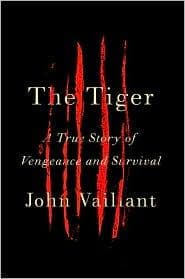
Core Idea
- The tiger is both a biological apex predator and a historical force: Vaillant uses one Amur tiger’s rampage in Primorye to show how ecology, Soviet collapse, poaching, and human fear converge in a frontier where survival is always negotiated.
- The book’s central tension is reciprocity: people hunt, wound, fear, and mythologize tigers, but tigers also remember, adapt, and sometimes seem to “answer” human intrusion with targeted vengeance.
- Markov’s death becomes the key case study: what looks like a simple mauling is reconstructed as a chain of human actions, wounded animal behavior, and a collapsing social order that made tiger conflict more likely.
The World of Primorye
- Primorye is portrayed as a harsh but biologically exceptional “Boreal Jungle” where arctic and subtropical species overlap, and where the Amur tiger is the only tiger adapted to severe cold.
- Vaillant dwells on the tiger’s physical design—mass, paws, skull, claws, swimming ability, and ambush power—to show why it is such an overwhelming predator and a lasting object of human awe.
- Indigenous peoples of the region, including the Udeghe, Nanai, and Orochi, are described as treating the tiger with ritual respect, sometimes as kin, and as recognizing it as the master of the forest.
- The book repeatedly frames the taiga as a place “where there are no witnesses,” meaning that signs, tracks, silence, and animal behavior become the only reliable language.
- The ecological web matters: Korean pine nuts, prey animals, scavengers, and human foragers are all linked, so forest collapse is never just about one species.
How the Tiger Became Dangerous
- Vaillant argues that the Amur tiger’s modern crisis came from Soviet collapse, border reopening, black markets, and poaching, not from tiger nature alone.
- Tiger parts became a lucrative cross-border commodity, while legal economies collapsed; in that setting, a tiger could be worth more dead than alive.
- The book traces a long history of tiger hunting, capture, and extermination, stressing that humans have often been more destructive to tigers than tigers have been to humans.
- A major historical turn is the work of Lev Kaplanov and later Soviet conservationists, who treated tigers not as “harmful fauna” but as a species requiring protection and strict reserves.
- The conservation system that emerges—especially Inspection Tiger—is a hybrid of law enforcement, anti-poaching patrol, and emergency response, staffed by men who operate far from backup and often on local knowledge.
- Vaillant stresses that a tiger attack is usually not random in the abstract: wounds, hunger, prior exposure to people, and learning can change an animal’s behavior into something more dangerous and specific.
Markov, the Attack, and the Hunt
- Vladimir Markov is presented as a poor but capable taiga man whose life is shaped by Soviet frontier history, logging-town decline, hunting skill, and the need to live from the forest.
- Markov and others survive through a mixed forest economy of honey, pine nuts, game, ginseng, trapping, and seasonal labor, but the post-Soviet breakdown makes that life more precarious and desperate.
- The initial attack is reconstructed from tracks and remains near Markov’s cabin: the tiger approached deliberately, and the scene suggests not a fleeting encounter but a focused predation event.
- Trush concludes that Markov likely shot the tiger at close range, probably after interacting with one of its kills, which helps explain why the tiger returned wounded and fixated on him.
- Vaillant uses local beliefs to explain the aftermath: taking meat from a tiger’s kill can create a dangerous debt, and a wounded tiger may become an egule, a liminal, almost spirit-like being that crosses into human territory.
- The tiger’s later attacks on other villagers are treated as part of the same chain; it begins hunting cabins, destroying shelters, and behaving with eerie deliberation rather than simple animal panic.
- The final hunt is staged as a professional but precarious operation, dependent on local hunters, radios, dogs, and the tiger’s own injury; the animal is finally killed in a close-range ambush that nearly kills Trush as well.
- After the kill, villagers gather around the body with a mix of awe, rage, pity, and superstition, and the book insists that the dead tiger’s hide still carries the marks of previous shootings.
Human Fear, Deep Time, and Conservation
- Vaillant widens the story into deep time, arguing that humans evolved under constant predator pressure, so fear of big cats is ancient, adaptive, and culturally persistent.
- He uses archaeology, primatology, and ethology to suggest that humans are unusually alert to predators because our nervous systems were shaped in a world where cats, hyenas, and other carnivores were real existential threats.
- This is why tigers function as both literal animals and symbolic monsters: they concentrate beauty, danger, intelligence, and the possibility of being erased.
- The book also emphasizes that coexistence is possible but costly; it depends on prey abundance, respect for local knowledge, enforcement, and limits on hunting, logging, and trade.
- Russia’s conservation success is real but fragile: the Amur tiger recovered from a catastrophic low, yet poaching, weak enforcement, and habitat pressure remain constant threats.
- Vaillant closes by arguing that extinction is increasingly a choice: if people want tigers to survive, they must fund protection, preserve habitat, stop the trade, and accept shared landscapes.
What To Take Away
- The tiger is not just a symbol in this book; it is a measurable product of history, ecology, and human behavior.
- Poaching and habitat loss are inseparable from politics and poverty; the tiger’s violence is tied to the violence done to its world.
- Local knowledge matters: tracking, hunting ethics, indigenous relationships to the forest, and on-the-ground enforcement shape whether tigers survive.
- Coexistence is the real endgame: Vaillant’s final point is that tigers remain only where societies choose to let them live.
Generated with GPT-5.4 Mini · prompt 2026-05-11-v6