Core Idea
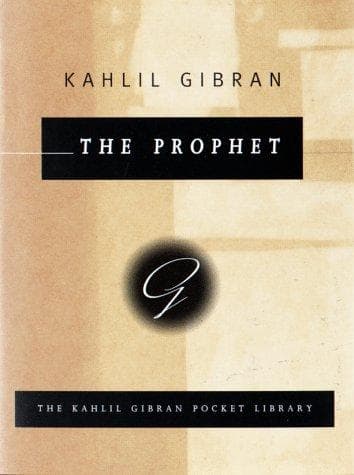
- The Prophet is a sequence of poetic discourses in which Almustafa, preparing to leave Orphalese, answers the people’s questions about the whole span of human life.
- Its central claim is that life is spiritually unified: love, work, joy, pain, freedom, prayer, beauty, and death are not separate subjects but different forms of one reality.
- Gibran consistently rejects possession, rigid control, and hard either/or thinking, and presents the fullest life as one of inward wholeness, generosity, and openness to change.
Human Bonds and Human Exchange
- Love is not comfort, security, or possession; it is a force that both “crowns” and “crucifies,” pruning the self as it enlarges it.
- To love is to yield to transformation without trying to direct the force itself, since love “possesses not” and “gives naught but itself.”
- Marriage should unite without fusing: the couple are like the pillars of a temple or the strings of a lute, joined in one music while still keeping their own spaces.
- Children are not possessions of parents but “the sons and daughters of Life’s longing for itself,” so parents may give love and care but cannot give thoughts, souls, or destinies.
- The parent is an archer’s bow: children are launched toward their own future, not made into the parent’s image.
- Friendship is a deep answering of need, shared laughter and silence, and a meeting that should deepen the spirit rather than merely fill emptiness.
- Giving is genuine only when one gives of oneself, not simply of possessions; when giving seeks recognition, it becomes unwholesome.
- Gift and gratitude should not become a heavy debt, because giving is ultimately life giving to life, with the human giver only a witness.
Work, Society, and Freedom
- Work is not a curse but participation in earth’s “furthest dream,” and the key criterion is whether work is done with love.
- Gibran’s formula is that “work is love made visible,” and craftsmanship without love distorts even ordinary goods.
- He uses concrete examples to make the point: indifferent bread becomes bitter, grudging wine becomes poison, and even song loses its humanity when made without love.
- Buying and selling should be sanctified by love and justice, so the market does not exclude the poor and also makes room for singers and dancers.
- The inclusion of dream-makers in exchange reflects the idea that human life needs food for the soul as well as for the body.
- Crime and punishment are treated as expressions of shared incompletion, not as a clean division between the guilty and the innocent.
- The guilty and innocent are intertwined like black and white threads in one cloth, so judgment should consider roots, conditions, and the whole weave of life.
- Laws are only useful to those who need them; for the spiritually free, they are shadows traced by fear and habit rather than final truth.
- Freedom is not public applause for liberty but inner release from the chains, fears, and tyrannies a person carries within.
The Inner Life: Sorrow, Knowledge, Prayer, Beauty, Death
- Joy and sorrow are inseparable, with joy as “sorrow unmasked”; greater sorrow makes greater joy possible, as a hollowed cup holds wine or a lute gives music because it has been wounded.
- Pain is the breaking of the shell that encloses understanding, and much pain is portrayed as a healing medicine administered by the “physician within.”
- Self-knowledge cannot be measured like a container, because the self is “a sea boundless and measureless,” so truth is always partial rather than owned.
- Teaching cannot pour wisdom into another person; it can only guide the learner to the threshold of their own mind, where knowledge already half-sleeps.
- Reason and passion are the rudder and sails of the soul: reason alone confines, passion alone destroys, and health lies in their mutual correction.
- Time is inwardly timeless, since past and future live as forms of present consciousness even when hours are measured externally.
- Prayer is not chiefly asking for things; it is expansion into the “living ether,” communion with other praying beings, and alignment with divine knowledge that already holds our needs.
- Pleasure is real but incomplete, a “freedom-song” rather than freedom itself, and should be received without shame or greed.
- Beauty is not mere satisfaction of need but an ecstasy, “life when life unveils her holy face,” and human beings are both its veil and its mirror.
- Religion is not separate from ordinary life; work, worship, and relationship can all be holy, making daily existence itself a temple.
- Death is not the opposite of life but one with it, like river and sea; dying is a stripping away that frees the breath to seek God unencumbered.
What To Take Away
- The book’s deepest pattern is the refusal of false oppositions: love needs distance, freedom has inner chains, joy depends on sorrow, and reason needs passion.
- Its ethics are relational and anti-possessive: give without owning, work without hardness, and let children, lovers, and friends remain themselves.
- Gibran treats ordinary existence as sacred material, so labor, exchange, prayer, beauty, and even death belong to one spiritual field.
- The prophet’s departure leaves no system to obey, only a way of seeing that continues to unfold in the listener’s own life.
Generated with GPT-5.4 Mini · prompt 2026-05-11-v6