Core Idea
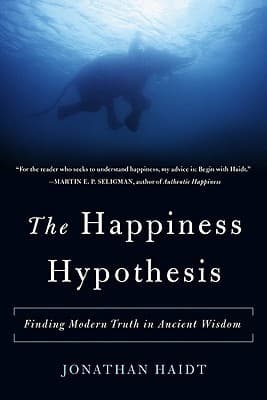
- Haidt’s central claim is that happiness and meaning come from understanding the mind as divided: a fast, automatic elephant largely drives judgment and emotion, while the conscious rider mostly explains, rationalizes, and nudges.
- Ancient wisdom traditions often got important things right, but their truths need to be tested and refined by modern psychology, neuroscience, and evidence from everyday life.
- The book’s recurring conclusion is a yin-yang view of flourishing: well-being comes from both within and without—from interpretation, habits, relationships, work, and conditions, not just willpower or detachment.
The Divided Mind and How Change Really Happens
- Haidt uses many metaphors—elephant and rider, split brain, mind-body conflict, left-brain interpreter, alien hand—to show that the self is not a single rational unit.
- The rider can plan and justify, but the elephant supplies most motives, emotions, and automatic reactions; moral judgment often happens first in the elephant, with reasons arriving afterward.
- Modern psychology reinforces this: much thinking is automatic, fast, and unconscious, while controlled thought is effortful and limited.
- Because the elephant is so powerful, insight alone rarely changes behavior; durable change requires retraining attention, emotion, and habit.
- Haidt treats meditation, cognitive therapy, and sometimes Prozac/SSRIs as tools for shifting the elephant, not as shortcuts around human nature.
- Cognitive therapy works by identifying automatic distortions—such as the depression-friendly trio of “I’m no good,” “My world is bleak,” and “My future is hopeless”—then challenging them in practice.
- Meditation helps by loosening attachment and reducing reactivity; medication can also be appropriate, especially for people disadvantaged by the “cortical lottery” of temperament and affective style.
Social Life: Reciprocity, Hypocrisy, and Moral Conflict
- Human social life is built around reciprocity: tit for tat, debt, gratitude, vengeance, and fairness form an “exchange organ” spread across the brain and social habits.
- The ultimatum game shows that people reject unfairness even at a cost, and fMRI work links this to emotion and reasoning systems working together.
- Gossip acts as moral policing and social teaching, spreading reputational information and helping reciprocity work in large groups.
- But reciprocity is constantly distorted by hypocrisy: people condemn cheating in others while excusing themselves, often without realizing it.
- Haidt’s inner lawyer metaphor says reasoning serves preferred conclusions; the rose-colored mirror makes us see ourselves as better than we are, and naive realism makes our own view seem objective while others seem biased.
- These biases scale up into politics and religion, where each side sees itself as defending good against evil; Haidt connects this to the myth of pure evil and our appetite for villains.
- He argues conflict often softens when people can find their own contribution first, because self-scrutiny lowers defensiveness and creates the possibility of real apology and reciprocal repair.
What Makes Us Happy, Strong, and Meaningful
- Haidt rejects the idea that happiness is only “from within”; the formula H = S + C + V captures his broader view: set point, conditions of life, and voluntary activities all matter.
- Some conditions do adapt away, but not fully: noise, commuting, lack of control, shame about appearance, and especially bad relationships can have lasting effects.
- The strongest condition is relationships: attachment, love, and social support strongly shape health, recovery, and longevity.
- Harlow’s cloth-mother studies and Bowlby/Ainsworth’s attachment work show that babies need contact comfort and that secure attachment balances safety and exploration.
- Adult romance is not just passion; it merges attachment, caregiving, and mating, with passionate love eventually giving way to more durable companionate love.
- Haidt warns against romantic myths: people often commit while intoxicated by passion or leave when passion fades, mistaking the normal decline of the high for the end of love.
- Work matters almost as much as love when it becomes a source of flow and vital engagement—challenge matched to skill, immediate feedback, and a sense of purpose.
- Positive psychology’s virtue language helps here: strengths such as gratitude, kindness, zest, and self-control are more fruitful than obsessing over weaknesses.
- Haidt repeatedly notes that gratification and meaningful effort tend to outlast mere sensory pleasure; kindness and gratitude often improve mood more durably than indulgence.
Growth, Virtue, Divinity, and the Uses of Adversity
- The book’s version of the virtue hypothesis is not puritan self-denial but the claim that developing character strengths makes life better; Franklin’s self-training is the model.
- Modern virtue language is revived by Peterson and Seligman through six virtue families and 24 strengths, but Haidt treats this as a practical framework rather than a final theory.
- He also argues that altruism helps the helper: service, generosity, and contribution can raise well-being, especially when tied to identity and purpose.
- Adversity can produce posttraumatic growth, but Haidt supports only the weak claim that hardship can help; trauma is not automatically good, and evidence for dramatic transformation is mixed.
- Growth usually comes from meaning-making: people integrate adversity into a coherent life story, often with help from disclosure, social support, or religion.
- Wisdom is tacit knowledge rather than a set of rules; it involves balancing self/others/future and adapting/shaping/choosing in ways that fit the situation.
- The book’s deepest moral-spiritual idea is the divinity dimension: beyond harm and fairness, humans experience purity, sacredness, awe, elevation, and disgust.
- Religious ritual, awe in nature, mystical experience, and elevation all point to a desire to transcend the selfish self and feel part of something larger.
- Haidt closes by linking meaning to the fit among self, others, work, and sacred reality: the happiest life is not detached, but well-attached to the right things.
What To Take Away
- The mind is not a sovereign rational agent; it is a partnership in which the elephant usually leads and the rider explains.
- Lasting change comes less from arguments than from reshaping habits, attention, emotion, relationships, and environments.
- Human flourishing depends on both inner cultivation and outer conditions, especially love, work, control, and meaningful roles.
- Wisdom lies in seeing where detachment helps, where attachment is necessary, and how to live with both without self-deception.
Generated with GPT-5.4 Mini · prompt 2026-05-11-v6