Core Idea
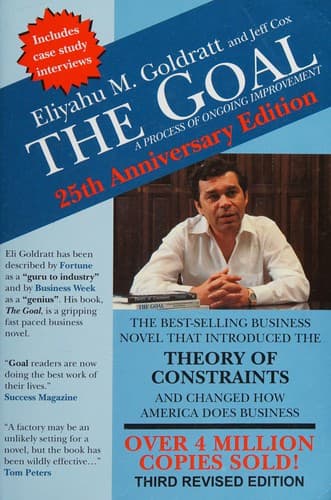
- Goldratt’s central claim is that a company’s real purpose is to make money, and management must judge every action by whether it improves the whole system toward that goal.
- The book argues that local efficiency, busy workers, and balanced capacities can all be misleading; what matters is system-wide throughput, inventory, and operating expense.
- The story follows Alex Rogo learning, through Jonah’s Socratic questions, to replace cost-accounting and “keep everyone busy” thinking with a scientific way of finding and exploiting constraints.
The Problem with Local Optima
- Alex’s plant looks good on paper—good people, good technology, and strong demand—but it still misses shipments, builds inventory, and loses money.
- Jonah challenges the assumption that automation, higher utilization, or lower labor cost automatically improve productivity; if sales, cash, and profit do not improve, the system has not improved.
- The book defines productivity as “the act of bringing a company closer to its goal,” so efficiency is only useful if it helps the whole business make money.
- A major warning is that a balanced plant is not the same as a productive plant: when dependent events and statistical fluctuations interact, matching every step to demand can actually reduce throughput and raise inventory.
- The Boy Scout hike gives Alex the key insight: in any dependent chain, the slowest person governs flow, and fluctuations accumulate rather than averaging out.
- The paper-and-dice simulation makes the same point in manufacturing terms: without protective capacity, small delays propagate downstream and reduce output far below nominal capacity.
- The lesson is that making every resource 100% busy is usually harmful; the plant should not optimize each machine independently.
What the Plant Learned: Bottlenecks, Flow, and the Five Focusing Steps
- Jonah distinguishes bottlenecks from non-bottlenecks: a bottleneck has capacity equal to or less than demand, while a non-bottleneck has excess capacity.
- The practical rule is balance flow, not capacity; bottlenecks should control release and schedule, because their lost time is lost forever.
- The plant discovers that the NCX-10 and heat-treat are bottlenecks, and that expensive-looking old machines, alternate routings, vendors, or process changes can sometimes free bottleneck time.
- Jonah reframes bottleneck time in system terms: a lost bottleneck hour is worth the plant’s total operating expense divided by available bottleneck hours, not the machine’s direct hourly rate.
- Quality control is moved before bottlenecks, because scrapping a part after it consumes bottleneck time wastes a scarce system resource.
- Red/green tags, priority rules, and later a “rope” based on bottleneck signals are all attempts to prevent too much material from being released ahead of the constraint.
- The plant’s original “efficiency” moves had backfired: robots, local utilization, and larger batches increased WIP without increasing sales.
- The plant’s breakthrough comes from the five focusing steps: 1) identify the constraint, 2) exploit it, 3) subordinate everything else, 4) elevate the constraint, 5) repeat when it shifts.
- Goldratt is explicit that the constraint can move: first a machine, then a policy, then the market; because of that, old solutions must be revisited.
- A key reversal is that reducing local efficiency can improve the whole system, as when reverting some non-bottleneck machining settings eliminated unnecessary heat-treat load.
- Another important distinction is that activation is not utilization; running every resource flat out can create inventory and overload downstream flow.
Management Is a Thinking Process, Not a Set of Tricks
- Goldratt uses Socratic dialogue and science as the model: start from a real phenomenon, form a hypothesis, derive IF…THEN consequences, and test them against reality.
- Alex’s reading of Newton and the Mendeleev story reinforce the idea that management needs an intrinsic order, not arbitrary categories or data dumps.
- Facts alone are not enough, because they can always be arranged into impressive but useless reports; managers need a way to reveal the system’s underlying structure.
- The book extends this logic to organizations: companies are chains, and the organization’s strength is set by the weakest link, or in complex systems, a small number of linked constraints.
- As the plant improves, the limiting factor shifts from physical capacity to policies, measurement systems, sales promises, and internal procedures.
- Lou and Alex also uncover how standard accounting distorts judgment: inventory is treated as an asset even though excess WIP can be a liability, and product-cost thinking can make profitable actions look bad.
- This is why the plant can show higher true profit while accounting statements appear worse after inventory falls; the old measures hide reality rather than reveal it.
- Sales decisions also change under the new logic: a low-price deal can still be profitable if the plant has spare capacity and the only meaningful out-of-pocket costs are materials and freight.
What To Take Away
- The book’s core shift is from cost world to throughput world: maximize throughput, protect inventory from becoming excess, and keep operating expense subordinate to the goal.
- “Busy” is not the same as productive; the right question is whether an action increases the company’s ability to make money now and over time.
- Constraints are dynamic, so improvement is not a one-time fix but an ongoing cycle of identifying, exploiting, subordinating, elevating, and then re-identifying.
- Goldratt’s deeper message is that management improves when it learns to think scientifically about cause and effect instead of relying on local metrics, intuition, or accounting conventions.
Generated with GPT-5.4 Mini · prompt 2026-05-11-v6