Core Idea
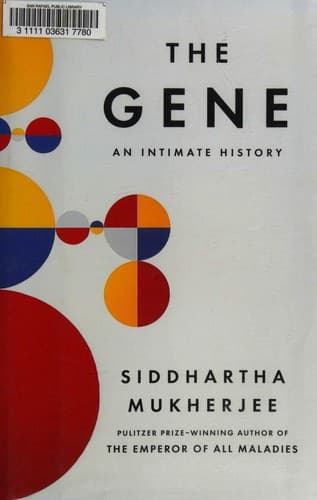
- The gene is both a scientific object and a moral idea: it explains inheritance, disease, identity, evolution, and eventually the possibility of reading and rewriting human fate.
- Mukherjee frames the book as an “intimate history” because his family’s history of schizophrenia, bipolar disorder, and displacement makes heredity feel personal, not abstract.
- The book’s central tension is that genes are powerful but not destiny: they work through probability, context, environment, trigger events, and chance, not simple one-to-one causation.
From Heredity to the Gene
- Before genes were visible as material entities, heredity was explained through flawed but important ideas: spermism, preformation, blending inheritance, and Aristotle’s insight that heredity transmits information, not just matter.
- Mendel supplied the decisive experimental turn by counting pea traits and showing dominance, recessiveness, and discrete inheritance, even though his 1865 work was ignored for decades.
- Darwin needed a mechanism for heredity to complete evolution, and his own pangenesis failed because blending would erase variation; Jenkin’s critique helped expose that problem.
- The rediscovery of Mendel around 1900, and Bateson’s advocacy, made heredity into a formal science called genetics.
- Galton’s eugenics was applied heredity before genetics had a proper mechanism; the book treats it as a warning that once heredity becomes legible, people try to control who gets to reproduce.
Chromosomes, DNA, Code, and Development
- Morgan’s fly room turned genes from abstractions into material units arranged on chromosomes, with linkage, crossing over, and the first genetic maps showing that genes are physically ordered.
- Fisher reconciled Mendelian particles with continuous traits by showing that many genes of small effect can produce smooth distributions like height.
- Dobzhansky reconciled genetics with evolution by showing that wild populations contain abundant variation and that selection changes gene frequencies in real time.
- The book’s account of Griffith, Avery-MacLeod-McCarty, and Schrödinger leads to DNA as the gene’s chemical basis: a molecule regular enough to copy, irregular enough to encode information.
- Watson, Crick, Franklin, and Wilkins solved DNA structure; the double helix explains complementary copying, and the pairing logic of bases makes heredity chemically intelligible.
- The genetic code turns DNA into protein through mRNA and translation; the flow DNA → RNA → protein is the book’s core informational architecture.
- The three great molecular functions are regulation, replication, and recombination: genes turn on and off, copy themselves, and reshuffle through meiosis and repair.
- Development is not a mystical force but a cascade of master regulators, segmentation genes, maternal factors, gradients, and cell-fate switches; the fly and worm become models for how a single cell builds an organism.
- Apoptosis is as important as growth: programmed cell death shapes bodies, and genes like ced and BCL2 show how failure of cell death can contribute to cancer.
Medicine, Diagnosis, and the Return of Selection
- Once genes could be mapped to disease, the book shifts to positional cloning and disease genes such as Huntington’s, cystic fibrosis, BRCA1, and hemophilia, each showing different patterns of penetrance, repeat expansion, or biochemical effect.
- The author repeatedly emphasizes that a mutation is a statistical deviation, not automatically a defect; whether it causes disease depends on age, background genes, exposure, and context.
- Human disease categories differ: high-penetrance rare disorders like BRCA1 or cystic fibrosis behave differently from polygenic illnesses like schizophrenia.
- Schizophrenia and bipolar disorder are presented as deeply heritable but not reducible to a single gene; the family history at the start returns here as an example of incomplete, probabilistic inheritance.
- Race is treated as a poor biological category for predicting individuals, because most variation is within groups rather than between them; ancestry matters, but racial essentialism does not.
- Sex determination is genetically organized by SRY on the Y chromosome, yet gender identity and sexual orientation are shown as far more complex, involving genes, hormones, development, and lived experience.
- The chapters on homosexuality and temperament argue for heritable influence without determinism: studies like Xq28, twin research, and D4DR suggest probabilistic contributions, not single causes.
- Epigenetics adds another layer: cells remember developmental history and environmental exposure through DNA methylation, histone marks, X-inactivation, and reprogramming, so nurture can be written into biology without changing sequence.
- The Dutch Hunger Winter and Waddington’s landscape illustrate that experience can leave biological memory across generations, though the author warns against naive Lamarckism.
From Gene Therapy to Genome Editing
- The last third of the book follows the move from reading genes to changing them: recombinant DNA, cloning, sequencing, the Human Genome Project, and then gene therapy and CRISPR.
- Asilomar is presented as a rare moment when scientists publicly regulated their own risky technology, but it focused on biohazards more than the ethics of human redesign.
- Gene therapy’s promise was undercut by the death of Jesse Gelsinger, showing how badly biology can behave when vectors, immunity, and history interact.
- Modern successes like hemophilia gene therapy show that even partial correction can matter enormously, but they also reinforce how hard it is to predict outcomes in living systems.
- CRISPR/Cas9 is the book’s most radical tool: a programmable bacterial defense repurposed for precise genome surgery, making heritable editing technically imaginable.
- Mukherjee warns that genetic enhancement raises the hardest questions, because once we can edit, we must decide what counts as an improvement and who gets to decide.
What To Take Away
- The gene is not a simple blueprint; it is an information-bearing unit whose effects emerge through networks, regulation, and developmental context.
- Genetics moved from family stories and pea plants to chromosomes, DNA, code, and editing, but the moral stakes only grew as the science became more powerful.
- The book’s deepest warning is that the same knowledge that can diagnose, prevent, and treat disease can also enable selection, coercion, and redesign.
- Mukherjee’s final position is neither genetic fatalism nor genetic optimism, but a plea for humility: human beings are legible to biology, yet never fully exhausted by it.
Generated with GPT-5.4 Mini · prompt 2026-05-11-v6