Core Idea
- Godin’s core claim is that winners quit—but they quit the right things, at the right time.
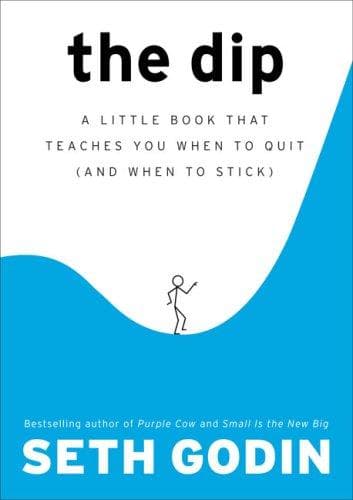
- Nearly every worthwhile pursuit contains a Dip: the painful stretch between early enthusiasm and real mastery.
- The central strategic question is whether you are in a Dip worth pushing through, a Cul-de-Sac worth abandoning, or a Cliff where staying becomes increasingly dangerous.
The Three Paths: Dip, Cul-de-Sac, Cliff
- A Dip is a temporary barrier that filters out dabblers and creates scarcity, which is why it can increase value and reward commitment.
- A Cul-de-Sac is a dead end: effort continues, but outcomes do not improve, so persistence there is wasted.
- A Cliff is a situation that becomes harder to leave over time, so quitting late can be much worse than quitting early.
- Godin warns that the most common mistake is not quitting too often, but quitting in the Dip before the payoff arrives.
- The practical test is whether the pain is a sign of a filter you must pass through or a signal that the path has no real upside.
Why Being Best Matters
- The marketplace disproportionately rewards being #1, not merely competent, because attention and benefits concentrate heavily at the top.
- “Best in the world” is subjective and local, meaning best for a specific buyer, niche, or constraint, not necessarily best in an absolute sense.
- As markets fragment into many micromarkets, there is no single global best for everything, but there is still a best inside each small world.
- Godin’s infinity problem is that buyers face nearly endless choices, which pushes them toward trusted leaders and makes clear excellence more valuable.
- His examples include top law clerks, bestselling books, hit movies, and premium brands, where outsized rewards go to the perceived leader.
How the Dip Works in Practice
- The Dip appears as the learning curve, certification hurdle, scale-up challenge, reputation-building phase, or market-acceptance lag that separates dabblers from stars.
- Success often depends on leaning into the Dip, not merely enduring it, because the hard stretch can sometimes be shortened by changing tactics while keeping the strategy intact.
- Godin uses organic chemistry, startup trade-show failures, executive apprenticeship, snowboarding, and weight training to show that real progress often requires passing through an initially punishing phase.
- He argues that many people settle for good enough in places where the market only rewards exceptional performance, which leaves them invisible.
- His blunt warning, “Average is for losers,” means that mediocrity is usually not distinguishable enough to earn market attention.
Strategic Quitting, Not Serial Quitting
- Godin distinguishes between quitting a tactic and quitting a strategy: you may drop a product, feature, job, or approach without abandoning the larger mission.
- He criticizes serial quitting, where someone repeatedly restarts after hitting resistance and never allows effort to compound.
- He also rejects mere coping in a dead-end situation, since muddling through without progress is not the same as persistence.
- The supermarket-line analogy says constantly switching to the shortest line wastes time because each switch resets your place and progress.
- He recommends deciding in advance when to quit, since panic, pride, and temporary pain are poor decision-makers.
- His three diagnostic questions are: Am I panicking?, Who am I trying to influence?, and What measurable progress am I making?
- If you are trying to influence one person and nothing is moving, quitting may be rational; if you are building in a market, progress can accumulate through attention, referrals, and momentum.
- A project that is not improving, not attracting buyers, and not generating spillover effects may be a Cul-de-Sac rather than a real opportunity.
What To Take Away
- Quit dead ends, and quit tactics that no longer serve the larger strategy.
- Do not quit a real Dip simply because it hurts; the pain may be what makes the eventual reward scarce and valuable.
- Before investing heavily, ask whether the path offers a plausible route to #1 in some meaningful market.
- The book’s recurring test is simple: Is this a Dip worth pushing through, or a Cul-de-Sac you are refusing to name?
Generated with GPT-5.4 Mini · prompt 2026-05-11-v6