Core Idea
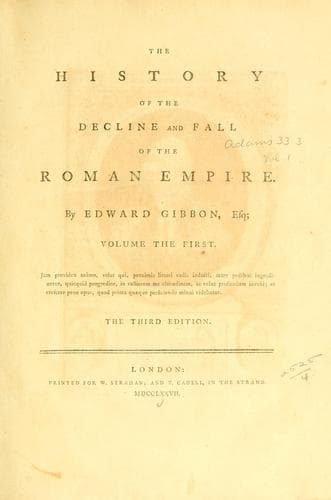
- Gibbon’s central project is to explain how Rome’s universal empire became a succession of weaker, more divided states, first in the West and then in the East, while tracing the role of army politics, fiscal strain, barbarian migration, religion, and court corruption.
- He treats the decline as a long structural process rather than a single collapse: imperial overreach, dependence on mercenaries, administrative multiplication, and the loss of civic/military spirit steadily eroded Roman power.
- The narrative is also a history of how Christianity, Islam, barbarian kingdoms, papal power, and later medieval empires inherited, transformed, and finally displaced the ancient Roman world.
How Rome Declined
- Gibbon’s early books contrast the high Roman Empire—orderly, prosperous, law-bound, and defended by disciplined legions—with the later empire, where emperors ruled through Praetorians, donatives, eunuchs, and frontier troops rather than civic authority.
- He repeatedly argues that the military institution itself changed Rome: the legions became a professional caste, then a political power, then a source of usurpation, civil war, and emperor-making.
- Under Severus and his successors, discipline loosened, pay rose, soldiers married and settled, and the army became more insolent while the senate and people lost real power.
- Gibbon presents the empire’s finances as decisive: taxation broadened from provincial levies to customs, excise, inheritance taxes, land taxes, corn levies, and compulsory deliveries, while the burden of maintaining court, army, and capital grew relentlessly.
- He sees Constantine’s reforms as a turning point that stabilized rule but weakened military vigor, separated civil from military authority, multiplied offices, and made the state more bureaucratic and expensive.
- The later imperial system is described as an absolute monarchy disguised by republican forms; once those forms disappeared, the East and West became effectively separate monarchies.
Religion as a Historical Force
- Gibbon makes Christianity one of the major forces in Roman transformation, but he is sharply critical: he says it contributed virtue, charity, discipline, and unity, yet also encouraged passive obedience, clerical power, monastic withdrawal, and theological faction.
- He treats the rise of Christianity through a set of recurring mechanisms: zeal, immortality, miracles, moral purity, church discipline, and the church’s ability to organize its members more effectively than pagan cults.
- The book insists that persecution was usually local, irregular, and limited, but the martyrs’ memory gave Christianity moral authority and helped it spread.
- Constantine’s conversion is presented as gradual and political as well as sincere: the labarum, the vision of the cross, the Edict of Milan, church endowments, and bishops at court all show Christianity becoming imperial.
- Once favored, the church became a political institution: bishops gained privileges, arbitration powers, sanctuary, wealth, and public influence, while councils turned doctrine into state-backed law.
- Gibbon’s long theological history follows the church from Trinitarian controversy to Incarnation disputes, then to schisms over images, relics, monasticism, the Filioque, Monophysitism, Nestorianism, and iconoclasm.
- His recurring point is that doctrinal nuance became a matter of empire because bishops, monks, emperors, and mobs used it to mobilize violence, legitimize office, and exclude rivals.
Barbarians, Successor States, and the New World of Power
- The fall of the Western Empire is explained through repeated barbarian pressures: Goths, Vandals, Franks, Alemanni, Huns, Avars, Bulgarians, Hungarians, Russians, Lombards, Normans, and others.
- Gibbon is careful to show these peoples not as uniform savages but as tribes with distinct politics, military habits, and degrees of assimilation; many became rulers by adopting Roman institutions, Christianity, and law.
- He repeatedly notes the danger of Rome’s own policy: barbarians were often invited in as allies, federates, or settlers, then became internal masters.
- The East survives longer because Constantinople combines commerce, fortification, naval power, diplomacy, and bribery, but it too becomes dependent on barbarians, mercenaries, and court intrigue.
- Gibbon’s long view culminates in the rise of Turks and Mongols: Seljuks, Roum, Avars, Tatars, and Ottomans reshape Asia Minor, the Balkans, and the Mediterranean.
- The sack of Constantinople by the Fourth Crusade and the later Ottoman conquest are presented as parallel catastrophes: both expose a weakened empire, both transfer wealth and texts westward, and both mark the end of an older Roman order.
What To Take Away
- Rome did not simply “fall”; it was reorganized, divided, and inherited by new military and religious powers that used Roman titles, laws, and prestige for their own ends.
- Gibbon’s master explanation is structural: armies, taxes, bureaucracy, and religion gradually outgrew the civic world that had once sustained the empire.
- Christianity mattered enormously, but not in a simple “cause of decline” sense; it strengthened moral cohesion while weakening old civic and military energies, and it created a new international church that outlived Rome.
- The final history is one of continuity through transformation: Roman law survives in Byzantine and medieval forms, barbarian kingdoms adopt Roman models, and the old empire’s culture is preserved even as its political unity disappears.
Generated with GPT-5.4 Mini · prompt 2026-05-11-v6