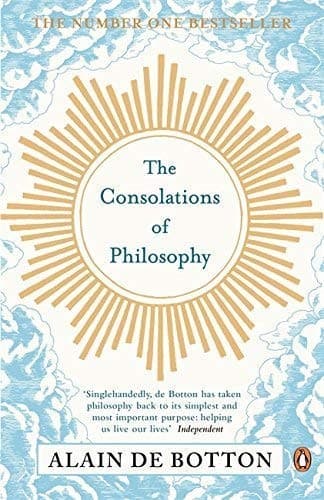
Core Idea
- De Botton uses six philosophers as “consolers” for recurring human problems: unpopularity with Socrates, lack of money with Epicurus, frustration with Seneca, inadequacy with Montaigne, unrequited love with Schopenhauer, and difficulty with Nietzsche.
- His central claim is that philosophy matters not as abstraction, but as a practical art of diagnosing why ordinary suffering happens and how a better judgment about life can ease it.
- The book repeatedly argues that many pains come from false ideas: confusing convention with truth, luxury with happiness, expectation with entitlement, familiarity with normality, desire with freedom, and comfort with virtue.
Philosophy Against Common Sense
- Socrates embodies philosophical independence: he preferred truth to approval, and his calm death after the hemlock becomes a model of dignity under pressure.
- De Botton treats common sense as often just inherited custom, historically arbitrary enough to have once accepted slavery, male dominance, militarism, and sacrifice as normal.
- Socrates’ method is to cross-examine confident beliefs, test them against exceptions, and keep revising them until they withstand logic rather than mere popularity.
- In dialogues like Laches and Meno, Socrates shows that everyday definitions of courage or virtue fail once examined closely.
- The book insists that being outnumbered by jurors, critics, or the public proves nothing; the real standard is whether a claim is reasoned well.
- Socrates’ trial dramatizes the danger of mistaking majority opinion for truth, while also warning that unpopularity alone does not make someone right.
- De Botton frames philosophy as a rational alternative to intuitive guesswork, comparing ethical life to pottery or medicine: one would not trust instinct alone in those fields.
The Consolations: Epicurus, Seneca, Montaigne
- Epicurus offers a pleasure-centered but anti-luxury philosophy: pleasure is the goal, yet the highest pleasures are simple and cheap.
- His acquisition list separates desires into natural and necessary, natural but unnecessary, and neither natural nor necessary; happiness depends mainly on the first group.
- The essentials are modest: food, shelter, clothes, friendship, freedom, and calm thought about major fears.
- Epicurus values friendship above almost everything, presenting it as the greatest good and a source of identity-confirming acceptance.
- He also values thought as a way of writing down and discussing worries until they become intelligible and less disturbing.
- His claim that death is nothing to us rests on the idea that where death is, sensation is absent; fear of it is therefore misplaced.
- De Botton extends Epicurus to modern consumer culture: advertising often teaches people to mistake surplus goods for solutions to loneliness, insecurity, or lack of freedom.
- Seneca’s Stoicism answers frustration by teaching that much distress comes from hidden expectations that reality should obey our wishes.
- He treats Fortune as the symbol of life’s instability, since money, status, health, and relationships can all be withdrawn without warning.
- His remedy is praemeditatio: rehearse loss, exile, illness, and death in advance so they lose some of their shocking force.
- Seneca also urges a “fireguard” around first impressions, because people often wrongly interpret accidents, delays, and annoyances as deliberate insults.
- The Stoic ideal is not passive resignation but rational consent to necessity: if something cannot be changed, freedom lies in not being dragged inwardly by it.
- Montaigne’s consolation is that human beings are less rational, less dignified, and more bodily than they pretend, so shame often rests on fantasy.
- He insists that education should teach wisdom, not just learning; knowledge is valuable only insofar as it makes us live better, more appropriately, and more happily.
- He mocks scholarship that fills memory while leaving judgment untouched, and he even suggests that if schooling does not improve life, a child might as well play tennis.
- Montaigne also attacks obscurity for its own sake, arguing that difficult writing is often a mask for vanity or emptiness.
- His essays model a plain style aimed at honest self-portraiture, including sex, fatigue, excretion, illness, grief, and other realities polite culture omits.
- He uses travel and comparison to dismantle cultural arrogance: what seems “weird” is often just unfamiliar, and Europeans are no benchmark for humanity.
- His response to cultural difference is not crude relativism but humility: locality, nationality, and custom are poor tests of truth.
- Friendship is again central, especially in his bond with Étienne de La Boétie, whose understanding lets Montaigne feel more fully himself than society usually allows.
Love, Pain, and Growth
- Schopenhauer presents love as a deception of the will-to-life: what feels like personal romance is really nature’s strategy for producing the next generation.
- He argues that attraction is governed by unconscious biological calculation, not by the lovers’ conscious hopes for companionship or happiness.
- This is why the best match for reproduction may not be the best match for personal fulfillment, and why romantic obsession can suddenly collapse after desire is satisfied.
- His broad pessimism makes him treat much of life as animal labor for survival and reproduction, with little genuine gain.
- Art and philosophy are his main consolations because they turn suffering into form, making one’s private misery intelligible as a shared human pattern.
- Nietzsche initially draws from Schopenhauer but rejects resignation, arguing that pain is often the price of creating, growing, and becoming strong.
- For Nietzsche, the best lives are not comfortable ones but life-affirming ones: curious, disciplined, sensual, independent, and willing to risk hardship.
- He praises figures like Montaigne, Goethe, Stendhal, and Galiani as examples of people who transformed adversity into achievement.
- Nietzsche’s recurring image is that mountains, resistance, and even destructive forces can be conditions for height, clarity, and fertility.
- His “live dangerously” outlook rejects utilitarian comfort as the standard of value and treats suffering as something that can be spiritualized or cultivated into strength.
- He also attacks Christianity as a moral system that sanctifies weakness, discourages ambition, and turns discomfort into virtue rather than confronting life directly.
What To Take Away
- The book’s deepest pattern is that consolation comes from better interpretation: seeing that many pains are produced by false beliefs about status, desire, custom, death, or self-worth.
- De Botton does not claim philosophy eliminates suffering; it helps by replacing panic, shame, and vanity with more accurate ideas about what is actually happening.
- The philosophers are not presented as perfect sages, but as specialists in particular human injuries, each offering a different way to think more clearly.
- The lasting message is that reason, honesty, and self-knowledge can make life less lonely and less tyrannized by convention, appetite, and fear.
Generated with GPT-5.4 Mini · prompt 2026-05-11-v6