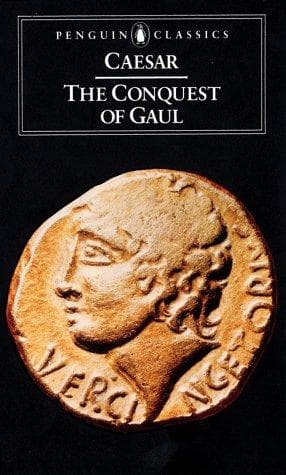
Core Idea
- Caesar’s commentaries present the Gallic and civil wars as a blend of military engineering, rapid movement, intelligence, and disciplined coercion, with clemency used strategically alongside terrifying example.
- The work also functions as political self-justification: Caesar repeatedly frames his campaigns as defensive, necessary, and lawful, while showing that his victories arise from superior judgment, speed, and morale management.
- The attached introduction and notes emphasize Caesar as a cultivated statesman and writer, not a mere destroyer, whose greatness lies in combining action, administration, and literary control of his own record.
Caesar’s Gallic Wars: Expansion by Speed, Works, and Psychological Pressure
- Caesar first checks the Helvetii, blocking their passage through the Province, defeating them at Bibracte, forcing surrender, and then reshaping the aftermath by resettling peoples and restoring order.
- He uses the victory to pivot into larger strategic claims, presenting German intrusion under Ariovistus as a threat to Rome’s Gallic allies and to Italy itself.
- Caesar’s confrontation with Ariovistus shows his style clearly: he refuses to be intimidated by rumor, rallies frightened troops by invoking Marius, and wins by forcing battle on his own terms.
- In Book II and beyond, the pattern repeats across Gaul: Caesar beats coalitions by rapid marches, fortification, and selective attacks on vulnerable points, not by reckless pursuit.
- He defeats the Belgae, the Nervii, maritime tribes like the Veneti, and inland groups by adapting method to terrain, whether that means siege works, cavalry skirmishing, or naval tactics.
- Against the Veneti, the key is engineering rather than brute force: Caesar’s fleet wins only after cutting the ships’ rigging, exposing the weakness of their tall, leather-sailed sea craft.
- Against marsh, forest, and hill tribes, Caesar repeatedly clears obstacles, throws up trenches and ramparts, and turns local geography into a weapon of siege and containment.
- The campaign against Britain enlarges this pattern: reconnaissance, shipbuilding, engineered landing, coastal fighting, fortification, and withdrawal once strategic limits are reached.
- Caesar’s account of Britain and the Britons mixes ethnography with war reporting, emphasizing chariot warfare, tidal danger, island logistics, and the difficulty of conquest.
- Across the Gallic campaigns, Caesar responds to revolt with a consistent mix of speed, deception, and exemplary punishment, including harsh reprisals where he wants deterrence more than reconciliation.
Rule, Rebellion, and the Making of Roman Authority
- Caesar treats many Gallic states as faction-ridden societies in which powerful men lead dependents, debts, hostages, and alliances; Roman intervention exploits these divisions.
- He gives extended attention to Druids and Gallic religion, contrasting them with Germans: Druids govern sacrifice, law, and memory; Germans are depicted as austere, warlike, and less socially complex.
- The work repeatedly presents Caesar as a protector of allies such as the Aedui, Remi, and other “friends” of Rome, even when he is effectively reorganizing the political map by force.
- The disaster of Ambiorix and the Eburones marks a major turning point: one legion is destroyed through deceptive negotiation, prompting Caesar to devastate the tribe’s territory and invite neighboring states to plunder it.
- Caesar’s treatment of rebellion is not uniform; he can pardon, restore, and resettle when useful, but he also annihilates, enslaves, or mutilates when he wants a lesson to spread.
- The siege of Uxellodunum is the clearest deterrent example: instead of storming the town, Caesar cuts off its water, takes the place by engineering pressure, and then orders the hands of the defenders cut off to deter future resistance.
- The later campaigns against Treviri, Bellovaci, Carnutes, Pictones, and others show the same principle: Caesar keeps Gaul unstable by moving faster than resistance can consolidate, while recruiting local allies against local enemies.
Civil War: Caesar’s Leap from Command to Mastery
- Once back in Italy, Caesar frames the clash with Pompey and the Senate as a conflict over legality and republican procedure, especially after his enemies demand he disband his army first.
- His speech to his soldiers turns constitutional grievance into military loyalty, and the 13th legion immediately supports him, marking the decisive start of civil war.
- In Italy Caesar advances by rapid occupation of towns such as Ariminum, Auximum, and Corfinium, often winning surrender before a battle can form.
- His opponents repeatedly flee stronger than they appear; Caesar uses the resulting panic to win cities, provinces, and armies with minimal bloodshed.
- The Spanish campaign at Ilerda shows Caesar at his most technical: bridges, earthworks, river control, and supply-line warfare matter more than open combat.
- He defeats Afranius and Petreius not by total battlefield annihilation but by starving, isolating, and persuading their troops to defect, then granting generous terms.
- The Massilian siege and the African disaster under Curio contrast Caesar’s own command with the failures of his subordinates: one side is stubborn and inventive, the other rash and eventually annihilated.
- In Thessaly, Caesar’s campaign against Pompey ends in the battle of Pharsalus, where Caesar’s special reserve against cavalry, disciplined infantry, and rapid exploitation of the enemy’s collapse secure a decisive victory.
- Pompey’s camp is depicted as already mentally divided by expectations of offices, rewards, and punishments, while Caesar’s army is hardened by hardship and guided by discipline.
- After Pharsalus, Caesar’s leniency becomes part of the victory itself: he pardons defeated enemies, takes control of the political future, and continues pursuing Pompey until his murder in Egypt.
- The Alexandrian war then begins almost immediately, showing Caesar again as a commander trapped between political role and military necessity, forced to fortify, seize the Pharos, and survive with limited forces.
What To Take Away
- Caesar’s own narrative is an argument that timing, engineering, discipline, and intelligence can outweigh raw numbers.
- His repeated pattern is to fragment enemy coalitions, seize strategic ground, and force surrender by logistics before risking full battle.
- Mercy is not sentimental in this book; it is a political tool used to stabilize provinces, recruit allies, and magnify Caesar’s authority.
- The introduction and commentaries together present Caesar as a rare figure who unites generalship, statecraft, and literary self-fashioning into one historical persona.
Generated with GPT-5.4 Mini · prompt 2026-05-11-v6