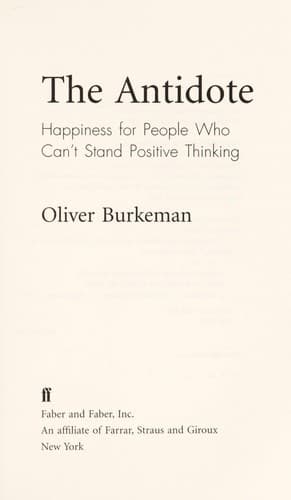
Core Idea
- The compulsive pursuit of positivity is self-defeating -- the demand to be relentlessly optimistic often makes us more anxious, not less
- Happiness comes from accepting uncertainty, failure, and mortality, not eliminating them
- What Alan Watts called the law of reversed effort: relaxing into what you fear often works better than forcing optimism
Why Positive Thinking Fails
- Affirmations and visualization backfire, especially for people with low self-esteem
- Obsessive goal-setting narrows focus and leads to "goalodicy" (a term Burkeman borrows from management scholar Christopher Kayes) -- doubling down on failing plans because abandoning the goal feels like personal failure. The 1996 Mount Everest disaster illustrates this fatally
- Seeking security paradoxically creates insecurity -- what Alan Watts called "the wisdom of insecurity"
- Positive fantasizing about success can reduce effort and preparedness
The Negative Path
Burkeman explores what he calls "the negative path" to happiness through a journalistic investigation of several philosophical traditions, thinkers, and psychological research.
Stoicism & Albert Ellis
- Regularly imagine worst-case scenarios -- reality is rarely as bad as your fears
- Control only your judgments about events, not events themselves
- Psychologist Albert Ellis modernized Stoicism through Rational Emotive Behavior Therapy (REBT), challenging "musturbation" -- the absolutist thinking ("I must succeed," "people should treat me well") that amplifies suffering
- Ellis's shame-attacking exercises: deliberately do mildly embarrassing things to prove you can survive social discomfort
Buddhism, Meditation & Present Moment
- Observe thoughts and emotions without clinging to them -- they pass on their own, though the practice is harder than it sounds
- You don't need to feel motivated to take action; act despite discomfort
- Attachment to outcomes causes suffering; uncertainty is the permanent baseline
- Burkeman visits an Eckhart Tolle retreat and explores the idea of stepping outside obsessive future-planning to engage with the present
Questioning the Self
- The fixed "self" we defend so fiercely may be less solid than we assume -- loosening identification with it reduces suffering
- Rate specific actions, not your entire self-worth
- Noticing thoughts without automatically believing them creates distance and perspective
Confronting Mortality
- Daily memento mori (remembering death) clarifies what actually matters
- Burkeman visits a Mexican town's Day of the Dead celebrations, where death is engaged with openly rather than hidden away
- Mortality awareness sharpens appreciation for life and makes living more authentic
Practices That Work
- Negative visualization: Specifically imagine losing what you value -- restores gratitude and builds resilience
- Sitting with discomfort: Observe anxiety without trying to fix it -- it passes faster than expected
- Embrace failure: Burkeman visits the Museum of Failed Products in Michigan to show how hiding failure prevents learning from it
- Start with what you have: Successful entrepreneurs tend to work with available resources and adjust direction based on results, rather than following rigid predetermined plans
Reframe Your Goals
- Money beyond basics doesn't increase happiness; obsessing over it decreases it
- Security is an illusion -- trying to eliminate all insecurity makes life smaller, while accepting it enables meaningful action
- The search for certainty is itself the problem -- demanding guarantees before acting leads to paralysis
- Act despite lack of motivation -- waiting to "feel ready" is often just another form of avoidance
Action Plan
- This week: Practice one "Stoic pause" -- when upset, identify your judgment about the situation, not the situation itself
- Daily: Spend 5-10 minutes observing thoughts without judgment (basic meditation)
- Weekly: Ask "What would I regret not doing if I died in 5 years?" -- reset priorities based on answer
- Monthly: Imagine a feared outcome in detail; identify realistic coping steps
- Ongoing: When pursuing goals, ask "What am I attached to here?" and practice non-attachment to outcomes
Generated with Claude Sonnet 4.6 · prompt legacy-pre-v6 · model inferred from repository history