Core Idea
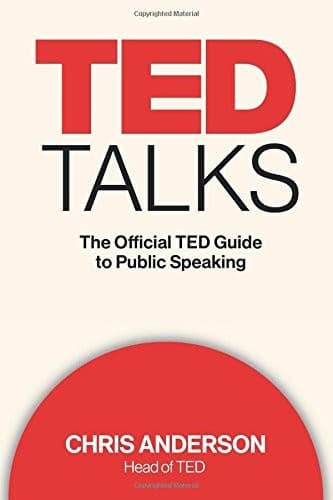
- Public speaking is a modern form of “fire”: a good talk can synchronize minds, transfer ideas at scale, and keep changing listeners long after the event.
- Anderson’s core claim is that presentation literacy is now a foundational 21st-century skill, and that great talks are learnable through tools, not a single formula.
- The book’s purpose is broader than TED: it aims to help anyone who wants to explain, inspire, inform, or persuade.
What Makes a Great Talk
- A speaker’s job is to rebuild an idea inside the listener’s mind, not simply perform confidence or recite information.
- Anderson repeatedly warns against four traps: the sales pitch, the ramble, the org bore, and the inspiration performance.
- The central organizing principle is the throughline: one clear, interesting thread that can usually be stated in about 15 words.
- A strong throughline is specific, fresh, and audience-aware; a weak one is just a topic list compressed into less time.
- The book insists on “kill your darlings” thinking: say less, cut range, and leave space for the audience to think.
- Talks often work best when they are framed as ideas rather than issues, because ideas invite curiosity and solutions rather than only moral urgency.
- Anderson’s five major tools are Connection, Narration, Explanation, Persuasion, and Revelation.
- Connection earns permission and trust through eye contact, warmth, vulnerability, humor, and selflessness.
- Vulnerability works only when it is authentic and bounded; as Brené Brown warns, vulnerability without boundaries becomes manipulation or oversharing.
- Storytelling is a major route to connection because people are wired for narratives of failure, danger, awkwardness, and misfortune that feel true and edited for meaning.
- Narration relies on empathy, tension, detail, and resolution; parables can also carry a lesson through metaphor.
- Explanation is about upgrading the audience’s mental model step by step from what they already know.
- Dan Gilbert’s talk is the model: it uses curiosity, simple conceptual steps, and memorable metaphors like the experience simulator and psychological immune system.
- Anderson emphasizes the curse of knowledge: experts must test explanations on novices and clarify transitions, sequence, and jargon.
- Persuasion often requires demolition of an existing worldview before rebuilding a better one, as in Steven Pinker’s violence talk or Barry Schwartz’s choice talk.
- Good persuasion uses intuition pumps, anecdotes, visuals, humor, and third-party validation to make the audience feel the force of the claim before formal argument arrives.
- Revelation simply shows the thing itself: a demo, a vivid image, a sequence of visuals, or a bold future.
- Wonder walks, dynamic demos, and dreamscape talks are different forms of revelation; they work when the visual or imagined future is tied to a clear theme.
- Anderson’s recurring warning is that format should serve substance; novelty without substance is a dead end.
Delivery, Slides, and Rehearsal
- Visuals are optional, not mandatory, and bad slides are worse than no slides.
- Visuals should mainly do one of three jobs: reveal, explain, or add aesthetic delight.
- TED’s best visual talks use one core idea per slide, avoid bullet lists, and never repeat spoken text on screen.
- A black or blank slide can be useful as a “vacation from images” so the audience returns to the speaker.
- Hans Rosling is the model for explanatory visuals because animation can radically change how people understand data.
- Great slides often use full-bleed images, high contrast, readable type, and minimal text; cluttered data should be broken into multiple slides.
- Good videos are short, high quality, and rare; flashy transitions, excessive effects, and overdesigned PowerPoint habits are discouraged.
- Practical production matters: file management, rights clearance, test runs, and stage compatibility are treated as part of the craft.
- Anderson rejects a simple script-versus-improv binary: both can work, but each talk should match the speaker’s natural style and the talk’s demands.
- Memorized talks can fall into an Uncanny Valley if they sound partly rote and partly unstable.
- Rehearsal is nonnegotiable, and the target is to finish comfortably under time, ideally at about 90% of the limit.
- Openings and closings matter disproportionately, so they are often worth scripting and memorizing.
- Strong openings create curiosity, drama, or a sharp visual hook; strong endings usually provide closure, a call to action, or narrative symmetry.
- Voice and body language add meaning beyond words, so pace, tone, movement, and silence should feel natural rather than performed.
- Nerves are normal, can be useful, and can be managed with breathing, water, support, humor, and backup plans.
- Anderson is skeptical of teleprompters and confidence monitors on the main stage because they weaken the sense of direct connection.
- He also notes that format innovation can be powerful, but props, dual presenters, telepresence, or other hybrids should never obscure the idea.
Why It Matters Now
- Anderson sees public speaking becoming more important because the world is more connected, and connectedness multiplies the reach of a single good idea.
- His own TED history shows the shift: short, cross-disciplinary talks proved that audiences want ideas that resonate beyond one specialty.
- He argues that the age of knowledge rewards contextual knowledge, creative knowledge, and a deeper understanding of our own humanity.
- Technology is changing what humans do best, but the answer is not to become less human; it is to become more human than ever in judgment, empathy, creativity, and service.
- The Internet and online video created a new ecosystem of visibility, learning, and imitation, which Anderson calls crowd-accelerated innovation.
- TED’s answer has been to expand the ecosystem through TEDx, TED-Ed Clubs, and OpenTED, while treating presentation literacy as a school-level skill.
- The book’s larger moral claim is that the future is shaped by what we choose to share, and by whether we speak in ways that appeal to shared values rather than tribalism.
What To Take Away
- A great talk is not a performance of genius; it is a carefully built transfer of understanding.
- The best talks are anchored by one strong throughline and then carried by the right mix of connection, story, explanation, persuasion, or revelation.
- Slides, script, rehearsal, and delivery are all subordinate to one question: does this help the audience receive the idea?
- Anderson’s bottom line is optimistic: if more people learn to speak well, ideas can spread faster, public thinking can improve, and shared progress becomes more possible.
Generated with GPT-5.4 Mini · prompt 2026-05-11-v6