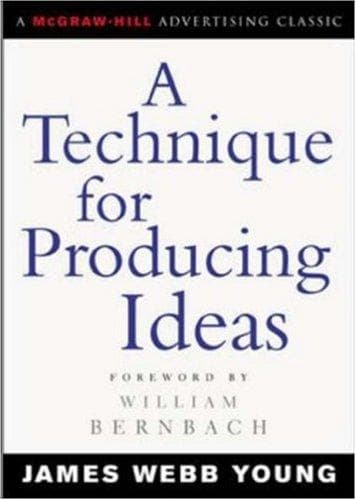
Core Idea
- Young’s central claim is that an idea is a new combination of old elements, not a mysterious flash of genius.
- Idea-making is therefore a teachable process with stages, much like a factory technique, and people improve by learning the method rather than waiting for inspiration.
- The stakes are practical: in advertising, better ideas come from a repeatable discipline of collecting, digesting, and recombining material.
What an Idea Requires
- Young distinguishes between people who are naturally reconstructive and those who are not, borrowing Pareto’s contrast between speculator and rentier.
- He does not reduce creativity to intelligence or raw facts; the crucial capacity is seeing relationships among facts and turning them into usable combinations.
- The mind needs two kinds of material: specific materials and general materials.
- Specific materials are the facts of the assignment, especially deep knowledge of the product and the people it is sold to.
- General materials are broad experience from life, history, the social sciences, literature, and observation, which enlarge the field of possible combinations.
- Young treats creative people as intense browsers; the richer the stock of general knowledge, the more varied the mind’s kaleidoscope of possible patterns.
- He even suggests that reading Veblen or Riesman may be more useful for advertising thinking than many advertising books.
- His soap example shows the point: studying soap in relation to skin and hair opened up a stream of advertising ideas and helped multiply sales.
- Knowledge alone is not enough; it must be digested so it can re-emerge as fresh relationships.
The Five-Step Process
- 1. Gather raw material: collect both the immediate facts of the problem and the wider material of general experience.
- Young recommends 3 × 5 cards for notes because writing forces expression, exposes gaps, and prevents halfhearted work.
- He also recommends a scrapbook or file for fugitive material like clippings and observations.
- 2. Masticate the material: mentally work over the facts, test possible relationships, and keep trying combinations until the problem starts to form a pattern.
- During this stage, partial or odd ideas should be written down at once, even if they are incomplete.
- Young warns not to stop at the first weariness; the mind often has a second wind, and the worker should push through initial fatigue.
- 3. Incubate: after sincere effort, put the problem out of conscious attention and let the unconscious continue the work.
- He treats rest as a necessary stage, not procrastination, and encourages stimuli such as music, theater, movies, poetry, or a detective story.
- 4. The idea appears: the solution arrives unexpectedly, often while shaving, bathing, or waking, but only because the earlier stages have prepared it.
- The “Eureka” moment is not random genius; it depends on prior gathering, working over, and incubation.
- 5. Shape it for use: test the idea against reality, adapt it to practical conditions, and submit it to the criticism of the judicious.
- A good idea may have self-expanding qualities, meaning others can extend it once it is shown.
Limits, Experience, and After-Thoughts
- Young later says experience confirmed the process, but he would give even more emphasis to enlarging the reservoir of general materials.
- His New Mexico example shows how prolonged immersion in a region’s history, language, people, and crafts created both business insight and ad ideas.
- He insists that some ideas require life experience that only time can supply, though vicarious experience can also widen the reservoir.
- People who seem to produce ideas instantly often do so because of long discipline and a well-stocked mind, not because they bypass the method.
- He adds that words are ideas in suspended animation, so mastery of language expands the mind’s usable stock of relationships.
- His final references to Wallas, Poincaré, and Beveridge place his method alongside other accounts of invention and discovery as understandable processes.
What To Take Away
- Treat idea production as a sequence of stages, not an accidental burst of inspiration.
- Build two reservoirs: deep specific knowledge of the problem and wide general knowledge of life.
- Expect the breakthrough to come after sustained effort plus deliberate incubation, not before it.
- Do not stop at the first notion; test, refine, and shape the idea until it works in practice.
Generated with GPT-5.4 Mini · prompt 2026-05-11-v6