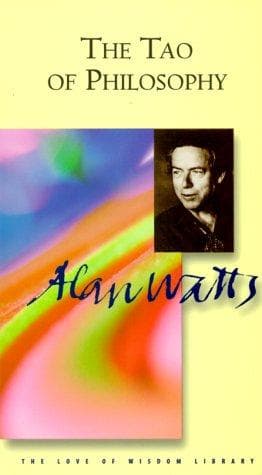
Core Idea
- Alan Watts argues that Western culture is trapped in the illusion of a “skin-encapsulated ego”: a separate controller inside the body trying to manage an external world.
- His corrective is a Taoist, Buddhist, and Hindu view that the self is not isolated substance but an expression of the whole process of reality.
- Freedom comes less from control than from trust, participation, and letting things happen in harmony with the Tao or the spontaneous order of things.
Against the Western Model of Control
- Watts says Western thought treats knowledge as control: to know becomes to predict, manage, and dominate.
- This creates a recursive trap of “controlling the controller,” as the ego tries to supervise itself from inside a supposedly separate head.
- Western civilization also oscillates between two unsatisfying myths: the universe as a made artifact ruled by a watchful God, and the universe as a dead mechanism in which intelligence is an accidental byproduct.
- He rejects both as distortions, insisting that intelligence in an organism-like universe is not a freak exception, just as an apple tree naturally “apples.”
- Much of the confusion comes from language, which pushes us toward nouns, substances, and “stuff” instead of events, processes, and forms.
- Under analysis, matter disappears as solid substance and leaves pattern, form, or named form (nama-rupa).
- The more adequate vision is tathata or “suchness”: reality as plain happening before it is forced into metaphysical boxes.
Tao, Nature, and Social Order
- Watts contrasts three broad models of nature: the Western view of nature as machine/artifact, the Indian view of nature as drama/play (maya, lila), and the Chinese view of nature as self-so (tzu-jan) governed by Tao.
- In the Chinese view, nature is biological rather than mechanical: things happen of themselves without a boss.
- Tao is the “course of nature” that “loves and nourishes all things but does not lord it over them.”
- The practical corollary is wu-wei, which Watts defines as not interfering with the grain of events, not as passivity or laziness.
- He uses li to name the organic pattern or grain in things, visible in wood, jade, muscle, clouds, mountains, seafoam, and art.
- A second sense of li refers to justice or fair patterning, but true judgment cannot be reduced to written law alone and requires intuitive equity.
- Politically, mistrust of nature and human nature leads toward surveillance, bureaucracy, and ultimately totalitarian control.
- Watts therefore favors a lightly governed, even anarchic, order in which the best ruler helps things along without claiming credit.
Meaning, Attention, and the Ego
- Watts distinguishes meaning as sign-reference from meaning as self-fulfilling significance.
- Much of what is genuinely meaningful is not a future endpoint but something that satisfies itself in the present: music, dancing, shared singing, food, and aesthetic attention.
- He attacks the habit of living for later payoffs—success, retirement, spiritual attainment, or Heaven—as a hoax of postponement.
- Life is not a means to a remote destination; its value lies in the joy of the process itself.
- He contrasts spotlight consciousness, which focuses on one object at a time, with floodlight consciousness, which quietly holds the wider field.
- Culture overvalues the spotlight and undervalues the tacit intelligence by which organisms coordinate, survive, and function.
- This leads people to identify with the small conscious ego rather than with the larger field of organism and environment.
- He also contrasts prickles and goo: the sharp, discrete, analytical mode versus the fluid, organic, relational mode.
- Modern science and technology have leaned too far toward prickles—measurement, bits, catalogs, scanning, and control—while neglecting holistic pattern recognition.
Death, God, and the Unsayable Ground
- Watts argues that religious images matter because emotional life is shaped more by images than by abstract theology.
- He proposes reversing the dominant paternal image of God with the feminine, dark, womb-like image “She is black”, associated with Kali.
- Kali represents the necessary negative principle: space, receptivity, death, and the dark background that makes appearance possible.
- Blackness matters because without empty space there can be no stars, and without death life would lose its felt value.
- Fear of death comes from the false image of the self as separate and self-contained.
- Watts treats death not as a problem to be mastered but as the counterpart that makes existence vivid and finite.
- He insists that no image of God, whether father, mother, light, or darkness, can capture the deepest reality.
- That reality is named variously brahman, sunyata, or the ineffable ground beyond concepts.
- This is not ordinary atheism, but a religious stance of trust and letting go, where grasping at images signals insecurity.
What To Take Away
- The book’s central claim is that the separate ego is a cultural hallucination, not the basic fact of experience.
- Reality is better understood as process, pattern, and play than as object, substance, or machine.
- Human life fits best within an ecological Taoist picture of organism/environment unity, not a model of isolated mastery.
- The deepest shift is from anxious control toward trust in spontaneous order, including the order of one’s own deeper nature.
Generated with GPT-5.4 Mini · prompt 2026-05-11-v6