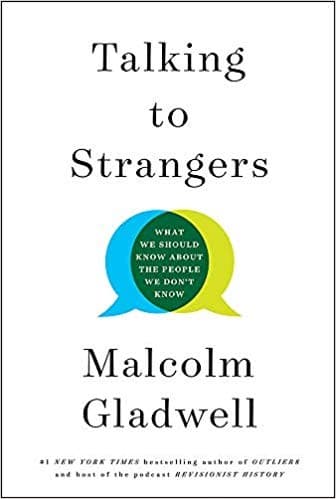
Core Idea
- Gladwell’s core claim is that strangers are hard to read, and modern life forces us to make consequential judgments about people we do not know.
- He argues that our biggest errors come from three recurring mistakes: defaulting to truth, trusting transparency too much, and ignoring context/coupling.
- The book does not say “never trust strangers”; it says human judgment is structurally noisy, confidence is often misplaced, and the conditions around an encounter matter as much as the person.
How We Misread Strangers
- In the Sandra Bland case, Gladwell uses the traffic stop to show how fast an ordinary encounter can escalate when an officer treats irritation and body language as signs of danger.
- He contrasts public debates that zoomed out to racism and structure with ones that zoomed in to individual blame, arguing both levels matter.
- The book’s first puzzle is why even skilled professionals miss liars; the CIA’s failure with Cuban double agents, despite polygraphs and experienced case officers, shows expertise can still be badly wrong.
- The second puzzle is why face-to-face contact can make us more confident but not more accurate; Chamberlain’s meetings with Hitler are Gladwell’s emblematic case.
- He uses the New York bail system to show the same pattern: judges think they can improve on algorithms by seeing defendants directly, yet a simple model using age and record outperformed them.
- The point is not that computers are omniscient, but that human observers often mistake felt insight for actual predictive value.
- Emily Pronin’s illusion of asymmetric insight helps explain this: people think they understand others better than others understand them, while treating themselves as more complex than the strangers they judge.
- Gladwell connects this to the common tendency to see strangers as legible from thin cues while excusing our own behavior as nuanced and contextual.
The Three Big Mechanisms
- Truth-Default Theory is Tim Levine’s idea that people normally assume honesty and only become skeptical when doubts cross a high threshold.
- This explains why most lie detection is weak: people are good at spotting truth-tellers but miss many liars because they do not start from suspicion.
- Ana Montes’s long-running espionage career shows how a clean file, good evaluations, and plausible answers can keep people in truth-default even when odd details accumulate.
- Gladwell contrasts Montes with Harry Markopolos, his “Holy Fool” example: a suspicious outlier who saw Madoff’s fraud because he did not default to trust.
- But he also stresses that society needs truth-default to function; if everyone behaved like Markopolos, ordinary social and institutional life would become paranoid and unworkable.
- The Friends fallacy is the belief that outward behavior reliably reveals inner feeling, as if life were as transparent as a sitcom with exaggerated facial cues.
- Gladwell uses FACS and Paul Ekman’s facial coding to show how seriously people overread faces, but he argues that real life is not organized like a scripted TV close-up.
- Cross-cultural evidence from the Trobriand Islands, Mozambique, Namibia, and even surprise-expression studies suggests emotional faces are less universal and less visible than people assume.
- The result is that judges, interrogators, police, and ordinary observers often treat demeanor as signal when it is really just noise.
- The Amanda Knox case shows how a person who is “mismatched” to the expected script can look guilty simply because her grief, sexuality, awkwardness, or affect do not fit the stereotype.
- Alcohol chapters extend the same logic: intoxication does not reveal a true self but creates myopia, narrowing attention to immediate cues and making behavior highly context-dependent.
- Dwight Heath’s work on Bolivian drinking rituals shows that alcohol’s effects depend on the social setting, not just the drink.
- Blackouts and binge drinking make consent and memory especially unreliable, and Gladwell treats the Brock Turner/Emily Doe case as a stark example of how dangerous these conditions are.
- The book’s method is consistent: what looks like character may be a product of situation, and what looks like signal may be produced by our own interpretive bias.
Coupling, Place, and the Limits of Judgment
- In the Sylvia Plath chapter, Gladwell shifts from person-reading to coupling, arguing that suicide can be tied to a particular method, setting, and moment rather than simply displaced to any other means.
- Britain’s transition from town gas to natural gas is his key natural experiment: as one highly lethal method disappeared, overall suicide rates for some groups fell rather than simply relocating.
- He uses Golden Gate Bridge jump data and related follow-up findings to argue that many suicides are linked to a specific place, not just a general intent.
- Sylvia Plath and Anne Sexton illustrate how method matters psychologically; the choice of gas or pills is part of the act, not a random interchangeable container for intent.
- In crime, David Weisburd’s work on the Law of Crime Concentration shows that crime clusters on tiny street segments, not evenly across whole neighborhoods.
- This leads to the policing lesson that place matters more than broad stereotypes: good enforcement is about the right hot spot, not just more enforcement everywhere.
- Kansas City experiments showed random patrol did little, while tightly focused stop-and-search in one violent district cut gun crime dramatically.
- Gladwell is careful that this tradeoff is ethically costly: aggressive tactics create many innocents stopped for the sake of catching a few offenders.
- The Sandusky and Bland stories converge here: institutions encouraged adults to read ambiguous behavior as suspicious, but in the wrong setting and with the wrong assumptions.
- Gladwell’s final Sandra Bland point is that Encinia was trained to search beyond the traffic ticket, but the road he chose was not a true hot spot, and his suspicion was amplified by a system built to reward pretext and productivity.
What To Take Away
- Do not confuse confidence with accuracy when judging strangers; direct contact often increases conviction more than insight.
- Defaulting to truth is normal and socially necessary, but it creates predictable blind spots when evidence is ambiguous or manipulated.
- Transparency is limited: faces, posture, and demeanor often mislead because emotion is not always legible, universal, or proportionate.
- Context is not background in Gladwell’s argument; place, method, environment, and institutional incentives can determine outcomes more than the stranger themselves.
Generated with GPT-5.4 Mini · prompt 2026-05-11-v6