Core Idea
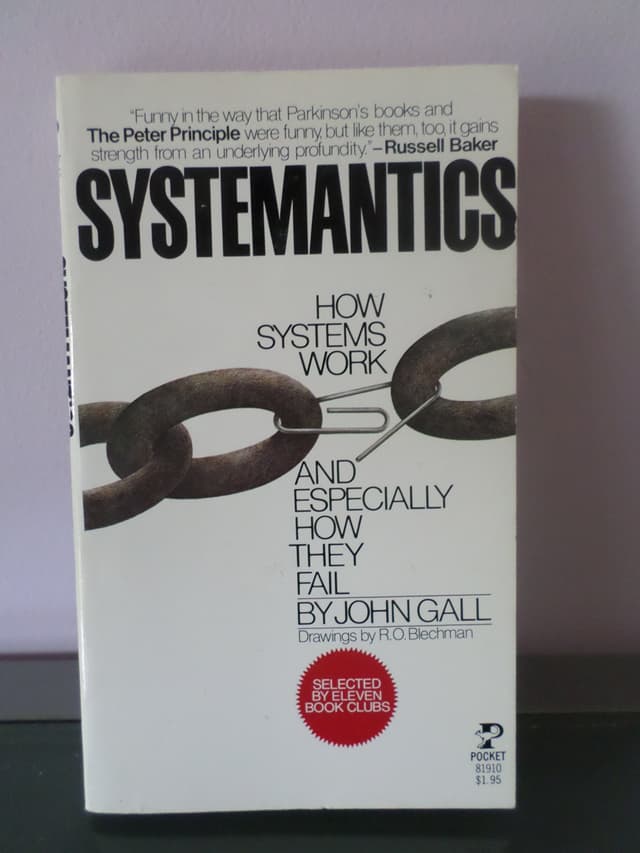
- Systemantics treats large systems as having their own behavior and “laws,” and its central claim is that systems usually do not do what they say they do.
- Gall’s outlook is satirical but serious: the bigger and more complex a system becomes, the more it tends to generate new problems, distort reality, and fail in ways its designers did not intend.
- The book is a warning against assuming that institutional scale, planning, or formal purpose guarantees actual performance.
How Systems Behave
- The Primal Scenario is that systems in general work poorly or not at all, and that this is closer to the norm than the exception.
- The Fundamental Theorem says new systems generate new problems; solving one issue by building a system creates a new object that itself must be managed.
- The Law of Conservation of Anergy holds that systems do not eliminate trouble so much as redistribute effort, friction, and difficulty into new forms.
- The Laws of Growth describe the tendency of systems to expand, encroach, and fill available space, with Parkinson’s law treated as only a partial version of this larger tendency.
- The Generalized Uncertainty Principle (G.U.P.) says that once a system exists in the real world, its behavior cannot be fully predicted from its design or internal model.
- The Non-Additivity Theorem and Climax Design Theorem say that scaling up a smaller system does not preserve its behavior; the “same” function changes qualitatively at larger size.
- Gall repeatedly stresses that scale changes function, so a larger version of a working small system may become a different system altogether.
Why Systems Mislead
- Gall argues that systems get in the way of their own proper function and can oppose it through their internal dynamics.
- Positive feedback is especially dangerous because it can create oscillation, useless noise, or runaway behavior instead of stable performance.
- Functionary’s Falsity means that people inside systems often do not actually do what the system says they are doing; titles and roles can diverge sharply from real work.
- His shipbuilder example shows that “shipbuilders” may be administrators rather than the people physically building ships.
- The Operational Fallacy is the claim that a function performed by a system is not operationally the same as the same-named function performed by an individual.
- The fresh-apple example makes this concrete: a home-picked apple, a grocery apple, and a supermarket apple may all be called “fresh apples,” but they are not the same product in any operational sense.
- The Fundamental Law of Administrative Workings (F.L.A.W.) says that in systems, things are what they are reported to be.
- From this come the coefficient of fiction and the narrowing of contact between systems and individuals, which reduces people to numbers, charts, or dossiers.
- The hospital example, “The Chart Is Not The Patient,” shows how report-based systems can displace the reality they are meant to track.
- Functionary’s Fault is the damage done to people by immersion in the system, especially through sensory deprivation and distorted reporting.
- Gall distinguishes Functionary’s Pride as inflated office self-importance and Hireling’s Hypnosis as the trance-like compliance of people who notice errors but do nothing.
- He also says systems attract systems-people, including those who fit, thrive in, or parasitize the system’s internal logic.
Failure, Goals, and the Limits of Management
- The Newtonian Law of Systems-Inertia says that a system that performs a function will keep doing so regardless of whether the function is still needed.
- Systems develop goals of their own as soon as they come into being, and internal goals often come before the stated purpose.
- A system’s self-preservation can therefore outrank the problem it was supposedly created to solve.
- The Functional Indeterminacy Theorem (F.I.T.) says that malfunction or total nonfunction may remain undetectable for long periods, if ever.
- The Fundamental Failure Theorem (F.F.T.) says that a system can fail in infinitely many ways, and its specific mode of failure is usually not predictable from structure alone.
- Gall is skeptical of management-by-goals because goals can become a way for the organization to monitor, constrain, and control the people who state them.
- His deeper critique is that a system is someone’s solution to a problem, but the system itself cannot truly solve the problem.
- Large systems often substitute reports, paperwork, and administrative response for the real achievement they claim to pursue.
- Great advances, in his view, do not come from systems explicitly designed to produce great advances, because such systems tend to produce process rather than breakthrough.
What To Take Away
- Gall’s most important warning is that systems change what they are when they scale, and that this change affects both function and truth.
- The right question is not what a system claims to do, but what it actually does, and who benefits from its self-preserving behavior.
- Many “solutions” are really new systems that redistribute trouble, create dependencies, and make the original problem harder to see.
- If a simple system works, Gall’s stance is to be skeptical of unnecessary expansion, because system growth often brings new failures, new distortions, and more administrative fiction.
Generated with GPT-5.4 Mini · prompt 2026-05-11-v6