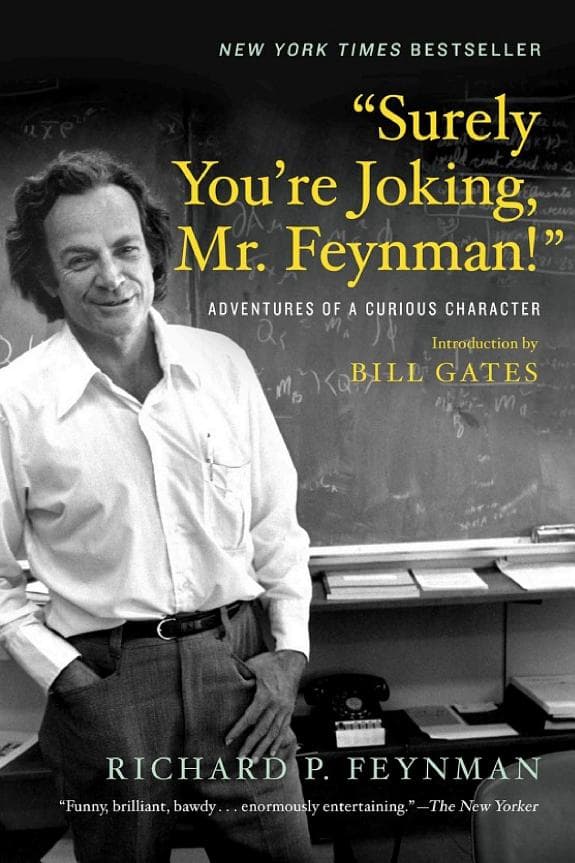
Core Idea
- The book is a set of autobiographical episodes that present Feynman as a curious, mischievous, anti-pretentious problem-solver who trusts direct observation over status, ritual, or authority.
- Across physics, biology, travel, teaching, and social life, he keeps returning to the same rule: real understanding comes from contact with the world, and the main danger is fooling yourself.
- The memoir’s stakes are broader than cleverness; Feynman argues that science and ordinary thinking both fail when people substitute appearance, vocabulary, or reputation for actual explanation.
Curiosity as a Way of Life
- From childhood onward, he builds radios, alarms, and other contraptions, and learns that many “mysteries” become ordinary once you inspect the physical mechanism.
- His recurring “puzzle drive” pushes him to keep working until a problem is solved, whether the puzzle is math, locks, Mayan hieroglyphs, or ants.
- He thinks best by making concrete models and examples, and he repeatedly shows impatience with ideas that stay abstract when they could be made visible.
- He likes improving everyday tasks and tools, treating ordinary labor as a site for invention rather than drudgery.
- His speed with mental calculation and problem solving comes partly from pattern recognition and from learning how to estimate intelligently instead of pretending to compute everything from scratch.
- He experiments with his own notation for trigonometry and calculus, showing both his desire to redesign confusing systems and the later need for shared language if ideas are to be communicated.
Science as Direct Testing, Not Ceremony
- Feynman’s scientific style is to test, compare, and observe rather than accept labels or elegant arguments that do not meet reality.
- In physics he and Wheeler develop the idea of half-advanced and half-retarded potentials, using interactions with other electrons to address a self-action problem and then trying to extend that insight into quantum theory.
- He repeatedly shows that experts can reason themselves into opposite conclusions unless an experiment settles the matter, as in the sprinkler-in-water example.
- He treats mathematics as a flexible toolkit: the same problem may yield to contour integration, differentiating under the integral sign, or approximation, depending on what tools you know.
- He is especially confident when he can tie a question to a specific physical case, and he becomes frustrated when people stay at the level of “general” talk without examples.
- In biology, he works hard to understand enough physics and technique to see where experiments can go wrong, and he notices that sloppy handling can create false results.
- He emphasizes the importance of controls and warns that apparent findings may actually come from hidden artifacts such as contaminated samples or unreliable preparation steps.
Social Knowledge, Status, and Pretending to Know
- Many stories turn on the gap between social performance and actual understanding, with people often responding to credentials, role, or style rather than substance.
- At Princeton and elsewhere, he can seem like a genius because he answers quickly and confidently, even when the underlying idea is simple or familiar.
- He enjoys exposing shallow knowledge, such as students who can repeat formulas but cannot explain what they mean or connect them to a real example.
- His accounts of MIT, Princeton, Cornell, Brazil, and Japan show him moving across institutions and cultures while treating them as systems to decode rather than hierarchies to admire.
- He repeatedly punctures pretension in rituals, manners, and academic or diplomatic formalities, noticing how much people are guided by costume and role.
- He also learns that many people are more social than he is, and that institutions often reward form over truth, which reinforces his anti-authoritarian temperament.
Cargo Cult Science and the Demand for Integrity
- The clearest explicit argument comes in his lecture on cargo cult science, where he says science is not just the outward form of experiments but the discipline of being honest about uncertainty, error, and alternative explanations.
- The cargo cult metaphor captures fields that imitate scientific ceremony while missing the essential thing: the planes don’t land.
- His central standard is scientific integrity: report everything that might invalidate a result, not just the parts that support it.
- He criticizes educational materials that produce memorization without understanding, using examples from Brazil’s textbooks and math instruction.
- He objects to vague explanatory language like “energy makes it go” when students have not yet understood the actual behavior of springs, motors, or engines.
- He also warns against averaging careless judgments or relying on polished presentation, because quantity and style cannot replace attention to how a result was obtained.
- The recurring error is not ignorance alone but the habit of caring more about appearing right than about being right.
What To Take Away
- Inspect the mechanism before accepting the label, slogan, or elegant story.
- Don’t confuse form with knowledge: rituals, notation, and credentials can hide shallow understanding.
- Treat error as information by making room for uncertainty, controls, and alternative explanations.
- Stay playful and curious: many of Feynman’s insights come from tinkering without a fixed purpose, then following the problem wherever it leads.
Generated with GPT-5.4 Mini · prompt 2026-05-11-v6