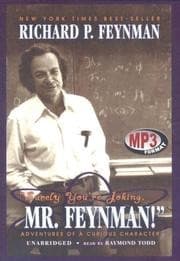
Core Idea
- Feynman presents himself as a relentlessly curious, playful, anti-pretentious problem-solver whose life was driven by the joy of figuring things out.
- The book’s recurring tension is between real understanding and mere performance: physics vs. social status, experiment vs. formula, honesty vs. self-deception, and science vs. “cargo cult” imitation.
- His adventures across radio repair, MIT, Princeton, Los Alamos, Cornell, Brazil, Japan, art, and public life show the same mind at work in wildly different settings: observe concretely, test assumptions, and distrust explanations that sound grand but do not connect to reality.
Curiosity as a Way of Life
- As a boy, Feynman built labs, burglar alarms, radios, and improvised gadgets, and he treated every malfunction as a puzzle rather than a setback.
- He became known for solving problems fast by spotting structure, pattern, or a lucky shortcut, not by following formal procedures in the expected way.
- He often trusted hands-on reasoning over abstract symbolism, whether in radio circuits, math, or physics, and he disliked notations that obscured what was really happening.
- His “puzzle drive” extended beyond science to safes, Mayan glyphs, ant trails, mechanical tricks, and social situations where ordinary people were also following hidden rules.
- He repeatedly learned that cleverness in the abstract can fail in practice, as with hotel bean-cutting schemes, switchboard shortcuts, and other improvements that ignored administration, labor, or context.
Physics, Teaching, and the Habit of Checking
- At Princeton, Cornell, Caltech, Los Alamos, and elsewhere, Feynman describes physics as a hands-on craft rooted in apparatus, experiments, and direct confrontation with nature.
- His work with Wheeler on radiation reaction led to the half-advanced, half-retarded classical theory, showing his taste for radical rethinking of assumptions.
- He loved teaching because student questions forced him back to basics and because explanation kept him alive intellectually when research was stalled.
- He could be dazzlingly fast at mental arithmetic and approximation, but he stresses that this came from memorized anchors, rough estimation, and a feel for structure, not magical calculation.
- In biology, chemistry, topology, and other fields, he learned enough to be useful but also enough to see where he was an outsider; he often exposed hidden assumptions by inventing concrete examples or demanding a real specimen.
- His Mayan work similarly combined curiosity and concrete artifacts: he decoded bars, dots, the zero sign, base-20 structure, and calendar tables from the Dresden Codex rather than trusting commentary.
- He valued experimental discipline more than polish, and he liked situations where an idea could be checked against a physical fact, a number, or a visible effect.
Systems That Pretend to Be Knowledge
- A major theme is his rejection of cargo cult science: outwardly scientific procedures that lack the integrity, completeness, and willingness to invalidate oneself that real science requires.
- He applies this critique to psychology, ESP, mysticism, pseudoscience, educational theory, and public-policy talk that uses science words without testing reality carefully.
- His strongest principle is don’t fool yourself; after that, being honest with others becomes possible.
- He insists on reporting negative results, stating what could have gone wrong, and “leaning over backwards” to make alternative explanations visible.
- He is equally skeptical of bureaucratic systems that reward appearances: Los Alamos censorship, patent paperwork, military committees, and textbook review boards all show how formal rules can produce nonsense.
- His attack on “new math” and science textbooks is especially sharp: they often used abstract words like energy or base notation without first building actual understanding from concrete mechanisms.
- He argues that education should start from real objects and operations, not from labels that students can repeat without grasping.
Social Worlds, Performance, and Self-Discovery
- Feynman’s stories about MIT fraternities, Princeton tea, Brazil, Japan, Las Vegas, bars, and royal ceremonies show him continuously learning that social life also has hidden rules, but he approaches them as puzzles rather than status games.
- He often uses imitation, misdirection, or blunt honesty to reveal what people actually value, as when he exploits social expectations, flatters no one unnecessarily, or refuses to play polite when politeness hides the real issue.
- He is fascinated by performance—drumming, dancing, stage mindreading, showgirls, art, and ceremonial protocol—but usually strips the performance down to its mechanics.
- In Brazil, he finds both joy and irritation: samba gives him belonging, while the education system illustrates how memorized language can masquerade as understanding.
- In Japan, he admires practical hospitality and ritual precision, but he also resists learning phrases mechanically when he cannot connect them to use.
- His art episodes show a similar pattern: he wants to draw not as decoration but as a way to express scientific wonder, and he values the craft of seeing over artistic pose.
- The Nobel Prize and its ceremonies make him uneasy because fame interferes with ordinary inquiry and invites pomp, which he distrusted all his life.
What To Take Away
- Feynman’s deepest habit is to reduce every situation to something you can actually inspect, test, or calculate.
- He treats understanding as a moral discipline: if you do not know, say so; if you can test, test; if you might be fooling yourself, assume you are.
- The book’s charm comes from the same source as its seriousness: he never stopped playing, but he played with reality, not with empty pretenses.
- The memoir is less about a genius performing feats than about a person who kept a childlike appetite for puzzles while refusing to let social authority replace evidence.
Generated with GPT-5.4 Mini · prompt 2026-05-11-v6