Core Idea
- Wallace uses highly specific reportage, memoir, and criticism to show how environment, mediation, and systems of spectatorship shape consciousness more than people usually admit.
- Across essays on tennis, television, the Illinois State Fair, Lynch, and cruising, he keeps returning to the same tension: modern pleasures often work by managing attention, desire, and self-consciousness rather than delivering simple enjoyment.
- His method is both comic and analytical: he treats ordinary American experiences as revealing structures of class, boredom, irony, violence, and the longing to be absorbed by something larger.
Wallace’s Main Subjects and Arguments
-
In “Derivative Sport in Tornado Alley,” Wallace argues that his junior tennis success came less from natural athleticism than from a Midwestern habit of geometric thinking, comfort with straight lines, and adaptation to ugly conditions.
-
Central Illinois tennis is ruled by wind, bad courts, heat, weeds, insects, and other distortions; he calls his style “Play the Whole Court,” meaning conservative, percentage-based play that accepts conditions instead of romanticizing ideal ones.
-
His rivalry with Gil Antitoi becomes a study in contingency: weather, sleep, puberty, and body changes matter as much as talent, and his decline is tied to the body’s betrayal and the failure of his “private religion of wind.”
-
The tornado material extends that logic: tornadoes are terrifying because they are force without law, and the possible 1978 tornado episode at Hessel Park becomes a blurred boundary between ritual, repetition, and catastrophe.
-
“E Unibus Pluram” is Wallace’s major essay on television and fiction, and its central claim is that TV has absorbed the old posture of ironic rebellion.
-
Early postmodern irony once served as a useful critique of hypocrisy, bureaucracy, and media culture, but now irony is institutionalized; it becomes “the voice of the trapped who have come to enjoy their cage.”
-
Television thrives by making viewers feel “in on” the joke, turning self-reference, mockery, and anti-naïveté into a protective style that disarms criticism.
-
Wallace argues that TV is not just an appliance but a culture-shaping medium that trains people to value watchableness, coolness, and the ability to seem unwatched while being watched.
-
He is especially interested in how commercials, sitcoms, and meta-TV make individuality and crowd approval depend on each other: you are asked to stand out in ways that only the crowd can recognize.
-
His diagnosis extends to fiction: Image-Fiction and similar postmodern writing often fail because TV has already mastered the surface effects of irony, speed, and self-awareness.
-
Wallace’s alternative is not anti-TV puritanism but the risk of sincerity, reverence, and “single-entendre” feeling, which are now embarrassing precisely because irony has become the default defense.
-
In the Illinois State Fair essay, Wallace treats the Fair as a Midwestern ritual of communal immersion rather than escape.
-
The Fair exposes a classed rural America split among ag-people, civilians, and carnies, while its food, crowds, livestock, and machinery create a logic of consumption, bodily strain, and spectacle.
-
He is interested in the weird dignity of public forms like clogging, tractor pulls, boxing, and sprint cars, but he also keeps registering the Fair’s grime, heat, violence, and consumer absurdity.
-
The essay shows his eye for the social meanings hidden in supposedly simple entertainments: even the Expo Building and its “As Seen on TV” culture reveal a whole Midwestern consumer world.
-
In the Lynch essay, Wallace argues that David Lynch’s films are strong because they are not merely clever but deeply Expressionist and psychologically direct.
-
He sees Lynch’s best work as a mode where the grotesque and mundane collide, and where evil is not just an external force but something that wears people.
-
He defends Lynch against the idea that his films are empty provocation: their creepiness matters because they make viewers feel implicated, especially in films like Blue Velvet and, more controversially, Fire Walk with Me.
-
For Wallace, the point of Lynch is not a neat moral lesson but the unsettling “bothness” of innocence and corruption, beauty and damage, self and shadow.
-
He also uses the Lost Highway material to insist that ambiguity is not the same as meaninglessness; some works resist paraphrase but still remain compelling.
-
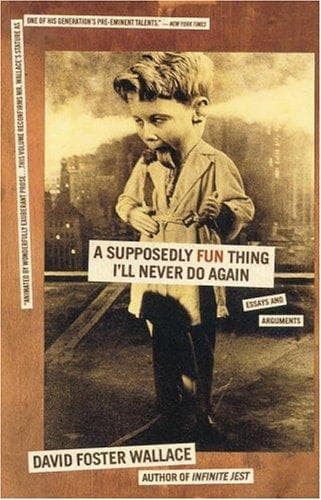
The cruise essay, “A Supposedly Fun Thing I’ll Never Do Again,” is the book’s most famous piece of social criticism by immersion.
-
Wallace treats the luxury cruise as a system designed to deliver pampering, certainty, and relief from choice, but finds that this very system produces paranoia, dependency, and escalating dissatisfaction.
-
The ship’s promise of “Absolutely Nothing” reveals a central American fantasy: that pleasure can be professionally managed so that no effort, ambiguity, or regret remains.
-
His own experience shows the instability of that fantasy; once novelty wears off, even perfect service becomes invasive, and the “Dissatisfied Infant” in the self keeps demanding more.
-
The cruise also exposes a class structure: affluent, camera-bearing passengers rely on invisible labor from crew members, and Wallace keeps noticing the gap between being cared for and being controlled.
How Wallace Thinks
- His best essays are built from precise observation plus exaggerated, often comic metaphors that make the underlying system visible.
- He repeatedly tracks the relation between surface feeling and hidden mechanism: a tennis match, a TV show, a fair ride, a film, or a cruise all turn out to be systems that shape desire before they satisfy it.
- He is skeptical of easy rebellion, because rebellion itself gets commodified; his real target is the comfort of cynical sophistication.
- The emotional signature of the book is a mix of fascination, embarrassment, loneliness, and moral seriousness under heavy irony.
What To Take Away
- Wallace’s essays are united by a suspicion that modern American pleasures often script the consumer more than they please them.
- He shows how irony, once a critical weapon, can become a deadening habit that protects media and self alike.
- He values forms of attention that are harder to fake: precision, sincerity, and willingness to be uncool.
- The book’s lasting power comes from making systems of leisure feel both hilarious and unsettling, as if fun itself were always already a structured problem.
Generated with GPT-5.4 Mini · prompt 2026-05-11-v6