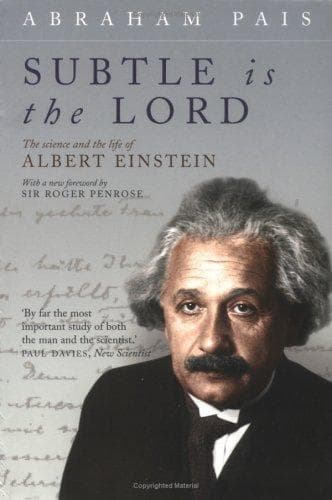
Core Idea
- Pais presents Einstein as a scientist whose life and work were united by a search for orderly transition, objective reality, and the deepest laws behind phenomena.
- The book’s central claim is that Einstein’s greatness lies not just in relativity, but in the full arc from statistical physics to general relativity, and then to his lifelong struggle with quantum mechanics and unification.
- Einstein is shown as both historically lucky and intellectually radical: he repeatedly turned puzzles in thermodynamics, light, and gravitation into foundational physics.
Einstein’s Scientific Style and Early Formation
- Pais emphasizes Einstein’s distinctive mode of thought: he preferred principle theories over ad hoc constructions, sought invariants, and trusted physical intuition more than formal mathematical manipulation.
- His childhood “miracles” — the compass, Euclid, and later self-study — helped form a lifelong sense that nature has hidden order accessible to reason.
- Einstein’s youth was marked less by failure than by apartness: he resisted authority, disliked rote schooling, and relied on independent reading and self-education.
- His years at Aarau, the ETH, and then Bern were decisive because they gave him a combination of freedom, stability, and time for thought.
- Pais repeatedly stresses that Einstein’s scientific temperament was inseparable from his personality: detached, stubborn, humane, occasionally petulant about priority, but also capable of reconciliation and self-criticism.
From Statistical Physics to Relativity
- Einstein’s early work on statistical mechanics and Brownian motion was not a side interest; Pais treats it as a major source of his later style, especially his use of fluctuations and volume dependence.
- The Brownian-motion papers show Einstein deriving measurable consequences from molecular reality, including a way to determine Avogadro’s number with a microscope and stopwatch.
- His doctoral thesis on molecular dimensions and his fluctuation work together established him as a master of statistical reasoning long before 1905.
- Pais argues that Einstein’s pre-1905 statistical work mattered because it introduced the germ of his later insight that random fluctuations can reveal deep structure.
- In the radiation problem, Einstein followed statistical clues to the light quantum, making the key conceptual leap from Planck’s law to discrete quanta of energy (h\nu).
- The 1905 photoelectric paper, the 1909 radiation-fluctuation paper, and the 1916 emission theory all fit Pais’s thesis that Einstein’s quantum contributions were fundamentally statistical in origin.
- Einstein’s special relativity is presented as a theory of principle: a clean kinematic framework built from the relativity principle and constant light speed, not from mechanical models of the ether.
- Pais gives unusual weight to the prehistory of relativity: Lorentz, Poincaré, Voigt, FitzGerald, Larmor, and Maxwell all supplied pieces, but Einstein made the conceptual break by discarding the ether as unnecessary.
- The key new ideas of special relativity are operational simultaneity, frame-dependent time, the Lorentz transformations as a group, and the derivation of length contraction, time dilation, and (E=mc^2).
General Relativity, Cosmology, and Unification
- Pais treats general relativity as Einstein’s greatest achievement because it combined physics and geometry into a new account of gravitation, inertia, and motion.
- The road to it runs through the equivalence principle, the realization that it is only local, and the move from a scalar gravity model to Riemannian geometry and tensor calculus.
- Einstein’s 1913–15 struggle is portrayed as a sequence of false starts, especially his mistaken belief that generally covariant field equations would fail to determine the metric uniquely.
- The final 1915 equations are presented as a triumph of both physical insight and mathematical correction, even though Einstein came to them through a tortuous route.
- Pais highlights the three early empirical successes: the Mercury perihelion advance, the deflection of light, and the gravitational red shift.
- He also stresses Einstein’s later insistence that the meaning of general relativity lies less in spectacular tests than in its conceptual economy and the conventional character of coordinates.
- After 1915 Einstein expanded into cosmology, introducing the cosmological constant to build a static universe and to give Mach’s ideas a field-theoretic form.
- Pais treats Einstein’s later unified-field program as the continuation of the same impulse: to find a single relativistic field theory that would account for gravitation, electromagnetism, particles, and eventually quantum phenomena.
- Those unification efforts repeatedly moved through ambitious but unsuccessful schemes: Kaluza–Klein ideas, distant parallelism, 5D variants, and nonsymmetric metrics.
- The recurring pattern is clear in Pais’s telling: Einstein would build a theory from mathematical simplicity, hope it explained particles and charge, and then abandon it when it failed empirically or conceptually.
Quantum Mechanics and Einstein’s Last Great Disagreement
- Einstein never stopped engaging quantum problems; instead, he became the sharpest critic of the new theory precisely because he had helped create its foundations.
- Pais’s Einstein is not anti-science or irrationally nostalgic: his objection to quantum mechanics is that it seems to lack a fully objective reality and a satisfactory causal account of individual events.
- Einstein accepted quantum theory’s success but rejected the claim that it was complete; he wanted it to be a limiting case of a deeper future theory.
- The book traces the debate from light quanta and the photon to Bose–Einstein statistics, de Broglie waves, Schrödinger’s wave mechanics, and Born’s probability interpretation.
- Einstein’s most famous objections — from the EPR paper to the clock-in-the-box argument — are treated as principled attempts to preserve realism and causality, not as mere stubbornness.
- Pais explicitly notes that Einstein’s incompleteness arguments did not defeat quantum mechanics, but he also leaves open the philosophical force of Einstein’s demand for an objective theory.
- Across the late chapters, Einstein is portrayed as increasingly convinced that only a future generalized field theory might reconcile quantum discontinuity with classical causality, though this hope ultimately remained unfulfilled.
What To Take Away
- Einstein’s scientific life, in Pais’s account, is a single long struggle to replace artificial description with deep principle.
- His most durable contributions came from seeing where old frameworks broke: molecular reality, blackbody radiation, the ether, classical simultaneity, and Newtonian gravity.
- The book’s distinctive achievement is to show Einstein not as a myth, but as a working physicist whose greatness came from repeated, risky conceptual revision.
- Pais’s final portrait is of a thinker who never stopped believing that nature is subtle, but not arbitrary, and that physics should eventually make that subtlety intelligible.
Generated with GPT-5.4 Mini · prompt 2026-05-11-v6