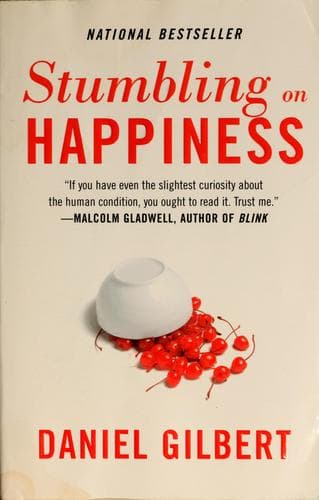
Core Idea
- Gilbert’s central claim is that people are bad at forecasting what will make their future selves happy, so they “stumble” into happiness by making systematic errors in imagination.
- The book is not self-help but a science of prospection: how the mind looks ahead, where foresight fails, and why the failures are lawful rather than random.
- The same brain that excels at anticipating the immediate next moment often misrepresents “later,” and that gap helps explain optimism, bad decisions, and surprise at our own future feelings.
How the Mind Forecasts
- Gilbert distinguishes ordinary nonconscious prediction, or nexting, from human future thinking; nexting is local, immediate, and widely shared by brains and even simple systems.
- Human distinctiveness lies in the ability to imagine events that do not exist yet, a capacity tied strongly to the frontal lobes and vulnerable when they are damaged.
- Frontal-lobe damage can leave basic intelligence intact while producing a “permanent present,” where patients can no longer project themselves into tomorrow.
- People spend a meaningful portion of consciousness thinking about the future, and that thinking can feel pleasurable because anticipation itself is rewarding.
- We often imagine both good and bad futures for instrumental reasons: good futures sustain desire, while bad futures can act as “fearcasts” that motivate precaution.
- The desire for control is a major driver of prospection; perceived control improves well-being, and humans often show an illusion of control over chance events.
Why Forecasts Go Wrong: Realism, Presentism, Rationalization
- Gilbert’s main explanation is that imagination is distorted by three shortcomings: realism, presentism, and rationalization.
- Under realism, the mind fills in missing details so quickly that imagined or remembered scenes feel like direct contact with reality, not reconstruction.
- Memory studies, false-recall experiments, and perceptual illusions like the blind spot show that the brain stores summaries and then reweaves the gaps, making reconstruction feel like retrieval.
- Imagination works the same way: when asked to imagine a future event, people silently invent specific details and then mistake those details for the event’s likely reality.
- This is why people can mispredict parties, jobs, or lives by treating the particular version they imagined as if it were the actual future.
- Presentism means the mind uses the present as a template for the future and has trouble representing how distant events will differ in concrete texture and emotional force.
- Far-future events are represented abstractly, while near-future events are vivid and specific, so people misread the blur of the distant future as the future’s true nature.
- Rationalization is the tendency to reinterpret experiences after the fact so they become more bearable, which means people often overestimate how badly future bad events will feel.
- Trauma, disability, and loss are often less devastating than outsiders expect because the psychological immune system reworks the meaning of events over time.
Happiness Is Subjective, Measurable, and Easy to Misread
- Gilbert insists that happiness is a subjective experience, not an objective fact, and that outside observers cannot reliably judge another person’s happiness from circumstances alone.
- He separates emotional happiness from moral or judgmental uses of the word, arguing that the feeling itself is only accessible from the first-person point of view.
- Because experience is subjective and memory is noisy, the best scientific measure of happiness is repeated self-report from the person experiencing it.
- Physiological measures, facial data, and brain scans may correlate with happiness, but they only become meaningful when anchored to people’s reports.
- Human reports are imperfect, so psychology needs large samples and repeated measurement to recover stable patterns from noisy individual judgments.
- Gilbert uses examples like the Schappell twins, Shackleton’s crew, and people with disabilities to show that circumstances alone do not determine experienced happiness.
- He also shows that people confuse bodily arousal and emotion, and that awareness can come apart from experience, as in blindsight and alexithymia.
How We Judge the Future, and What That Implies
- People misforecast not only because imagination is flawed, but because they rely on it even when better information exists.
- The most accurate forecast of a future feeling is often another person’s current report from the same situation, which Gilbert calls using surrogates.
- In prize, food, and loss studies, surrogation beat imagination because it avoided the three big distortions: filling in, presentism, and rationalization.
- People resist surrogates because they believe they are unusually unique, even though Gilbert argues that emotional lives are more similar than we like to think.
- The mind also “cooks the facts” by selectively gathering, remembering, and weighting evidence to support preferred conclusions.
- This motivated reasoning shows up in self-evaluation, political judgments, and even how much evidence people demand before accepting a favorable or unfavorable diagnosis.
- Gilbert’s broader claim is that beliefs often function as super-replicators: they persist because they support social systems, not because they maximize individual happiness.
- Money and children are his key examples: people chase wealth as if it directly produced happiness despite diminishing returns, and culture praises children even though the data often show lower day-to-day happiness during childrearing.
- The deepest implication is not that people are irrational in a simple sense, but that imagination, self-protection, and social beliefs all bias us toward futures that feel plausible, defensible, or socially rewarded rather than emotionally accurate.
What To Take Away
- Forecasts of happiness are systematically distorted, not merely a little off, because the mind reconstructs the future through the same machinery it uses for memory and perception.
- The biggest errors come from filling in missing details, projecting the present forward, and later revising experience to make it livable.
- Happiness is real but subjective, so it is best studied through repeated first-person reports rather than outside intuition.
- When trying to predict feelings, Gilbert’s main corrective is to distrust imagination’s specialness and pay more attention to actual reports from people who are already living the situation.
Generated with GPT-5.4 Mini · prompt 2026-05-11-v6