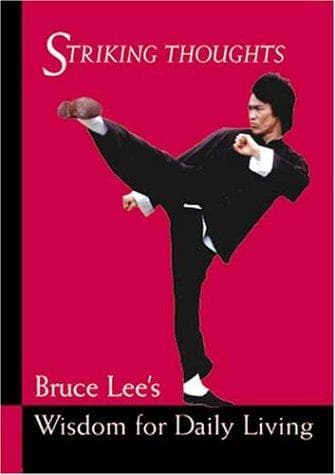
Core Idea
- Bruce Lee treats martial art as a path to self-knowledge, not merely technique, and argues that real freedom comes from liberating the spirit from conditioning, imitation, and blind obedience.
- His central target is the gap between living reality and second-hand living: people waste energy maintaining images, copying styles, and relying on external authority instead of becoming actual, self-directing human beings.
- The book’s ethic is simple but demanding: know yourself, be sincere, act in the present, and use only what is truly your own.
Self-Knowledge Over Image
- Lee distinguishes self-actualization from self-image actualization: one develops real potential, the other only polishes a facade.
- The Mirror Person is trapped by how he appears to others, whereas the real person is grounded in inward truth rather than public projection.
- Imitation is a symptom of insecurity; Lee repeatedly warns that people trust what they copy more than what they originate.
- The core question is not how to fit a role, but “how can I be me?”
- A person who lives for image becomes mechanical and dependent, while a person who accepts himself becomes capable of change.
- Lee insists on self-reliance: external evaluation, money, status, and even other people’s opinions cannot substitute for inner grounding.
- His formula for self-cultivation is explicit: rectify the heart/mind, be sincere in thought, extend knowledge to the utmost, and investigate things.
- The self-actualized statement is not a theory but a fact of being: “I am what I am here and now.”
How Lee Thinks Learning and Freedom Work
- Lee rejects teaching as dogma; a teacher is only a guide or pointer, and the student must test everything directly.
- The empty tea cup image captures his method: one must empty preconceived opinions before truth can enter.
- Books, systems, styles, and conclusions are not truth themselves; at best they are signposts or staging posts.
- He favors choiceless awareness over narrow concentration: awareness includes what is present without filtering it through conclusions.
- Thinking is useful but limited, because abstract concepts can replace direct seeing; Lee repeatedly urges less theorizing and more immediate perception.
- Reality is presented as isness or suchness, which appears when comparison and conditioning drop away.
- He also stresses monism or interdependence: subject and object, self and world, are not truly separable in lived experience.
Action, Process, and the Present Moment
- The book’s most famous practical claim is that knowing is not enough; we must apply and willing is not enough; we must do.
- Lee treats life as flow rather than fixed structure: like water, one cannot step into the same stream twice, and rigidity means death while pliability means life.
- The Now is the only real time; truth is instantaneous, and freedom lives in present action rather than in yesterday’s patterns or tomorrow’s fantasies.
- Wu-wei is presented not as passivity but as natural, spontaneous action that does not force opposition.
- The model of growth is not mechanical accumulation but living responsiveness in the present, where action and awareness meet.
- Unfinished situations keep much of the past alive in us, so liberation requires seeing what is unresolved and no longer identifying with it.
- Lee’s criticism of conditioning applies broadly: tradition and formal systems become dead when they replace living intelligence.
The Inner Work of Self-Help
- Lee says there is ultimately only self-help: no master can do realization for you, and each person must answer his own questions.
- The path is solitary because satori or awakening cannot be handed over; it must be seen into personally.
- He values sincerity above displays of strength, because sincerity is what finally reveals the Way.
- Mistakes are forgivable when admitted courageously, but evasion, laziness, fear, and self-preoccupation keep people bound.
- He links freedom to accepting one’s nature rather than fighting it, since there is no single right way for every body or temperament.
- Self-knowledge comes through study of oneself in action with others, because relationship reveals what one is.
- Intelligence, in Lee’s strong sense, is not mere cleverness but understanding of self.
What To Take Away
- Do not confuse your image with your being; Lee thinks most suffering comes from performing a self instead of realizing one.
- Use what is useful, reject what is useless, and add what is uniquely your own; that is his standard for growth, art, and learning.
- Act now, sincerely, and without forcing; for Lee, real freedom is not an abstract goal but a quality of present conduct.
- Self-knowledge is the master key: every external problem ultimately points back to how honestly you can see yourself.
Generated with GPT-5.4 Mini · prompt 2026-05-11-v6