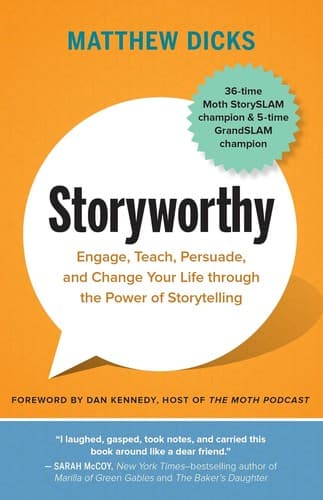
Core Idea
- Storyworthy argues that great storytelling is not about dramatic life events, but about finding the small five-second moment when a person changes.
- Dicks’s central claim is that storytelling builds connection: it helps people teach, persuade, perform, and understand themselves by turning lived experience into a shareable, vulnerable narrative.
- The book insists that story-worthy material is everywhere, but you have to train yourself to notice it through daily attention and repeated practice.
Finding Storyworthy Material
- A true story centers on change: the teller begins as one version of self and ends as another, even if the shift is subtle.
- Dicks rejects lots of material as not really stories: anecdotes, romps, drinking stories, and most vacation stories may be fun, but they usually lack transformation.
- His rule for drinking stories is that they almost always matter less than the teller thinks, and his rule for vacation stories is that only the truly consequential moment is worth telling.
- The storyteller must tell their own story, not merely retell someone else’s; even family-history stories work best when the narrator is the protagonist of the experience.
- Homework for Life is his daily discipline: each day ask, “If I had to tell a story from today, what would it be?” and capture just a sentence or two.
- Homework for Life trains a storytelling lens, revealing moments that were missed in real time, resurfacing old memories, and showing patterns in ordinary life.
- Crash & Burn is a stream-of-consciousness exercise, “dreaming on the end of your pen,” where you keep writing without judging or getting attached to any idea.
- First Last Best Worst is a prompt game that generates stories by scanning memory for firsts, lasts, bests, and worsts across categories like kiss, car, pet, trouble, and injury.
Crafting the Story
- The key to a great story is the five-second moment: a brief instant of realization, decision, forgiveness, despair, or acceptance that changes everything.
- In “Charity Thief,” the real center is not the tire blowout or the scam, but the moment he realizes he knows nothing about loneliness and never wants to.
- Dicks says the story should be shaped around that moment, with everything else cut or compressed if it doesn’t help clarify it.
- To find the beginning, he says to start from the opposite of the ending, since true stories already know their ending and need an opening that creates an arc.
- He warns against stories of people who start great and end great, or pathetic and stay pathetic, because those are not stories but flat character displays.
- The Dinner Test says a stage story should feel like the polished version of something you could plausibly tell a friend at dinner.
- That means avoiding fake dialogue, theatrical gestures, purple prose, and other performance flourishes that make the tale feel unnatural.
- He repeatedly stresses that oral storytelling is more like a river than a written lake: listeners cannot pause, so the story must be simplified and directed with care.
- Good openings should start close to the end and preferably with forward movement; don’t waste time with long setup or lecture-like exposition.
- He gives Thirteen Rules for an Effective Commencement Address, including: don’t praise yourself, don’t ask rhetorical questions, make it about the audience, use one concrete idea, and end early.
- The most useful architecture for a story is but and therefore, not and; causation and opposition create momentum, while simple listing deadens it.
Stakes, Surprise, and Story Tools
- Stories need stakes: what the teller wants, what is at risk, and why the audience should care.
- Dicks offers five tools for raising stakes: Elephant names the obvious problem early, Backpack loads the audience with hopes and fears, Breadcrumbs hint at future events, Hourglasses slow the reveal, and Crystal Balls create plausible false predictions.
- These tools work only if the underlying story already has real tension; they can heighten, but not invent, stakes.
- He also says great storytelling depends on surprise, because surprise is the most reliable way to move an audience emotionally.
- The storyteller should hide the reveal by delaying key information, burying it in clutter, or using humor as camouflage.
- Humor is treated as a form of surprise: the best joke or detail usually belongs at the end of the setup, and exaggeration only works if the audience recognizes it as exaggeration.
- Stories should end on heart, not on a joke; laughs are useful in the middle, but the final note should leave meaning, vulnerability, or connection.
- Dicks argues that big stories are hardest because the dramatic event is rarely the real point; the storyteller must locate the small, universal human moment inside it.
- Examples like the car crash, arrest, robbery, childbirth, and plane crash all work only when they reveal something intimate and relatable, such as friendship becoming family or a parent protecting a child.
- He repeatedly prefers smaller, ordinary stories—regret, embarrassment, household conflict—because they are often easier to tell and just as powerful.
Truth, Memory, and Meaning
- Dicks is explicit that storytellers make permissible alterations for the audience’s benefit, not their own, and should never invent facts that were never there.
- His allowed changes include omission, compression, assumption, progression, and conflation.
- Omission removes distracting material, compression collapses irrelevant time or space, assumption fills in missing but reasonable details, progression reorders events to match emotional logic, and conflation turns a long arc of change into a single dramatic beat.
- He says memory itself is unstable, so stories are true as remembered, even if not perfectly exact.
- Storytelling also helps locate meaning: sometimes a story keeps bothering you until you tell it and realize what it was really about.
- But he insists a story can ultimately be about one thing; if one event means two different things, it may need to become two separate stories.
- The book ends by treating storytelling as a way to understand yourself and connect unexpectedly with others, even reconnecting him with people from his past.
What To Take Away
- Great stories come from ordinary life noticed well, not from having the most dramatic biography.
- The job of the storyteller is to find the five-second moment, then build the whole story to make that instant land.
- Craft matters: simplify, sharpen stakes, preserve surprise, and keep the narrative moving with but/therefore logic.
- Storytelling, at its best, is less about performance than about making strangers feel like family for the length of a story.
Generated with GPT-5.4 Mini · prompt 2026-05-11-v6