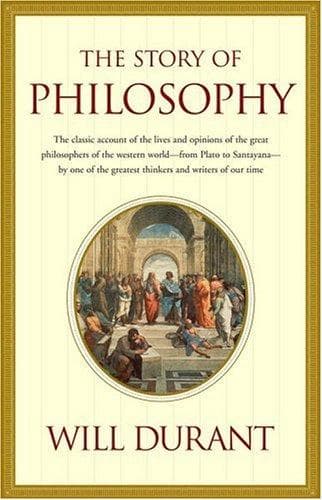
Core Idea
- Durant’s central claim is that philosophy is not an abstract technical game but a synthetic interpretation of human experience: it should clarify life’s meaning, coordinate ends, and give wisdom where science only gives analysis.
- He writes philosophy as a story of great minds, arguing that ideas are best understood through the living personalities, historical pressures, and moral temperaments that shaped them.
- The book also defends the need for outlines: in an age of specialization, philosophy and history must be translated into plain language for the public or they become sterile, scholastic, and disconnected from life.
The Classical Pattern: Plato and Aristotle
- Plato is presented as the first great architect of ideal politics and ideal morality, shaped by Socrates’ death and by his disgust with democracy’s instability and mob rule.
- Socrates becomes the model philosopher: he begins from doubt, shifts thought from nature to man, and asks exact definitions of justice, virtue, patriotism, and the self.
- Plato’s answer is that justice means each part doing its proper work in both soul and state; the soul has desire, emotion, and reason, and the city should mirror that order.
- His ideal state is an aristocracy of merit: philosophers rule, soldiers defend, producers work; women may share guardianship, but power belongs to those trained by long tests of character and intellect.
- Plato’s educational scheme is severe and selective: bodily training, music, philosophical study, and repeated trials sort the few who can rule from the many who cannot.
- Durant stresses that Plato’s Utopia is not mere fantasy: he thinks it anticipates medieval clerical rule, later revolutionary communisms in limited form, and modern ideas about professional selection for office.
- Yet Plato’s state is also deeply static, anti-luxury, anti-commercial, and openly eugenic, with community of wives and children among guardians, breeding controls, and restrictions meant to prevent corruption.
- Aristotle answers Plato by grounding philosophy in observation, classification, and the search for causes; Durant calls him Greece’s “Encyclopedia Britannica.”
- Aristotle creates logic almost single-handedly, defining correct thinking, syllogism, and the method of definition, but Durant says logic often clarifies what is already assumed rather than discovering truth.
- He rejects Plato’s separate Ideas and insists universals are names for kinds, while his own science joins biology, physics, metaphysics, ethics, and politics into one system.
- Aristotle’s biology is vast and often mistaken, yet historically immense: he observes embryology, animal continuity, and the relation of form to function, even if he lacks experiment and modern instruments.
- His metaphysics says each thing is matter seeking form, and every process has an end; God is the unmoved mover, pure actuality, not a Christian creator.
- In ethics Aristotle defines happiness as the full activity of reason, guided by the golden mean; in politics he prefers order, law, and a constitutional middle course supported by a strong middle class.
Modern Philosophy: Method, Unity, and the Mind
- Bacon opens the modern age by attacking scholastic verbalism and calling for a new science built on ordered observation, experiment, and the clearing of the mind’s Idols.
- His Idols of the Tribe, Cave, Market-place, and Theatre name the shared, personal, linguistic, and doctrinal biases that distort inquiry.
- Bacon wants science organized socially and politically: cooperative research, state support, international division of labor, and a governing class of scientists in the spirit of Solomon’s House.
- His greatest philosophical point is that knowledge should increase human power over nature, but his induction is often less fruitful than later hypothesis-driven science.
- Spinoza seeks unity where Descartes found dualism: God and nature are one, all things follow by necessity, and the world is best understood geometrically.
- He interprets religion symbolically, treats Scripture as adapted to ordinary imagination, and insists that miracles are not breaks in nature but pedagogical devices.
- In the Ethics, freedom means not exemption from causation but liberation through understanding; the passions are natural, and virtue is increased power, clear thought, and intellectual love of God.
- His politics favors liberty of thought and speech, but also sees law as the coordination of individual power for the common good.
- Kant tries to save both science and religion after Hume’s skepticism: the mind actively structures experience through space, time, and the categories, so knowledge is certain only within phenomena.
- Kant’s first critique limits theoretical reason; his moral philosophy then bases religion on practical reason, the categorical imperative, duty, and the dignity of persons as ends in themselves.
- His political ideal is cosmopolitan peace: republican government, the restriction of war, and the rejection of imperial conquest disguised as civilization.
- Schopenhauer turns philosophy toward suffering and will: the world is blind striving, art releases us into will-less contemplation, and music most directly expresses the will itself.
- He is pessimistic, ascetic, and biographically severe, but Durant credits him with forcing philosophy to confront evil, instinct, and the psychological roots of thought.
- Nietzsche radicalizes the attack on herd morality: he opposes democracy, pity, Christianity, and egalitarianism in favor of rank, strength, self-overcoming, and the will to power.
- He interprets morality as the conflict of master and slave values, praises instinct over rationalized conscience, and seeks a higher type, the Übermensch, beyond conventional good and evil.
Pragmatism, Religion, and Democratic Growth
- Santayana treats beauty as inward conception, skepticism as a disciplined starting point, and religion as a poetic human interpretation rather than literal fact.
- He is a materialist without metaphysical certainty, denies personal immortality, and prefers a cultured, detached wisdom that “dreams with one eye open.”
- William James defines philosophy as comprehensive thinking, treats consciousness as a stream, and makes truth a matter of practical consequences and verification.
- His pragmatism is pluralistic and anti-absolutist: philosophies reflect temperament, the universe is a multiverse, and belief is sometimes justified by vital and moral need.
- John Dewey turns pragmatism into social method: education should be experiential, democracy experimental, and thought a tool for adjusting life in changing conditions.
- For Dewey, growth is the measure of value; schools, politics, and institutions should be judged by whether they enlarge intelligent participation and future development.
What To Take Away
- Durant’s book is a guided march through philosophy as a history of great personalities wrestling with the same human problems: justice, knowledge, freedom, suffering, God, and the good life.
- The recurring tension is between analysis and synthesis: science dissects, while philosophy tries to restore unity, meaning, and direction.
- Across the whole book, Durant favors philosophers who keep thought connected to life, character, institutions, and history, even when he disagrees with their systems.
- His deepest admiration goes to thinkers who enlarge the human horizon: Plato for ideals, Spinoza for serenity, Kant for limits, James and Dewey for practical intelligence, and all of them for refusing to let knowledge become mere specialization.
Generated with GPT-5.4 Mini · prompt 2026-05-11-v6