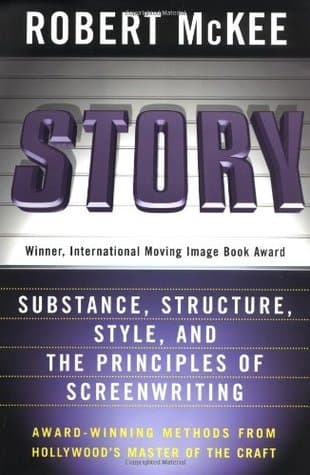
Core Idea
- McKee argues that screenwriting is a craft of principles, not rules: lasting story knowledge can be taught, but not as formulas, trends, or market templates.
- A strong story is an artfully designed chain of events that creates meaningful change, emotional charge, and insight through conflict and turning points.
- The aim is archetypal story: culturally specific in detail, yet grounded in universal human values, risk, and transformation.
Story, Structure, and Meaning
- A story event is a meaningful change in a character’s life, expressed through a value and brought about by conflict.
- McKee’s chain of development is beat → scene → sequence → act → story: actions and reactions create beats, beats build scenes, scenes build sequences, sequences build acts, and acts culminate in the irreversible story climax.
- A true scene must turn its value charge from positive to negative or negative to positive; if nothing changes, it is only exposition or a nonevent.
- The central creative question is often, “What is the opposite of that?” because story energy comes from reversals, surprises, and the gap between expectation and outcome.
- Story is a metaphor for life, not a transcript of life; it abstracts experience into a shaped form that reveals truth more clearly than raw actuality.
- The key engine of story is the gap between what characters expect and what actually happens; from that gap come surprise, insight, and emotional power.
- Characters act on probability, but story reveals necessity when events force unforeseen consequences.
- McKee stresses risk: the protagonist must have something genuinely valuable to lose, or the story has no real pressure.
- The audience is treated as a serious intelligence; good story design creates a conspiracy of interest through empathy, curiosity, and payoff.
Story Forms, Genre, and Character
- McKee’s Story Triangle distinguishes Archplot, Miniplot, and Antiplot as three broad story possibilities.
- Archplot is the classical form: an active protagonist, external conflict, causal continuity, and a closed ending.
- Miniplot reduces classical design and often leans more internal, passive, or open-ended.
- Antiplot reverses or contradicts classical norms through fragmentation, coincidence, inconsistency, or open form.
- He treats genre as a system of creative limitations rather than cages, because conventions help define protagonist, setting, values, and expected turns.
- The book names a wide range of genres and supra-genres, including Love Story, Horror, Modern Epic, Western, War, Maturation, Redemption, Punitive, Testing, Education, Disillusionment, Comedy, Crime, Social Drama, Action/Adventure, plus Historical Drama, Biography, Docudrama, Mockumentary, Musical, Science Fiction, Sports, Fantasy, Animation, and Art Film.
- Genres differ by their dominant values, typical roles, and conflict patterns; for example, Crime depends on point of view, while Comedy is governed by the convention that nobody gets hurt in the audience’s felt experience.
- The writer must know genre well enough to fulfill expectation and then surprise it, not merely repeat it.
Character, Subtext, and Craft
- True character is revealed by choices under pressure; characterization is only the visible surface.
- McKee treats structure and character as inseparable: structure creates pressure, and character choices create structure.
- The protagonist must be complex enough to generate empathy, even if not always likable; empathy matters more than sympathy.
- His “Mind Worm” idea is to burrow into a character’s interior life and then devise the precise event that will drive that character to the limit.
- Subtext is essential because dialogue rarely says exactly what is meant; strong scenes hide or distort emotional truth beneath the spoken text.
- Exposition should be dramatized, not dumped; facts become useful only when turned into ammunition within conflict.
- Backstory is valuable when it arrives at decisive moments and helps trigger major turning points.
- Flashbacks, montage, voice-over, and dream sequences are not automatically wrong, but they are dangerous if they become substitutes for dramatized conflict.
- McKee recommends an inside-out process: research, outline, treatment, then screenplay, rather than drafting dialogue first and trying to force a story around favorite scenes.
- He values ruthless revision: writers should generate far more material than they keep and then discard most of it to preserve what is truest to character, world, and controlling idea.
What To Take Away
- The decisive unit of screenwriting is the turning point, not the line of dialogue.
- Conflict, pressure, and risk are the engine of story; without them, there is no dramatic movement.
- Genre and structure are not limits to originality but tools for shaping expectation so the writer can satisfy and surprise at once.
- Great endings feel inevitable and unexpected: they are surprising in the moment and justified in retrospect.
Generated with GPT-5.4 Mini · prompt 2026-05-11-v6