Core Idea
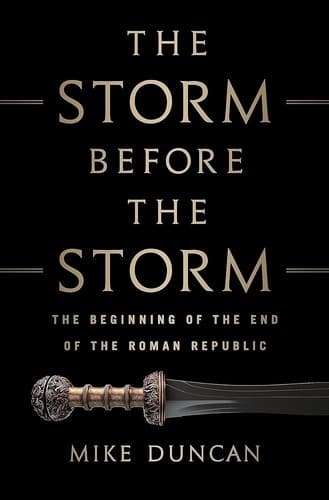
- Duncan argues that the Roman Republic did not suddenly fall to Caesar’s ambition; it decayed over generations, and the real “storm before the storm” was the era of the Gracchi, Marius, and Sulla.
- The key collapse was not a single constitutional failure but the breakdown of mos maiorum—the unwritten norms, restraints, and mutual expectations that had made republican politics workable.
- Rome’s late-Republic crisis looks familiar because it mixed inequality, land loss, military privatization, elite corruption, ethnic resentment, citizenship संघर्ष, and political violence into one self-reinforcing spiral.
How the Republic Broke
- Rome’s expansion produced the conditions for instability: conquest filled the city with wealth and slaves, ruined small farmers through long service, and let nobles convert public land into vast estates.
- The Gracchan crisis began when Tiberius Gracchus tried to restore the small-farmer base with the Lex Agraria, enforcing the 500-iugera limit on ager publicus and redistributing excess land.
- Tiberius deliberately bypassed the Senate and brought the bill directly to the Assembly, breaking custom in the name of necessity; his deposition of tribune Marcus Octavius and later push into finances and foreign policy made the conflict feel like a constitutional emergency.
- His murder in 133 BC was a turning point: it made political killing precedent, and the Senate’s afterward-response punished lower-ranking followers while shielding the elite instigators.
- Gaius Gracchus and his allies broadened the agenda into a durable populares program: grain doles, land reform, equestrian juries, secret ballots, and limits on aristocratic impunity.
- The opposing optimates were not a formal party but a shifting elite coalition defending senatorial control, and the book stresses that the real divide was between oligarchic habit and reformist pressure, not modern party lines.
Marius, Empire, and the Militarization of Politics
- Marius shows how outsiders could use war to bypass aristocratic gatekeeping: as a novus homo, he built status through military command rather than elite oratory or ancestry.
- His career benefited from the crisis in Numidia and then from the panic over the Cimbri, which made repeated commands, emergency exemptions, and conscription reforms politically possible.
- Marius’s recruitment reforms mattered because they shifted Roman armies toward long-service forces tied more closely to commanders than to the old citizen ideal.
- The book treats the famous “Marius’s Mules” image, the eagle standard, and the broader professionalization of the legions as part of that transformation, even while cautioning against over-crediting him for every later reform.
- Marius’s alliance with Saturninus and later willingness to use armed politics normalized tactics such as intimidation, mob violence, and the weaponization of the Assembly.
- The collapse of Saturninus and Glaucia shows that by then violence was no longer exceptional: the Senate repeatedly used emergency decrees, but the state itself was becoming a machine for political murder.
Italy, Asia, Sulla, and the Final Republican Collapse
- Italian citizenship becomes the central fault line in the 90s BC: Italians carried the military burden but remained politically inferior, and every compromise—partial enfranchisement, citizen purges, selective grants—made the issue worse.
- Marcus Livius Drusus tried a grand bargain of land reform, grain relief, jury reform, Senate expansion, and full Italian citizenship, but the package collapsed and his assassination triggered the Social War.
- The Social War turns Rome’s domestic crisis into a war over whether Italy would be ruled as subjects or incorporated as citizens; the rebel slogan was essentially “civitas or libertas.”
- The war’s aftershocks fed directly into the rise of Sulla, whose march on Rome was unprecedented because he crossed the sacred boundary of the Pomerium with armed legions and conquered the city itself.
- Sulla’s rule is presented as both constitutional theater and terror: he claimed to restore the Republic while launching the proscriptions, where confiscation and private revenge made killing profitable and arbitrary.
- His dictatorship rebuilt the state around senatorial supremacy: he weakened the tribunate, expanded the Senate, tightened the cursus honorum, restored senatorial control of the courts, and tried to make the Republic function as an aristocracy again.
- Yet the book’s key judgment is that Sulla proved the deeper lesson of the age: a Roman could seize permanent personal power and still claim to be saving the Republic.
What To Take Away
- The fall of the Republic was a long structural process in which elite refusal to reform turned ordinary political conflict into civil violence.
- The decisive breach was not just law but legitimacy: once Romans began settling disputes by murder, proscriptions, and marching armies on Rome, the old republic was effectively finished.
- Sulla’s settlement did not solve the crisis; it postponed it and demonstrated the feasibility of one-man rule, helping clear the path for Pompey, Crassus, Caesar, and Augustus.
- Duncan’s larger point is that Rome did not die because one man wanted a dictatorship; it died because the Republic had already lost the habits that made republican self-government possible.
Generated with GPT-5.4 Mini · prompt 2026-05-11-v6