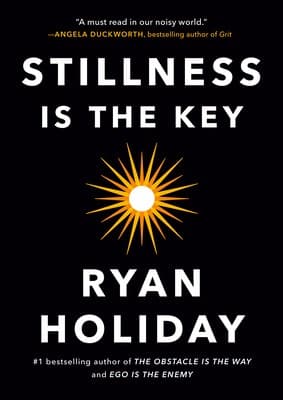
Core Idea
- Stillness is Holiday’s central standard for a good life: the capacity to stay inwardly steady amid noise, pressure, appetite, and change.
- The book argues that elite performance and genuine fulfillment both depend on harmony across mind, spirit, and body, not on achievement alone.
- Stillness is not passivity; it is the condition that makes clear judgment, disciplined action, virtue, and service possible.
Mind: Presence, Clarity, and Self-Mastery
- Holiday’s first major claim is that modern life scatters attention through devices, news, ambition, and rumination, so the first task is to be present.
- He uses Seneca, Kennedy during the Cuban Missile Crisis, and Marina Abramović’s The Artist Is Present to show that concentration and calm can hold under extreme pressure.
- A recurring practice is limit your inputs: Napoleon delayed mail, Eisenhower controlled information flow, and Holiday warns that constant notifications and real-time news create analysis paralysis.
- The book stresses empty the mind and slow down, think deeply rather than forcing outcomes; Shawn Green’s baseball turnaround and Zen archery illustrate that overthinking undermines performance.
- Holiday treats journaling as a tool for externalizing thoughts, self-examination, and objectivity, drawing on Anne Frank, Seneca, and Foucault.
- Silence matters because it reveals what is usually hidden and allows better listening; John Cage’s 4′33″ becomes a symbol of disciplined awareness, not mere emptiness.
- Wisdom comes from humility, questioning, study, and big-picture perspective; Socrates, Tolstoy, mentors, and hard experience matter more than information that only confirms existing beliefs.
- He distinguishes confidence from ego: real confidence is earned, grounded, and calm, while ego is grandiosity mixed with insecurity and leads to overreach.
- The ideal is to let go of outcome fixation; Awa Kenzo’s archery teaching shows that obsession with the result ruins the very performance you seek.
Spirit: Virtue, Enough, and Connection
- In the spiritual domain, Holiday argues that stillness is impossible without moral clarity, healed wounds, and a sense that enough exists.
- Choose virtue is a core principle: virtue reduces internal conflict, gives people something steady under stress, and is available regardless of status or circumstance.
- He warns that unchecked desire—for sex, power, possessions, admiration, or envy—keeps the soul restless; Epicurus’s test is to ask what will happen if you get what you want.
- The book repeatedly returns to enough as an inner state, not an external finish line; Heller and Mill are used to show that accomplishment alone does not cure spiritual poverty.
- Heal the inner child means recognizing how childhood wounds continue shaping adult anxiety, sensitivity, and attachment; Leonardo, Ankiel, Apatow, Thich Nhat Hanh, and Garry Shandling illustrate that old pain needs attention, not denial.
- Holiday also insists on bathe in beauty: nature, quiet, dawn, clouds, and even small moments of stillness can produce a sense of transcendence and relief.
- A further spiritual practice is to accept a higher power; whether framed as God, logos, Dao, Brahman, or another tradition, surrender breaks the fantasy that the self is the center of everything.
- Stillness is expanded through all is one: sympathy, agape, and shared human vulnerability make compassion rational, and others’ joy and suffering are not separate from one’s own.
- He rejects the idea that solitude is the highest state; meaningful relationships are essential, and love gives courage, perspective, and a reason to endure.
- The book’s moral horizon is service: stillness should not end in self-protection but in being more useful, generous, and humane to other people.
Body: Energy, Limits, and Rhythm
- Holiday argues that bodily habits either support or sabotage inner peace, so the body must be trained as carefully as the mind.
- Conservation of energy is a major principle: Churchill’s routines, naps, walks, baths, hobbies, and fixed rhythms show how rest can power sustained greatness.
- The body needs sleep, not as a luxury but as a foundation of judgment, emotional control, and productivity; sleep deprivation is treated as a serious form of self-damage.
- Routines become rituals when repeated sincerely, reducing decision fatigue and freeing attention for meaningful work, whether in religious practice, sport, or disciplined daily life.
- Holiday recommends meaningful hobbies and leisure—painting, walking, fishing, woodwork, language study—not as escape but as restorative activities that replenish the soul.
- He also warns against escapism: travel, substances, overwork, and constant activity can become ways of fleeing the self rather than facing it.
- Seek solitude because clarity and perspective require time away from noise; Gates’s “think week,” Merton’s monastic silence, and Mattis’s call for reflection show solitude as productive rather than antisocial.
- The body chapter includes say no and take a walk as practical disciplines: restraint protects life energy, while walking functions as moving meditation and opens the mind.
- Get rid of your stuff is both literal and symbolic; possessions create maintenance, anxiety, and dependence, while the person should remain master of things.
- Finally, be a human being means avoiding workaholism and honor systems that consume life itself; the goal is a sustainable life, not endless output.
What To Take Away
- Stillness is Holiday’s answer to modern fragmentation: a disciplined inner steadiness that depends on attention, virtue, and bodily care.
- The book’s deepest claim is that calm performance and moral life are the same project, not separate ones.
- Its recurring warning is that anger, ego, appetite, distraction, and overwork all promise motion but produce inner chaos.
- The endpoint is not self-optimization for its own sake, but a life prepared for service, love, and death with less fear and more peace.
Generated with GPT-5.4 Mini · prompt 2026-05-11-v6