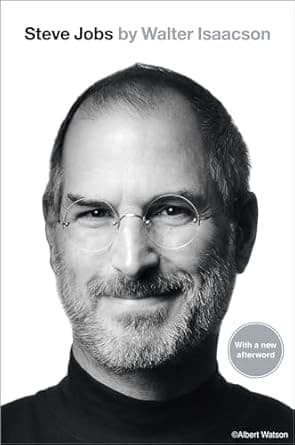
Core Idea
- Walter Isaacson portrays Steve Jobs as a brilliant, abrasive, “roller-coaster” innovator whose personality and products were inseparable.
- The biography argues that Jobs changed multiple industries by combining imagination, engineering, design, and ruthless focus into tightly controlled end-to-end systems.
- The book is both admiring and cautionary: Jobs could inspire extraordinary work, but he also manipulated, humiliated, distorted reality, and harmed people around him.
The Making of Jobs
- Jobs’s adoption, his sense of being chosen and apart, and his intense bond with his practical father Paul Jobs shaped his hunger for control and perfection.
- His childhood mixed precocious curiosity, pranks, boredom in school, and formative teachers who rewarded his abilities rather than forcing conformity.
- Early lessons from Paul Jobs—make even the hidden parts beautiful, understand craftsmanship, and care about what others do not see—became a lifelong design principle.
- Silicon Valley’s culture of engineering, entrepreneurship, and electronics tinkering provided the environment in which Jobs learned to think like a builder and showman.
- Reed College, Zen Buddhism, LSD, vegetarianism, and later spiritual searching all fed Jobs’s belief that intuition and simplicity mattered more than conventional authority.
- His relationship with Steve Wozniak was decisive: Woz was the engineering genius, while Jobs supplied product sense, salesmanship, and business ambition.
- The Blue Box scam and later Apple projects showed their working formula: Woz solved the technical problem, Jobs turned it into a product and a venture.
Apple, Control, and the “Reality Distortion Field”
- Jobs learned at Apple that computers had to be sold as complete experiences, not hobbyist parts: integrated hardware, software, case, keyboard, packaging, and presentation.
- Mike Markkula and Regis McKenna taught him marketing discipline, especially the idea that people judge quality from the signals a company sends.
- The “reality distortion field” described Jobs’s ability to make others believe the impossible was doable; it could be inspiring, but it also enabled denial and overreach.
- Jobs’s management style was famously binary: people and ideas were often either gods or shitheads, and “adequate” was treated almost as a moral failure.
- The Mac team absorbed his pressure, and many engineers improved under it, but the process was often abusive and fear-based.
- Jobs’s defining instinct was for integrated “whole widgets”: he rejected openness when it threatened user experience, compatibility, or control.
- That instinct shaped the Macintosh, then later NeXT, Pixar, the iPod, the iPhone, the iPad, and iCloud.
The Great Product Revolutions
- The Apple II succeeded because Wozniak’s circuitry was turned by Jobs into a consumer product with polished industrial design and a marketable identity.
- The Macintosh made the graphical user interface mainstream, drawing inspiration from Xerox PARC but simplifying and improving it for ordinary users.
- Jobs connected design to typography, icons, fonts, and packaging; the Reed calligraphy course mattered because it helped make the Mac’s text look humane instead of merely functional.
- Jobs’s belief that hidden details matter extended from circuit boards to boxes to manufacturing lines, all of which he wanted to be beautiful.
- The iMac returned Apple to its core aesthetic: an approachable, colorful all-in-one machine that looked like “it just arrived on your desktop.”
- The iPod worked because Jobs paired a beautiful device with iTunes and the iTunes Store, making music management simple while keeping control inside Apple’s system.
- The iPhone and later the iPad extended the same logic: screen-first devices, careful integration, and an ecosystem in which Apple controlled the whole user experience.
- The App Store was the key strategic move that made the iPhone/iPad model scale, while also letting Apple curate and police what could run on its devices.
Conflict, Rivalry, and Legacy
- Jobs’s life is marked by recurring conflict with Bill Gates, John Sculley, Michael Eisner, Google/Android, Adobe, and Apple’s own engineers, usually over openness versus integration.
- He saw Android as a theft-ridden threat to the iPhone model and responded with legal, strategic, and rhetorical “thermonuclear war.”
- He attacked Flash and other cross-platform tools because he believed they produced weaker experiences and made platforms generic.
- His battles with Microsoft, Xerox, and others show the book’s central tension: Jobs could borrow ideas boldly, but he insisted that execution and refinement were what made products transformative.
- Pixar gave Jobs a second empire and a more humane creative home, where he learned to let artists lead while he handled dealmaking and leverage.
- His return to Apple in 1997 was a restoration story: he cut products, rejected clutter, focused the company, and rebuilt it around a small number of great devices.
- Jony Ive became Jobs’s most important design partner, and their shared obsession with simplicity, materials, and manufacturing produced Apple’s most influential late-career products.
- The book ends by arguing that Jobs’s real legacy was not just products but a philosophy of tight integration, aesthetic seriousness, and control over the whole experience.
What To Take Away
- Jobs’s genius lay in turning technology into desirable, legible, emotionally resonant products.
- His greatest strength was also his flaw: the same drive for control that made Apple’s products coherent also made him harsh, manipulative, and often wrong in human terms.
- Isaacson’s larger claim is that the modern digital age was shaped by the battle between open systems and integrated systems, and Jobs was the most consequential champion of the latter.
- The biography presents Jobs as a maker who built enduring companies by insisting that design, hardware, software, content, and retail all belong to one experience.
Generated with GPT-5.4 Mini · prompt 2026-05-11-v6