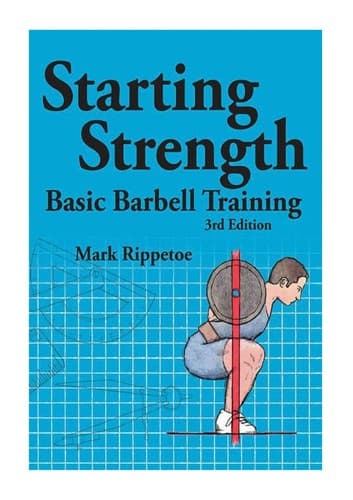
Core Idea
- Strength is the central physical adaptation because humans are built for a physically demanding environment, even if modern life is sedentary.
- The book argues that barbell training best restores functional strength because it trains the body as an integrated system, under gravity, with transferable movement patterns.
- The whole method is built around a few lifts, taught with mechanics, anatomy, and repeatable technique rather than machines, folklore, or “feel.”
The Big Lifts and Why They Matter
- The squat is the foundational lower-body lift and the best overall exercise in the weight room because it trains the posterior chain—glutes, hamstrings, adductors—while also driving skeletal loading, coordination, and conditioning.
- Rippetoe strongly favors the low-bar back squat over front squats, partial squats, and machine leg work because it recruits more muscle mass, uses a better hip moment arm, and transfers strength better.
- Correct squatting means below parallel, knees shoved out, bar over mid-foot, controlled descent, and a powerful ascent driven by hip drive from the bottom.
- The book treats many squat problems as mechanical chain reactions: stance, bar position, depth, gaze, and trunk rigidity all affect the whole lift.
- The deadlift is the best lift for raw lower-back strength and learning rigid spinal support under load, but it is harder to recover from and easier to do badly than the squat.
- Deadlifting is taught as a precise sequence: stance, grip, bring shins to bar, set the chest and back, then pull the bar straight up while keeping it close to the legs.
- The deadlift is analyzed as a lever system; the bar should stay over mid-foot, the arms stay straight, and the back must hold a fixed position while the hips and knees extend.
- The press is the most useful upper-body lift because it moves force from the ground through the trunk to the bar, making it more athletic than the bench press.
- A proper press is a standing overhead lift with a strict vertical finish, a slight lean-back-to-get-the-bar-past-the-face, and a return of the torso under the bar so the lockout ends over mid-foot.
- The bench press is still valuable as the biggest raw upper-body strength builder, but it is less transferable than the press and can overemphasize the front of the shoulder if not balanced by overhead work.
- The bench is taught as a full-body brace: feet drive into the floor, the upper back stays tight on the bench, the bar touches the sternum, and the path is controlled rather than simply vertical.
- The power clean is the book’s best power exercise: it is basically a jump with the bar in the hands, teaching explosive force production that carries over to sport.
- The clean and its snatch variant are taught from the top down: rack, hang, then floor, with the key rule that the bar must touch the thighs and the arms must stay straight until the jump.
How the Book Explains Technique
- The constant technical standard across lifts is the same: keep the bar and body system balanced so the bar moves in the most efficient vertical path over mid-foot.
- “Good technique” is defined less by aesthetics than by balance, lever arms, and work against gravity.
- The book repeatedly uses moment arm logic: the farther the bar drifts from mid-foot, the more wasted force and the greater the spinal or joint stress.
- The author treats the Valsalva maneuver as essential for heavy lifts because bracing with held breath raises intra-abdominal and thoracic pressure and stiffens the trunk.
- Belts are recommended not as a crutch but as a way to improve trunk rigidity and feedback for stronger abdominal contraction.
- The squat, deadlift, press, and bench are all taught as lifts where the bar should be on the body’s “stack”: feet, hips, trunk, shoulders, and bar arranged so force transfers efficiently.
- The book is very skeptical of machines, Smith machines, leg press sleds, and isolation work because they limit natural movement, reduce specificity, and often encourage meaningless load numbers.
- Supportive gear such as squat suits, wraps, and special bench gear belongs to competition contexts, not general strength training.
- For technique learning, the author favors short cues like “chest up,” “knees out,” “drag the bar up your legs,” or “keep the bar vertical” over long explanations in the gym.
Programming, Assistance Work, and Recovery
- Programming follows the principle that the body adapts to the hardest recoverable stress, not just accumulated exercise, so training must progressively increase load in a planned way.
- The book’s novice model is simple: train the main lifts frequently, add weight whenever possible, and keep the program small enough that recovery is not overwhelmed.
- The most important programming idea is linear progression: beginners can get stronger every session because they start far below their adaptive capacity.
- As lifters advance, progression slows and programming must become more complex, with more careful management of volume, intensity, and exercise variation.
- Assistance work is useful only if it directly supports the main lifts; the book prefers partials, variants, and targeted ancillary lifts that build specific weak points.
- Examples include halting deadlifts, rack pulls, Romanian deadlifts, good mornings, front squats, chin-ups, dips, rows, back extensions, and glute-ham raises.
- The author distinguishes productive assistance from junk volume: if an exercise does not improve strength, power, or usable muscle mass, it is probably a poor use of recovery.
- He also emphasizes diet and bodyweight as part of training, arguing that novices often need to gain mass to keep getting stronger.
What To Take Away
- Train the fundamentals hard and simply: squat, press, deadlift, bench, and power clean cover most of what the book thinks matters.
- Technique exists to serve force transfer: the key question is not whether a lift looks stylish, but whether the bar stays balanced and the body stays rigid.
- Strength is specific and cumulative: get stronger in the exact patterns you want to improve, then add assistance only when the main lifts stop advancing.
- The book’s deepest claim is that barbell training is the most efficient way to build useful human strength because it matches anatomy, physics, and adaptation.
Generated with GPT-5.4 Mini · prompt 2026-05-11-v6