Core Idea
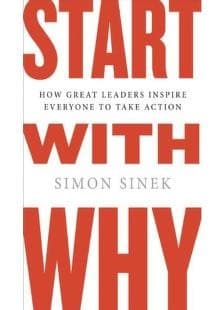
- The book’s central claim is that great leaders and organizations start with WHY—their purpose, cause, or belief—before explaining HOW they do it or WHAT they do.
- People do not truly follow ranks, products, or incentives; they follow leaders and brands that inspire them, because inspiration creates trust, loyalty, and belonging.
- Sinek argues that manipulating behavior can produce transactions, but only a clear WHY creates lasting commitment, resilience, and influence.
Why Starting With Why Matters
- Sinek contrasts inspiration with manipulation: discounts, promotions, fear, novelty, peer pressure, and aspirational messaging can drive short-term sales, but they do not build loyalty.
- Manipulation is fragile because it forces companies to keep inventing tactics, while inspiration gives customers and employees a reason to choose you even when alternatives are cheaper or flashier.
- The book’s recurring warning is that many businesses know WHAT they do, some know HOW, but very few know WHY they exist; once a company loses that clarity, price and features become the only visible differentiators.
- The Wright brothers and Langley illustrate the difference: Langley had money, status, and talent, but the Wright brothers had belief and commitment, and that inspired persistence.
- Apple is the book’s model of a company that communicates from the inside out: “We believe in challenging the status quo” is stronger than “We make great computers.”
- The same logic appears in Martin Luther King Jr., whose “I Have a Dream” speech gave people a shared belief and destination, not a detailed operational plan.
- The author’s point is that leaders should win hearts first, then minds; people often rationalize decisions after they already “feel right.”
The Golden Circle, Trust, and Belonging
- Sinek’s main framework is the Golden Circle: WHAT you do, HOW you do it, and WHY you do it, with inspiring leaders communicating from the center outward.
- WHY lives in the limbic brain, which drives feelings, trust, and decision-making; WHAT maps to the neocortex, which handles language and rational explanation.
- This is why people often cannot clearly explain why they chose a product, employer, or cause: the real decision was emotional first, then rationalized afterward.
- The book uses this to explain why market research can mislead and why customers often ask for the wrong thing, like Henry Ford’s “faster horse” idea.
- Trust is presented as the transference of values: people trust organizations that visibly act on a shared belief, not ones that merely claim competence.
- Strong cultures form when people feel they belong to a group whose values match their own; The Sneetches and the Mac/PC ads illustrate identity as much as utility.
- Symbols matter only when they consistently express a belief system, as with Harley-Davidson, Apple, the flag, or military insignia.
Culture, Leadership, and the Danger of Success
- Continental Airlines shows that turnaround starts with culture: Gordon Bethune concluded the company was “a crummy place to work,” and he fixed trust before expecting good service.
- Herb Kelleher’s ordering—employees first, customers second, shareholders third—is presented as the right logic because treated-right employees treat customers well, which ultimately benefits shareholders.
- Leadership is not the same as position; real leaders are followed voluntarily because people believe they have the group’s best interests at heart.
- The book repeatedly argues that the hardest challenge for an organization is success, because growth makes it easier to confuse a company’s WHY with its HOW or WHAT.
- WalMart is the cautionary tale: Sam Walton’s original belief was people-first and community-minded, but after him the company drifted toward cheapness, efficiency, and margin obsession.
- Similar “split” stories appear in Microsoft, Starbucks, Dell, AOL, and others: as scale increases, the original cause can blur and the company starts managing outputs instead of living its purpose.
- Sinek’s School Bus Test asks whether the organization would survive if the founder disappeared; if not, the WHY has not been embedded in the culture.
- Succession works when the next leader believes in the same cause, not when they simply bring strong management skills.
Diffusion, Decision-Making, and Living the WHY
- The Law of Diffusion of Innovations says new ideas spread through innovators, early adopters, early majority, late majority, and laggards.
- Sinek argues that the first two groups buy because the product matches who they are; the middle of the curve follows only after trust has been established through social proof.
- This is why mass appeal without a clear WHY fails: TiVo and Sirius/XM had products, PR, and features, but not enough belief-driven momentum to tip the market.
- By contrast, Apple and the civil rights movement succeeded because they spoke to people who already shared the underlying belief and gave them words and symbols for it.
- The book’s practical filter is the Celery Test: if a decision does not fit your WHY, don’t force it just because it looks attractive or profitable.
- That logic applies to brands as well as products: Disney, Southwest, and Costco are praised because their actions consistently reinforce their stated beliefs.
- Sinek’s final personal example is that he discovered his own WHY—to inspire people to do the things that inspire them—and says clarity of purpose changed his work without changing who he was.
What To Take Away
- Start with WHY if you want loyalty, not just transactions.
- Treat WHAT and HOW as proof of belief, not substitutes for it.
- Build culture, hiring, and succession around shared values, or growth will dilute the cause.
- The book’s deepest claim is that people are moved most reliably by meaning, belonging, and trust—not by logic alone.
Generated with GPT-5.4 Mini · prompt 2026-05-11-v6