Core Idea
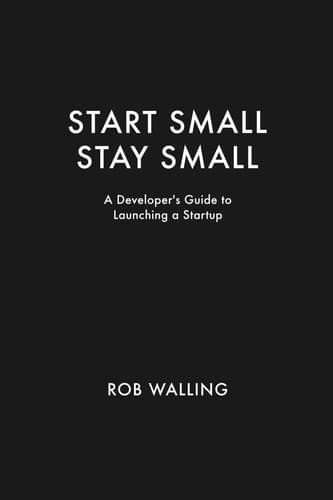
- The book argues that most developers should build self-funded, niche software businesses rather than chase venture capital, because the common path to a durable startup is finding a real market, selling into it, and growing from profit.
- Walling’s central mantra is “Product Last. Marketing First.”: the biggest failure mode is not weak code, but building something nobody wants and then discovering too late that the market, pricing, and traffic plan do not work.
- The ideal reader is a technical founder who values control, location independence, and lifestyle flexibility more than swinging for a venture-scale exit.
The Self-Funded Mindset
- Walling separates micropreneurs from bootstrappers: micropreneurs want no employees, while bootstrappers may build a small team, but both share the same core startup steps for most of the journey.
- He rejects the idea that VC is the “real” startup path and warns that outside funding pushes founders toward huge markets that are far harder to get right because of competition, ad costs, SEO battles, and product complexity.
- A small niche can be enough; he argues that a market around $10k/month in revenue can support a business, and later growth can come from expanding outward.
- He frames entrepreneurship as more than coding: the founder is a blend of developer, webmaster, and marketer, and basic web skills matter because the sales site is constantly changing.
- Starting for the wrong reasons—“having an idea,” wanting to get rich, or because entrepreneurship sounds fun—usually leads to disappointment; you need written goals and a willingness to pay the price of success.
- The hardest period is the dip: the gap between the excitement of launch and the point where software leverage and recurring revenue make the work feel worth it.
- Developers are drawn to entrepreneurship because salary and consulting eventually cap out, while a product creates equity; Walling uses the rent-vs-buy analogy to stress that ownership matters.
How He Evaluates Markets, Niches, and Products
- The book’s core planning frame is the Product Success Triangle: product, market, and execution all matter, but product quality alone is only one-third of the equation.
- He insists on Market First thinking: verify that a group of people will pay before building, because the common mistake is product-first enthusiasm without demand.
- Niches are a major advantage because they reduce competition, increase pricing power, and make customer knowledge and word-of-mouth much easier.
- He prefers vertical markets over horizontals because verticals have more similar needs, better-defined hangout places, and clearer messaging; generic tools are usually weaker than tools for, say, landscape architects or therapists.
- He advises looking for a warm niche connected to your work or hobbies, but also notes that under-the-radar niches often emerge from doing things rather than brainstorming keywords.
- To sanity-check a niche, he looks for whether it is large enough and reachable cheaply; a magazine devoted to the niche, with a full-page ad under $5,000, is one rough sign of a real segmented market.
- He recommends measuring demand with search data, conversion rates, and traffic sources, and using tools like Google AdWords Keyword Tool, SEO Logs, Micro Niche Finder, and sometimes SEOmoz.
- His rough conversion ranges depend on price: low-priced products may convert around 1%–4%, while higher-priced or recurring products may convert around 0.5%–2%.
- He suggests testing ideas for under $100 using AdWords and a Mini Sales Site rather than building full software first.
- The mini site is usually just a few pages—Home, Tour, Pricing, and sign-up—used to test interest, not to close every sale immediately.
Sales, Traffic, Outsourcing, and Launch Mechanics
- Walling treats the website as a funnel: see URL → visit → prospect → buyer, and most users drop off at each stage.
- The site’s first job is usually to get an email address, because first-visit sales are rare and email lets you build trust, relevance, and reward over time.
- Strong sales sites are simple: one primary call to action per page, minimal distraction, skimmable headlines and bullets, obvious buttons, and a few core pages such as Home, Tour, Testimonials, Contact, and Pricing.
- He says testimonials are mandatory, the contact page should build trust, and the pricing page should make the next step obvious, often with a free trial or money-back guarantee.
- Email is treated as the most durable marketing channel; he recommends permission-based lists, double opt-in, clear subject lines, one goal per email, and a sequence of lead magnets such as a useful PDF or a free email course.
- For launch, he favors building an audience months ahead of time, then mailing the list with a timed offer and reminder; targeted lists can convert dramatically better than cold traffic.
- He distinguishes Top Shelf traffic—mailing list, blog/podcast/video, and organic search—from Second Shelf tactics like PPC, social media, forums, guest posts, affiliates, and press; ads are best used to test, not to build a whole business.
- SEO is presented as a long game built on on-page work plus quality links; he emphasizes relevant, aged links and warns against spammy link farms and other bad neighborhoods.
- Virtual assistants and drip outsourcing are major leverage points: founders should outsource repetitive, well-specified tasks early, because it can save dozens of hours a month and raise the founder’s effective hourly rate.
- He prefers to outsource before automating when the task is noncritical, using humans for research, admin, support, link building, HTML tweaks, and other processable work.
What To Take Away
- Build only after you know there is a reachable market, and prefer narrow, identifiable niches over broad “big opportunity” fantasies.
- Treat launch as a combination of market validation, sales-page design, email capture, and traffic acquisition, not just coding.
- Use small tests—mini sites, AdWords, and lead capture—to reduce risk before investing heavily in development.
- Optimize for profit and low maintenance, because that makes the business better for you now and also increases its value if you later automate it or sell it.
Generated with GPT-5.4 Mini · prompt 2026-05-11-v6