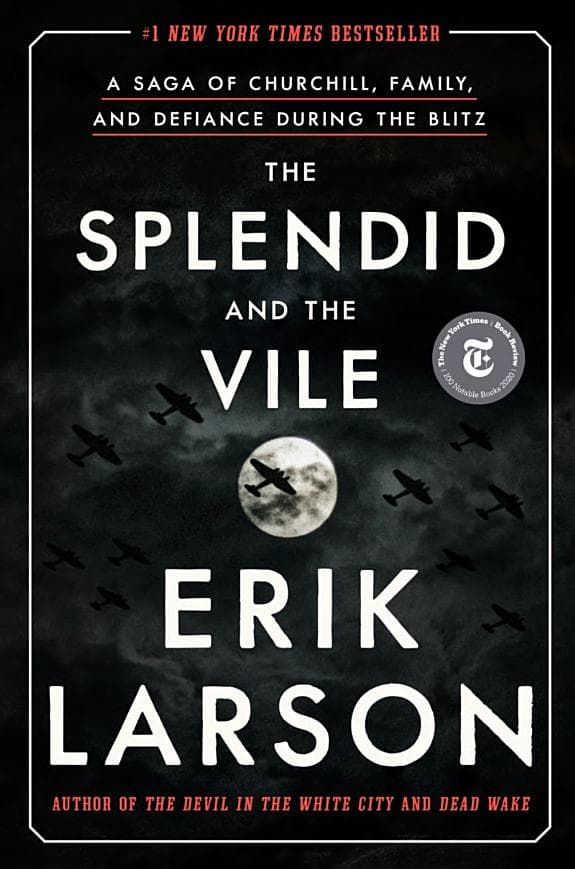
Core Idea
- Larson tells the story of Churchill’s first year as prime minister as an intimate, document-based chronicle of Britain surviving the Blitz, not as a full biography.
- The book’s central tension is between catastrophic public war and vivid private life: Churchill’s cabinet work, his family’s turmoil, and London civilians’ daily adaptation to bombing.
- Larson argues that Churchill’s power lay not just in strategy, but in his ability to focus fear into resolve, using performance, language, and urgency to keep Britain fighting.
Churchill’s Leadership Under Pressure
- Churchill takes office on May 10, 1940 as France collapses, immediately believing Britain cannot win without eventual U.S. support.
- He reshapes Whitehall around speed and command, issuing terse “minutes,” demanding one-page memoranda, and appointing himself minister of defense.
- His working style is theatrical and relentless: he runs government from bed, bath, and multiple offices, with whiskey, cigars, dispatch boxes, and little concern for decorum.
- The “Secret Circle” around him—especially Hastings Ismay and Frederick Lindemann—helps translate science, intelligence, and military complexity into action Churchill can use.
- Churchill’s famous speeches, including “blood, toil, tears and sweat” and “we shall fight on the beaches,” are presented as morale weapons as much as policy statements.
- He is repeatedly shown making hard, emotional choices, especially the attack on the French fleet at Mers el-Kébir, which he saw as necessary to keep ships from German hands.
- Publicly, that decision and later his Commons performances help cement his standing; privately, he is shaken by the moral cost and by the burden of being alone.
The Blitz as a System of Fear, Science, and Improvisation
- Larson treats the Blitz as a contest of technology, information, and nerves: air-raid planning, blackouts, invasion alerts, and civilian sheltering all become part of national survival.
- Britain fears invasion so intensely that officials plan trenches, gas defense, hidden defenses, and even discuss suicide, poison capsules, and evacuation routes.
- Intelligence breakthroughs matter: Dr. Reginald V. Jones and others uncover German beam-navigation systems such as Knickebein and X-Verfahren, and Churchill pushes immediate countermeasures.
- The book emphasizes how science and bureaucracy interact; code-named responses like “Headache” and “Aspirin” show the improvisational logic of wartime counterintelligence.
- German bombing tactics evolve from terror raids to precision-guided destruction, using pathfinder aircraft to mark targets and exploit moonlight, weather, and beam systems.
- The London raids are rendered through eyewitness detail—dust, cordite, collapsing masonry, red skies, improvised shelters, and the uncanny normality of people continuing to work, dance, or dine.
- Coventry becomes the defining example of modern aerial catastrophe: massive destruction, cathedral ruin, civilian deaths, and the later term “coventration.”
Family, Home Front, and the Private Wartime World
- Larson makes the Churchill household part of the war story: Clementine, Mary, Randolph, Pamela, and the wider social circle are not side notes but essential witnesses.
- Clementine is portrayed as fiercely intelligent and politically unsparing, often correcting Churchill’s temperament and pushing him toward restraint, kindness, and shelter reform.
- Mary Churchill’s diary shows the Blitz home front as a mix of danger, parties, work, and attraction to RAF life; she becomes an important lens on wartime youth and social looseness.
- Randolph is depicted as charismatic but self-destructive—drinking, gambling, debt, sexual recklessness, and public embarrassment all complicate Churchill’s private life.
- Pamela Churchill is shown as socially adept and independent, eventually drawn into a relationship with Averell Harriman as wartime marriages and loyalties fray.
- Larson uses these domestic scenes to show that war does not erase ordinary desires; it intensifies them, especially around sex, intimacy, boredom, and the wish not to be alone.
- London’s hotels, shelters, dances, and rooftop raids reveal a city improvising normal life inside catastrophe, sometimes with gallows humor and sometimes with genuine courage.
- Civilian morale is not romanticized: the book includes fear, fatigue, rumor, blackouts, ugly shelters, and the psychological strain of living under constant threat.
Roosevelt, America, and Britain’s Dependence
- A major through-line is Churchill’s insistence that America is essential; he repeatedly tries to pull Roosevelt toward deeper support while Britain stands alone.
- The book follows the diplomatic machinery of this effort through cables, envoys, and figures like Lord Lothian, Harry Hopkins, and Averell Harriman.
- Roosevelt’s eventual move toward Lend-Lease is framed as decisive, but not easy; Churchill continually pushes for ships, aircraft, and practical aid rather than sentiment.
- Churchill’s speeches to Americans stress endurance and shared purpose, while American reluctance and internal politics delay action.
- Larson presents Churchill’s relationship with Roosevelt and Hopkins as personal as well as strategic, with trust built through private talk, travel, and symbolic gestures.
- By the end of the first year, Britain’s survival is inseparable from the emerging Anglo-American partnership.
What To Take Away
- Churchill’s first year in office is portrayed as a test of whether character, language, and improvisation can hold a nation together under bombardment.
- The book’s distinctive strength is its fusion of grand strategy with domestic and sensory detail, making wartime leadership feel lived rather than abstract.
- Larson’s evidence base matters: he leans on diaries, cables, minutes, and eyewitness accounts to reconstruct both decisions and atmosphere.
- The larger lesson is not simple hero worship, but the uneasy mix of courage, vanity, exhaustion, calculation, and moral compromise required to survive 1940–41.
Generated with GPT-5.4 Mini · prompt 2026-05-11-v6