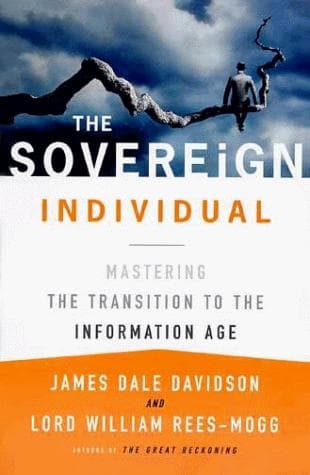
Core Idea
- The book’s central claim is that the Information Revolution will overturn the nationstate by changing the logic of violence, taxation, and economic organization.
- As wealth, work, and communication become deterritorialized, power shifts from governments to Sovereign Individuals who can earn, store, and move value across borders and into cyberspace.
- The authors treat this as a civilizational transition comparable to the shift from feudalism to industrial society, but faster, more disruptive, and likely to produce backlash, crime, and institutional decay.
How Sovereignty Changes
- The authors’ method is megapolitics: history is shaped by hidden variables such as topography, climate, microbes, and technology, which alter who can monopolize violence.
- In their view, the modern nationstate rose because gunpowder, industrial scale, and mass taxation made large coercive systems effective.
- The Information Age reverses that advantage because small, mobile, encrypted, networked actors can protect assets more cheaply than territorial governments can extort them.
- Cyberspace is the key new frontier: unlike land, it cannot be monopolized in the old way, so sovereignty becomes commercialized rather than purely political.
- The book contrasts territorial monopoly with competitive sovereignty, using march regions, Andorra, and the Hanseatic League as historical analogues for overlapping or semi-sovereign arrangements.
- Government, in this framework, is often a protection racket: it both protects and threatens, and its pricing power depends on monopoly.
- Once monopoly weakens, protection becomes a market good, and people will shop for jurisdictions the way they shop for insurance or services.
From Nationstate to Cyber-Economy
- The authors argue that the nationstate’s fiscal base will erode as capital, labor, and transactions move across borders and into private digital systems.
- They predict a large fall in the state’s taxing power, with smaller jurisdictions, enclaves, and city-states outperforming large continental states.
- Cybermoney is central to this shift: private digital money is described as anonymous, divisible, hard to counterfeit, and resistant to inflationary overissue.
- If money can be moved instantly and privately, governments lose one of their main tools for extracting wealth through inflation and capital controls.
- The authors expect a transition period of higher real interest rates, credit contraction, and debt liquidation as old financial systems adjust.
- The cybereconomy is presented as a three-stage process: ordinary internet commerce, advanced online services within state jurisdiction, and then true cybercommerce beyond effective state control.
- Lower communication costs, satellite networks, encryption, and digital credentials are expected to make borders much less relevant to commerce.
- The result should be global jurisdictional competition, where states must attract productive people and capital with lower taxes, better rules, and stronger protection.
- They repeatedly frame this as exit replacing voice: the wealthy and skilled will leave, relocate, or route transactions around coercive states rather than reform them politically.
Social Consequences and Backlash
- The book expects the Information Age to produce a sharper divide between an information aristocracy and an information poor underclass.
- The top tier will be highly educated, mobile, and globally employable; the bottom will include many people whose skills and literacy do not fit the new economy.
- As with earlier transitions, the authors predict backlash from those who lose status, especially middle-skill workers in rich countries and beneficiaries of redistribution.
- They call this reaction moral anachronism when industrial-era moral expectations are applied to information-era conditions.
- Nationalism is treated as a fading but dangerous response, rooted in kin-selection instincts and state propaganda that casts citizens as a kind of family.
- The authors expect anti-globalization, anti-immigration, and anti-technology politics, plus sabotage or violence from neo-Luddites and other displaced groups.
- They also predict that the state itself may respond coercively with censorship, sabotage, arbitrary forfeiture, and other desperate measures as its control weakens.
Institutions, Morality, and the Future Order
- The book argues that democracy and the welfare state were historically useful because they helped mass states mobilize resources during the Industrial Age.
- But once returns to violence fall and mobility rises, mass democracy becomes a costly mechanism that redistributes wealth while failing to protect it efficiently.
- They expect many industrial-era institutions—large firms, mass politics, national languages, and centralized bureaucracies—to be downsized or reorganized.
- The virtual corporation is their model for business in the new age: decentralized, networked, and built to minimize transaction costs rather than maximize hierarchy.
- They also anticipate changes in morality: strong societies need a shared core morality of trust, honesty, hard work, and restraint, but old mass moral systems will fragment.
- Technology increases the value of reputation, trust, and encryption, because theft, fraud, and extortion become harder to reverse in networked systems.
- Their long-run picture is not world government but a patchwork of fragmented sovereignties, private treaties, and commercially governed communities.
- The book’s deepest claim is that people will increasingly define themselves less as citizens and more as customers, contractors, and residents by choice.
What To Take Away
- The book’s big thesis is that information technology weakens territorial states by making wealth more mobile, protection more privatizable, and coercion less efficient.
- Its preferred future is not anarchic collapse but a world of competing mini-sovereignties and cyber-enabled exit.
- The authors see the transition as economically liberating but socially volatile, with crime, nationalism, and state overreaction as the main dangers.
- Whether one accepts their predictions or not, the book is a sweeping argument that the key political unit of the industrial age—the nationstate—is historically contingent, not permanent.
Generated with GPT-5.4 Mini · prompt 2026-05-11-v6