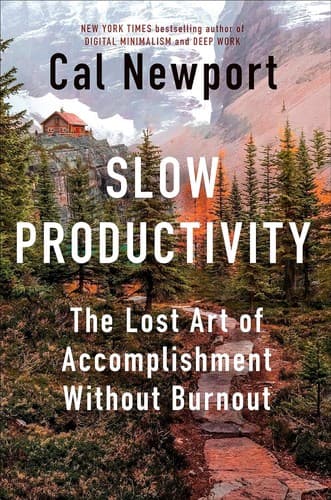
Core Idea
- Newport argues that knowledge workers have been trapped by pseudo-productivity: the habit of using visible activity—emails, meetings, fast replies, long hours—as a proxy for real accomplishment.
- His alternative, slow productivity, is a philosophy for organizing knowledge work in a sustainable, meaningful way, built on three principles: do fewer things, work at a natural pace, and obsess over quality.
- The book’s central claim is not that ambition should shrink, but that important work is often best done with less busyness, more space, and a time horizon measured in years rather than days.
Why Modern Work Breaks
- Newport contrasts knowledge work with farming or manufacturing: cognitive work is variable, collaborative, and hard to measure, so organizations default to judging effort by what is visible rather than what is produced.
- He traces pseudo-productivity to the modern office stack of email, Slack, laptops, and smartphones, which made busyness easy to display and hard to escape.
- The result is a culture of endless coordination, meetings, and task switching, where workers often feel overloaded before they are actually doing meaningful work.
- He argues this system intensified burnout, especially when work and home blurred during the pandemic, leaving workers exhausted and families forced to absorb the cost privately.
- The book is not just a critique of speed; Newport uses Slow Food as the model for a reform that offers a humane alternative instead of merely improving the existing system.
Principle 1: Do Fewer Things
- “Do fewer things” means reducing commitments until they can be handled with time to spare, then concentrating on the few projects that matter most.
- Newport’s key mechanism is the overhead tax: every new project creates emails, meetings, coordination, tracking, and mental load that consume time away from core work.
- He argues that fewer simultaneous commitments can produce both more output and better output because they reduce fragmentation and administrative drag.
- The principle is shown through examples like Jane Austen, whose best writing came when domestic obligations lessened at Chawton, and through modern readers who earned the same or more while narrowing scope.
- Newport recommends limiting work at three scales: missions (ongoing professional directions), projects (multi-session initiatives), and daily goals.
- He advises limit the big by keeping mission count low, tracking project count, and avoiding adding work when no calendar space can be found.
- He also emphasizes contain the small by taming the “productive termites” of minor tasks that erode deep work.
- Practical containment tools include fixed routines for recurring tasks, batching communication, replacing endless back-and-forth with office hours or docket-clearing meetings, and designing processes that make other people do more of the initiation work.
- His simulated pull system uses a holding tank, a small active list, clear intake procedures, and weekly list cleaning so new work enters only when capacity opens.
- Newport also argues for avoiding task engines—projects that generate endless follow-up—even when they look attractive on the surface.
- Another lever is spend money: outsourcing operations, software, accounting, legal work, and similar drudgery can buy mental space for higher-value work, as in Jenny Blake’s deliberate use of many subscriptions.
Principle 2: Work at a Natural Pace
- Newport insists that meaningful knowledge work should often be judged on a yearly or multi-year timescale, not on the fast scale of days and weeks.
- He uses historical scientists—Copernicus, Brahe, Galileo, Newton, and Marie Curie—to show that major breakthroughs often emerged from uneven, slow, and contemplative rhythms rather than constant intensity.
- Anthropological evidence reinforces the point: hunter-gatherer life contained more leisure and variation than agriculture or factory labor, which were increasingly continuous and monotonous.
- Newport’s claim is that knowledge work has become an invisible factory, with pseudo-productivity extending work into evenings, weekends, and vacations without the labor protections industrial workers eventually won.
- To restore a natural pace, he recommends take longer by allowing projects to unfold over years, and warns that the line between slow development and procrastination is thin.
- He suggests make a five-year plan and double your project timelines to counter chronic underestimation of cognitive work and reduce panic.
- He also advises simplify your workday by cutting daily tasks and meetings, including the “one for you, one for me” rule: if you add a meeting, protect equivalent time for yourself.
- Natural pace does not mean zero urgency; it means bursts of intensity should be followed by troughs, not maintained as a permanent state.
- Newport’s seasonal examples—Georgia O’Keeffe, Ian Fleming, Jenny Blake, Basecamp-style cycles, no-meeting days, matinees, and cooldowns—are all attempts to reintroduce variation into work.
- The point of seasonality is not to copy a rural life exactly, but to make modern knowledge work feel more human by alternating intensity, recovery, and protected space.
What To Take Away
- Newport’s target is not productivity itself, but a broken definition of it that rewards visible effort over real accomplishment.
- The book’s strongest practical insight is that overcommitment, not laziness, is often the enemy of serious work.
- Slow productivity asks workers with some autonomy to trade constant responsiveness for fewer commitments, better pacing, and higher-quality outputs.
- Its deepest promise is not merely working less, but building a work life where meaningful accomplishments can emerge without burnout.
Generated with GPT-5.4 Mini · prompt 2026-05-11-v6