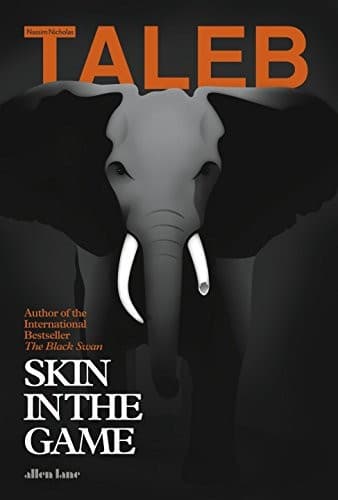
Core Idea
- Taleb’s central claim is that skin in the game means being exposed to downside, not merely having a “stake,” and that this is essential for fairness, reliability, learning, and survival.
- His recurring target is asymmetry: people who get upside while shifting losses, risks, or embarrassment onto others create fragile systems, bad knowledge, and moral corruption.
- The book argues that reality, not theory or credentials, is the final judge; systems improve when actors must personally absorb consequences.
Hidden Asymmetries, Knowledge, and Rationality
- Taleb contrasts real-world knowledge with detached expertise: like Antaeus, people lose contact with reality when lifted away from consequences, and pathemata mathemata captures learning through pain.
- He attacks top-down policy and “intellectualism” because they ignore second-order effects, feedback loops, and higher-dimensional interactions, as in regime-change interventions that produce disasters like Libya’s slave markets.
- Bureaucracy is a major culprit because it separates decision-makers from consequences, while decentralized systems and local accountability keep feedback closer to action.
- His recurring example is the Bob Rubin trade: bankers keep gains, socialize losses, and then invoke uncertainty after the blowup.
- He prefers legal liability and torts over rigid regulation, since rules are gameable and often create new predation by the state and its allies.
- Rationality is defined non-psychologically: what survives is rational, and what threatens collective survival is irrational.
- He treats via negativa as a core principle: systems learn by removing the fragile, and evolution itself requires exposure to extinction risk.
- He insists that skin in the game should not be applied mechanically to harmless opinions; the target is professionals who can harm others without paying for it.
Transactions, Morality, and Minority Rule
- A major theme is that advice, sales, and disclosure are often ethically mixed up: “good for you” advice is frequently good for the adviser, and selling disguised as advice is dishonest.
- In a fair transaction, neither side should have certainty while the other bears uncertainty; Taleb treats gharar as “inequality of uncertainty.”
- He uses Rav Safra and the “turtle” proverb to stress that one should be willing to consume what one offers, literally or morally.
- Moral rules are often scale-dependent: what works in a tribe, city, or bounded community does not automatically generalize to humanity at large.
- His account of the commons follows Elinor Ostrom: shared resources can be self-governed when the group is small enough to behave like a club.
- The Silver Rule is his reciprocity norm: treat others as they treat you, especially in bounded communities.
- The minority rule is one of the book’s most important mechanisms: a small intransigent minority can impose its preference on a flexible majority when accommodation is cheap.
- He illustrates this with kosher/halal food, peanut allergies, disabled bathrooms, language spread, and religion’s tendency to be shaped by the most committed or intolerant branches.
- This is why Taleb distrusts simplistic political labels and aggregate averages: collective outcomes are often driven by vetoes, not means.
- He extends the same asymmetry logic to markets and science, where a few motivated actors can move prices or overturn beliefs disproportionately.
Skin in the Game as Social, Occupational, and Spiritual Discipline
- Taleb distinguishes workers, practitioners, artisans, and owner-operators from people whose role is mainly to manage, comment, or cash out.
- He is suspicious of contractors and financiers who can defect opportunistically; employees are often more dependable because they have reputation loss, job loss, and other downside.
- The old company man had strong identity and commitment, whereas modern “companies persons” are optimized for employability rather than loyalty or depth.
- He praises visible commitment: scars, defects, and even bluntness can signal reality better than polished professional surfaces.
- The IYI (“Intellectual Yet Idiot”) is his satirical label for credentialed elites who mistake jargon and status for competence and have been wrong on major issues from Iraq to GMOs to financial theory.
- He criticizes academia as a self-referential publishing game and prefers primary sources, doers, craftsmen, and people who have actually lived the problems they discuss.
- His ideal of soul in the game appears in artisanship, writing, and honor: quality comes from existential commitment, not industrialized output.
- He also treats religion through this lens: faith without sacrifice is cheap, while fasting, ritual, and suffering are forms of commitment that make belief real.
- Christianity, Judaism, Islam, and related traditions are discussed as systems where sacrifice, law, ritual, and action matter more than mere declarations.
- He repeatedly contrasts belief in words with belief in actions, arguing that deeds reveal the real relationship to a creed or principle.
- His ergodic warning is that averages and ensembles hide ruin: a person exposed repeatedly to risk can be ruined even when the average outcome looks fine.
- This leads to his final standard of rationality: one may be risk-loving, but must be absolutely averse to ruin; survival comes before elegance, theory, or narrative.
What To Take Away
- Skin in the game is Taleb’s master test for ethics, expertise, and institutional design: if you can impose costs without bearing them, the system is suspect.
- Many of his sharpest examples—banking, bureaucracy, medicine, journalism, academia, and policy intervention—show how modern life systematically removes responsibility from decision-makers.
- The book’s deepest contrast is between real exposure and symbolic competence: reality punishes the former less than the latter, but only the former reliably teaches.
- Taleb’s bottom line is blunt: no virtue, trust, or knowledge without exposure to consequence.
Generated with GPT-5.4 Mini · prompt 2026-05-11-v6