Core Idea
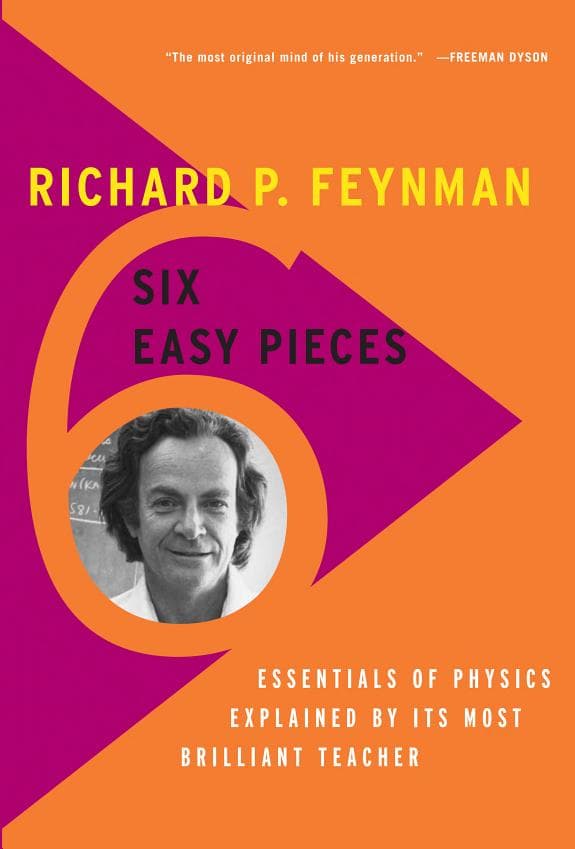
- Six Easy Pieces is Feynman’s compact introduction to physics as a way of seeing the world through a few deep, testable laws that explain enormous complexity.
- The book’s distinctive claim is that physics is both radically unified and necessarily approximate: laws are simple in form, but their consequences range from atoms and chemistry to stars, gravity, and life.
- Feynman’s method is to use intuition, measurement, and careful examples to show what is known, what is uncertain, and where classical ideas break down.
Physics, Matter, and the Atomic Hypothesis
- The opening “atomic hypothesis” says that all matter is made of atoms in constant motion, attracting at moderate distances and repelling when crowded.
- Feynman uses water, ice, steam, and salt to show that solids, liquids, and gases differ by how atoms/molecules are arranged and how freely they move.
- Heating increases atomic motion, causing expansion and sometimes phase change; cooling or pressure changes can reverse the balance.
- Water’s odd behavior, including shrinking when ice melts and helium’s refusal to freeze at low pressure, shows that everyday substances can be exceptions to simple rules.
- Chemical change differs from physical change because atoms change partners; combustion, dissolution, and crystallization are all dynamic rearrangements, not one-way transformations.
- Brownian motion and x-ray crystal studies are presented as direct evidence that atoms are real, not just a convenient idea.
- Feynman extends the atomic view to biology: living things are not “merely” atoms, but their behavior still ultimately comes from atoms obeying physical law.
What Physics Explains, and Where It Stops
- Physics is defined as the search for a small set of elemental rules behind a complicated world, much like learning the rules of chess rather than predicting every move.
- Science differs from speculation because experiment is the sole judge; theory’s job is to guess general laws from experimental hints.
- Classical physics explained motion, heat, sound, pressure, and chemistry in atomic terms, but it assumed particles moving in space and time with definite positions and velocities.
- Electromagnetism replaces invisible short-range “chemical” forces with electric charge, fields, and magnetism; electric interactions are enormously stronger than gravity.
- Quantum mechanics overturns classical certainty: at atomic scales one cannot know both position and momentum exactly, and individual events cannot be predicted, only probabilities.
- Feynman presents QED as the great success for ordinary matter outside gravity and the nucleus, explaining electricity, magnetism, chemistry, light, and antimatter.
- Nuclear physics remains incomplete: the strong force is real and much stronger than chemistry, but its detailed law is still unknown, even though particles like pions helped organize the “subatomic zoo.”
- The book repeatedly stresses that laws are approximate and revisable; even familiar ideas like constant mass or exact classical trajectories fail in the right regimes.
The Reach of Physics Across the Sciences
- Feynman treats physics as the most fundamental science because chemistry, statistical mechanics, and much of biology reduce in principle to atomic behavior.
- Statistical mechanics bridges microscopic jiggling atoms and macroscopic heat, pressure, and thermodynamics.
- Biology is shown in physical terms through nerve impulses, acetylcholine release, muscle contraction, enzymes, proteins, and DNA.
- DNA is the “blueprint” because its complementary strands can separate and copy themselves; the great unsolved problem is how the genetic code specifies protein sequence.
- Isotope labeling made biochemistry tractable because chemical behavior depends mainly on electrons, not nuclear mass.
- Astronomy is also physics: spectral lines show that stars contain the same atoms as Earth, and stellar energy comes from nuclear fusion turning hydrogen into helium.
- The elements in our bodies were “cooked” in stars, so biology and chemistry depend on cosmic history as well as local law.
- Geology and meteorology obey physics but remain difficult because of instability, turbulence, and the extreme conditions inside Earth.
- Feynman contrasts physics with fields that ask how things got to be the way they are; biology, geology, and astronomy have historical dimensions that physics usually does not.
Gravity and the Quantum Break
- Newton’s law of gravitation is presented as one of the mind’s greatest generalizations: every mass attracts every other mass with an inverse-square force.
- Feynman traces its discovery through Tycho, Kepler, and Newton, showing how accurate measurement, ellipses, and inertia led to universal gravitation.
- The law explains orbits, tides, the roundness of planets, double stars, globular clusters, galaxies, and even helped determine Earth’s mass through Cavendish’s torsion-balance experiment.
- Einstein refines Newton by requiring that gravity not act instantaneously and by showing that energy also gravitates, including the bending of light by the sun.
- Gravity remains conceptually mysterious because no accepted mechanism explains it in terms of deeper forces, and a quantum theory of gravity is still unfinished.
- The quantum chapter distills the central paradox with the double-slit experiment: bullets add probabilities, waves add amplitudes, and electrons behave like particles at detection but like waves in distribution.
- If one can determine which hole an electron used, the interference pattern disappears; if not, one must not claim a definite unseen path.
- The rule is not philosophical decoration but an operational fact: distinguishable alternatives add probabilities, indistinguishable alternatives add amplitudes.
- The uncertainty principle is the practical limit that protects this behavior; any attempt to measure the path precisely enough destroys the interference that would reveal it.
What To Take Away
- Physics works by compression: many phenomena reduce to a few laws, but those laws produce rich and often surprising behavior.
- The deepest divide in the book is between classical certainty and quantum probability, with measurement playing an active role in what can be meaningfully said.
- Feynman’s strongest unifying theme is that nature is one continuous whole: atoms, life, stars, weather, and gravity are all connected by physical law.
- The book’s recurring caution is that success in physics means knowing both what is explained and what remains open.
Generated with GPT-5.4 Mini · prompt 2026-05-11-v6