Core Idea
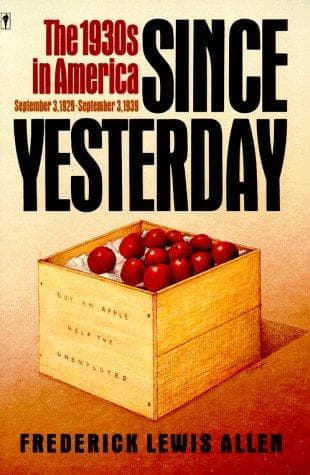
- Allen’s central purpose is to narrate the United States from the peak of Coolidge-Hoover prosperity into the Depression, New Deal, and approach to war, showing how suddenly and contingently the country changed after September 1929.
- He treats the 1930s as more than a downturn: the decade exposed deeper structural shifts in capitalism, public power, labor, agriculture, mass culture, and world order.
- The book’s recurring argument is that Americans moved from faith in private prosperity and frontier-style expansion to a new reality of government management, organized mass politics, and chronic insecurity.
From Crash to Depression: How the Old Order Failed
- Allen begins at September 3, 1929, the high point of the bull market, to emphasize how prosperous and self-confident the country still looked before the crash.
- The stock collapse of October 1929 destroyed about $30 billion in wealth, shattered credit, cut consumption, and ended the inflationary momentum that had kept industry roaring.
- Hoover’s response—tax cuts, public-works encouragement, and reassurance that conditions were “fundamentally sound”—proved politically and economically inadequate once the damage spread across jobs, farming, and banking.
- Allen argues that the Depression was not just a normal cycle but the result of larger forces: industrialization, population growth, imperial expansion, resource depletion, global interdependence, and the limits of endless credit-fueled growth.
- Early 1930s public attention often missed the real crisis; Prohibition, crime, and other moral issues still dominated elite concern while unemployment was still being underestimated.
- Prohibition appears as a major symbol of social strain: speakeasies, bootlegging, bathtub gin, and gangster violence made the law look hypocritical and unworkable, and the Wickersham Commission exposed the confusion behind enforcement.
- Depression culture included odd diversions and fads, such as miniature golf, Amos ’n’ Andy, Bobby Jones, and tree-sitting, which Allen uses to show a society trying to distract itself.
- Hoover’s political failure deepened because he helped banks and corporations but resisted direct relief, clinging to “rugged individualism” and local self-help even as distress became national.
- The crisis became visible in breadlines, Hoovervilles, transients, evictions, servants dismissed from wealthy homes, and middle-class embarrassment, showing that the Depression reached far beyond the poorest Americans.
- The Bonus Expeditionary Force and farm blockades signaled growing militancy; Hoover’s use of troops and tear gas against veterans became a symbol of official insensitivity.
- Rural protest, barter, share-the-wealth ideas, anti-bank sentiment, and Technocracy revealed how badly faith in old economic arrangements had broken down.
The New Deal: Recovery, Relief, Reform, and Its Contradictions
- Roosevelt’s rise is presented as politically organized and historically contingent, with his 1932 acceptance speech introducing the phrase “new deal” and the promise of action.
- In 1933 Washington became a laboratory of improvisation, crowded with plans, lobbyists, agencies, and emergency legislation.
- Roosevelt’s first decisive move was gold embargo and devaluation, which Allen treats as one of the few proven tools for general recovery because it raised prices and revived confidence.
- The early New Deal bundled together many disparate programs: AAA, CCC, TVA, banking reform, securities regulation, debt refinancing, federal relief, and NRA codes.
- Allen sees TVA as the most revolutionary early measure because it put the federal government directly into regional development and industry.
- The NRA embodied the era’s confusion and ambition at once: shorter hours, higher wages, planning, self-government, and business discipline were all attached to the same banner.
- Hugh Johnson became the public face of recovery, and the Blue Eagle campaign turned economic policy into patriotic theater.
- The New Deal’s deepest ambiguity was that deflationary and inflationary impulses, scarcity and abundance, regulation and stimulus all coexisted.
- Federal relief under CWA and WPA rested on a humane principle: unemployed people were to be treated as citizens, not paupers, and put to useful work, even if the system was messy, politicized, and costly.
- Allen’s judgment is that pump-priming worked better than austerity, but public spending never solved the underlying employment problem in a labor-saving economy.
- As the years passed, the New Deal drew attacks from all sides: business feared it was anti-profit, radicals thought it too cautious, and the Supreme Court struck down key measures including the NRA and AAA.
- Roosevelt’s court-packing plan backfired because it looked disingenuous and because the Court suddenly began upholding New Deal laws, making the fight seem unnecessary and politically damaging.
- The 1937–38 recession showed how fragile recovery remained; Allen blames a mix of inventory correction, premature budget balancing, and reduced government spending.
Politics, Culture, and the New America
- Allen argues that Roosevelt’s greatest political asset was that he seemed to respect ordinary Americans, especially relief recipients, who voted for him as a government they trusted rather than merely as a source of money.
- The anti-Roosevelt backlash among wealthy Americans was, in Allen’s view, both emotionally exaggerated and economically self-defeating, turning Roosevelt into a scapegoat for all post-1933 change.
- The 1936 election pitted Roosevelt’s “economic royalists” against Alfred Landon’s respectable but uninspiring moderation; Roosevelt won a huge landslide because his coalition fused relief, loyalty, and popular confidence.
- Much of the book’s middle and late sections show a new social consciousness in literature, art, photography, music, and broadcasting, where Depression America became a subject worth representing directly.
- Works like Tobacco Road, Pins and Needles, It Can’t Happen Here, and The Grapes of Wrath illustrate the turn toward class, labor, waste, and social criticism.
- Photography and reporting by Bourke-White, Dorothea Lange, and Walker Evans helped make poverty and hardship visible as serious art.
- Swing music and the rise of mass radio culture expanded taste while also showing how deeply the nation still craved entertainment, glamour, and escape.
- Hollywood, especially through Disney and the censorship regime, offered an aspirational fantasy world of wealth and comfort that often obscured the real America.
- Allen insists that mass culture showed America had not become proletarian-minded; the old Horatio Alger faith in mobility and glamour still survived.
Labor, Business Power, and the Limits of Recovery
- The 1937 labor wave, especially the Flint sit-down strike, marked a major CIO breakthrough and revealed the new power of industrial unionism.
- U.S. Steel made peace with labor while Little Steel resisted violently, showing how uneven corporate reactions were to the new labor order.
- Roosevelt’s labor gains and social reforms were real, but recovery remained constrained by the power of large corporate “principalities” such as GM, AT&T, U.S. Steel, du Pont, and General Electric.
- Allen argues that private investment lagged because these giant firms already dominated the economy, leaving little room for new enterprise and making Wall Street less central than before.
- The late 1930s left the country with more permanent federal power, more economic planning, and less confidence in easy mobility, even as unemployment remained high and relief became a standing feature of government.
What To Take Away
- The book’s big theme is that the 1930s remade America by exposing the limits of laissez-faire prosperity and forcing a larger federal role.
- Allen sees Roosevelt as both pragmatic improvisor and symbolic leader: not a master planner, but the president who gave a frightened country action and confidence.
- The New Deal did not end insecurity, but it changed the rules of political expectation, making direct relief, regulation, and federal responsibility normal.
- By the eve of war, the nation had moved from speculative optimism to a harsher, more managed, and more conscious modern America.
Generated with GPT-5.4 Mini · prompt 2026-05-11-v6