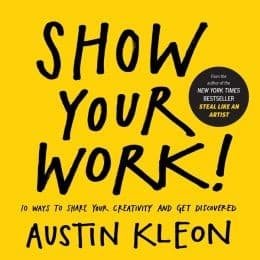
Core Idea
- Creativity is a way of operating, not a rare gift, and work becomes discoverable when sharing is built into the way you already make things.
- The book’s anti-schmoozing version of self-promotion is simple: make your process visible, so people who are already looking can find your work, follow your progress, and trust your voice.
- Kleon’s deepest advice is to keep making, keep sharing, keep learning in public, and keep your own home base online so your work can accumulate over time.
Scenius, Amateurism, and Finding Your Voice
- Kleon rejects the lone genius myth and replaces it with scenius: creative value emerges from scenes, networks, and ecologies where people copy, support, critique, and contribute to each other.
- In a scenius, what matters is not prestige but what you add: ideas, connections, conversation, and generosity.
- He treats the amateur as an asset rather than an insult, because amateurs work from love, take risks, and keep a beginner’s mind open to possibilities experts may miss.
- The book argues that in a fast-changing world, everyone needs some amateur spirit, because not knowing exactly what you are doing can enable experimentation instead of shame.
- “Find your voice” is reframed as use your voice: talk about what you love, and your voice will emerge through practice.
- Roger Ebert’s post-surgery blogging is a key example: after losing his spoken voice, he kept communicating online, and his writing became his real voice.
Showing the Work: Process, Daily Dispatches, and Stock vs. Flow
- The main practical distinction is process vs. product: finished work is only part of the story, while sharing the making creates a stronger bond with an audience.
- If your work is hard to photograph or package, document it with journals, scrapbooks, photos, video, voice notes, and other traces of invisible labor.
- Kleon recommends a daily dispatch: once a day, share one small piece of what you are working on, such as an influence, method, work-in-progress, finished piece, or story about progress.
- Social media is best used to answer “What are you working on?” rather than to perform feelings or generic life updates.
- He warns not to let sharing replace doing, and suggests imposing a time limit if needed before returning to the work itself.
- A central distinction is flow vs. stock: flow is the stream of posts that keeps you present, while stock is durable work that remains useful and discoverable over time.
- The best stock often comes from revisiting and expanding your flow, since repeated themes and patterns can become larger, more enduring work.
- A blog or personal site can function as a sketchbook, studio, gallery, storefront, and salon, letting small posts accumulate into a longer body of work.
Curate, Storytell, Teach, and Avoid “Human Spam”
- Sharing is not only broadcasting your own output; it also means sharing your cabinet of curiosities—the books, records, sites, images, and odd objects that shape your taste.
- Taste is part of identity, and your influences may reveal who you are as clearly as polished finished work.
- Kleon urges people to share what they genuinely like without fake coolness or “guilty pleasure” posturing.
- If you share others’ work, attribution is mandatory: name the source, give context, and provide links when possible.
- Stories create value because objects and ideas become more meaningful when you explain where they came from, how they were made, and why they matter.
- Good storytelling can be simple structure: beginning-middle-end, a character-wants-something arc, or a Pixar-style “Once upon a time…” sequence.
- When asked “What do you do?”, a good answer should be plain, truthful, brief, and audience-aware rather than inflated with adjectives or mystique.
- Teaching what you know does not diminish your value; it can amplify it by helping others and turning your expertise into a form of free education in return.
- The anti-model is human spam: people who only push themselves, do not listen, and treat communities as extraction machines.
- The opposite is being an open node: be a fan first, be useful, give credit, notice others, and connect people and ideas.
Money, Criticism, and Staying Power
- Kleon rejects the romanticized starving artist pose, insisting that creative work has always needed money and that earning money is not automatically a moral failure.
- “Sell out” is treated as a lazy insult; the real question is whether a financial opportunity helps you do more of the work you want to do or pulls you away from it.
- If you have built an audience, you can ask for support through tips, crowdfunding, paid work, products, or services, but only after earning trust.
- Email is one of the most durable tools because it reaches people directly in their inbox, so permission-based mailing lists matter.
- Success creates obligation: if luck, attention, or platform has helped you, use it to support teachers, peers, and newer people.
- Public criticism is part of the job, so the book advises breathing, taking many punches, and remembering that your work is not your whole self.
- Trolls and nasty comments should not be fed; sometimes the best response is to block, delete, or turn off comments.
- Long-term creative life depends on sticking around, often by beginning the next project before the current one has fully faded.
- Kleon calls this chain-smoking: keep momentum by lighting the next project with the end of the last one.
- Periodic sabbaticals and ordinary breaks matter too, because stepping away can restore attention and generate future ideas.
- The ending emphasis is not mastery but beginning again: when you outgrow one path, become an amateur in a new one and show that process too.
What To Take Away
- Show your work is not a marketing trick but a creative ethic: make in public, document the path, and let people follow the trail.
- A durable personal site matters because platforms change, while a home base lets flow accumulate into stock over time.
- Credit, curate, and teach are core practices, not side duties, because they build trust, signal taste, and create reciprocal relationships.
- The book’s practical ideal is to be generous but selective: support others, ignore noise, and keep enough momentum to make the next thing.
Generated with GPT-5.4 Mini · prompt 2026-05-11-v6