Core Idea
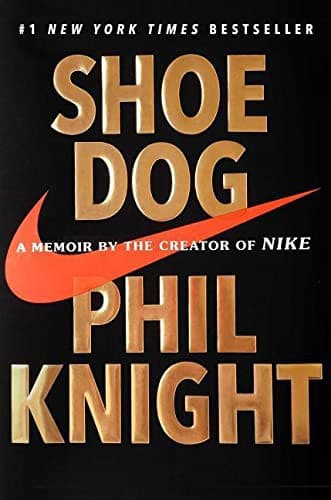
- Shoe Dog is Phil Knight’s memoir of building Blue Ribbon Sports into Nike, told as a story of obsession, improvisation, near-failure, and the need to make work feel like play and calling rather than mere success.
- Knight frames his life around the Crazy Idea: pursue the unconventional path, keep moving, and accept that building something meaningful is messy, risky, and often irrational-looking from the outside.
- The book’s stakes are not just business growth but identity: Knight is searching for freedom from respectability, a way to create, and a life that feels larger than money or status.
Building the Business
- The company begins with Knight’s conviction that Japanese running shoes could disrupt the U.S. market, much as Japanese cameras disrupted German dominance.
- His first pitch to Onitsuka in Japan succeeds because he presents Blue Ribbon Sports as a serious U.S. distribution opportunity, and the Japanese executives surprise him by asking whether he will represent them.
- The early business runs on improvisation: shoes arrive in cellophane instead of boxes, sales come from the trunk of a car, and the first office is a shabby, cold room near the Pink Bucket bar.
- Knight learns that he is better at selling shoes than encyclopedias or securities because he actually believes in running and in the product.
- Bowerman becomes the company’s crucial partner, demanding better performance, experimenting constantly, and eventually taking a 50-50 stake that becomes 51-49 so Knight retains operating control.
- Blue Ribbon grows through track meets, word-of-mouth, mail order, and the enthusiasm of salesmen like Jeff Johnson, whose obsessive letters and runner’s zeal make him both exhausting and invaluable.
- The company’s culture is intensely personal: family loans, improvised financing, favors, and trust often matter more than formal systems.
Japan, Truth, and the Fight for Survival
- Knight’s repeated trips to Japan deepen his understanding of the country’s mix of history, austerity, business etiquette, and spiritual seriousness, while also keeping the wartime past in view.
- He gradually realizes that Japanese business requires indirectness, patience, and reading between the lines, even as he often blunders into negotiations with American bluntness.
- The relationship with Onitsuka turns volatile when the company tries to control or replace Blue Ribbon, forcing Knight into years of precarious brinkmanship.
- Knight repeatedly lies, stalls, or withholds information to survive, but he also makes truthfulness part of the company’s identity; in later legal and sales battles, customers and judges respond to Blue Ribbon’s reputation for telling the truth.
- The break with Onitsuka becomes the opening for Nike’s own identity: once the old contract collapses, Knight sees that the company can stop selling someone else’s brand and compete on its own terms.
- The Nike name, the orange boxes, the lowercase branding, and the swoosh become part of a new story that customers buy into even before the shoes are perfect.
- A crucial creative high comes when Knight names models himself—Cortez, Marathon, Blazer, Bruin, Wimbledon, Forest Hill—and feels, “We made this.”
People Who Make the Company
- Penny Parks Knight is not a background figure but a central stabilizing force: she types, books, stocks, budgets, handles mail orders, and eventually becomes the emotional and practical center of the household and business.
- Their courtship and marriage are quiet, shy, and worklike; Knight treats marriage as a true partnership rather than a separate domestic sphere.
- Woodell becomes a model of toughness, loyalty, and one-task-at-a-time discipline, even after a devastating accident leaves him in a wheelchair.
- Johnson evolves from idealistic runner to relentless salesman and negotiator, and his conflicts with Knight show how much the company depends on strong personalities that do not always fit neatly together.
- Strasser emerges later as a crucial lawyer and dealmaker, valued because he can fight hard without losing sight of the company’s real needs.
- Knight keeps returning to Bowerman’s approval, his father’s respectability, and his mother’s quiet support, showing how family pressures and validations shape the business as much as capital does.
Product, Myth, and the Cost of Growth
- Nike’s breakthroughs are partly technical, like Bowerman’s waffle sole and Rudy’s air shoe concept, but Knight argues that design gains matter because they are tied to a larger runner’s myth and a culture of striving.
- The company’s most important product advantage is not perfection but willingness to experiment publicly, fail, recall, revise, and keep going.
- The brand gains power through athletes, especially Steve Prefontaine, whose swagger and total commitment Knight treats as central to Nike’s identity.
- The company’s growth is repeatedly threatened by cash shortages, bank cancellations, customs bills, credit squeezes, and the constant need to finance inventory before sales arrive.
- Knight survives by juggling banks, trading companies like Nissho Iwai, manufacturing shifts to Japan, Taiwan, Korea, Puerto Rico, and domestic factories, and by making uncomfortable tradeoffs about control versus survival.
- Major crises—the ASP customs fight, the FBI inquiry, the loss of credit, and the push to go public—reveal that Nike’s rise is not linear progress but a series of near-death improvisations.
- The public offering eventually solves the capital problem while preserving control through dual-class stock, but Knight treats it as a hard-won necessity rather than a triumphant destination.
What To Take Away
- Knight’s deepest lesson is that building something big requires a calling, not just ambition; the work has to feel worth the fear, exhaustion, and uncertainty.
- The memoir treats entrepreneurship as sustained improvisation under pressure, where survival depends on relationships, timing, credibility, and the ability to keep moving when the plan breaks.
- Nike’s story shows that product, story, and identity are inseparable: people buy the shoes, but they also buy the meaning attached to them.
- Knight ends with gratitude, regret, and unfinishedness, suggesting that even after success, the real work is understanding what the long struggle cost and why it mattered.
Generated with GPT-5.4 Mini · prompt 2026-05-11-v6